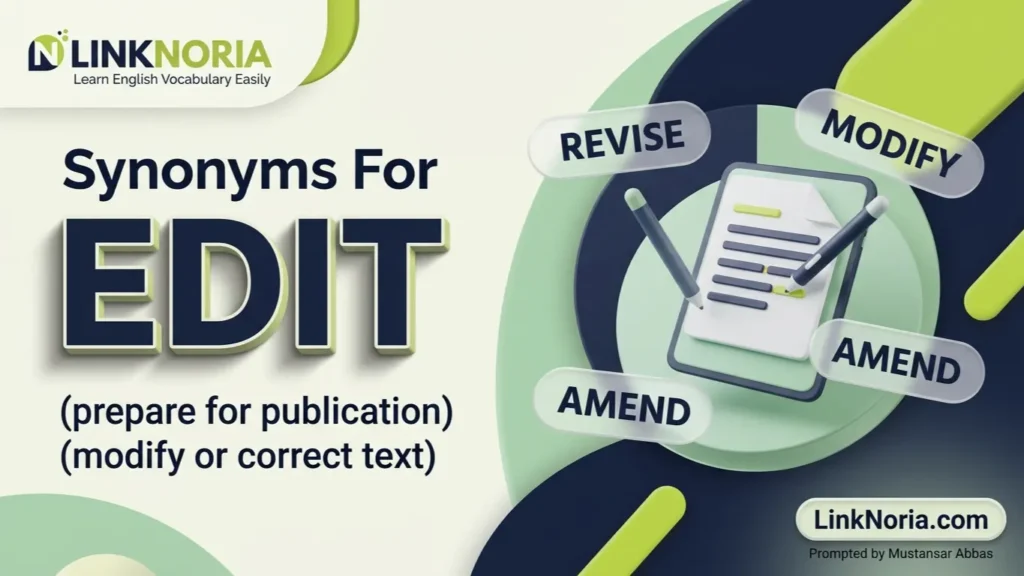
To edit means to prepare written, audio, or visual material for publication or presentation by correcting, condensing, or modifying content.
A writer reviews a manuscript to correct spelling mistakes and refine awkward sentences before sending it to a publisher. The verb “edit” describes revising text, altering video footage, refining photos, or making structural changes to documents. It applies to authors, video producers, graphic designers, programmers, and students polishing school assignments. Understanding synonyms for edit helps creators choose precise terms for specific editing tasks across text, media, and digital software.
This article explains the meaning of “edit,” its emotional tone, history, pronunciation, word parts, and 30 useful synonyms with clear examples. By the end, you will know how to talk about it like a confident English speaker.
Meaning of Edit
Definition
“Edit” is a verb meaning to correct, revise, reorganize, or prepare text, audio, video, or data for final publication or public release.
Simple Meaning
To change, correct, or clean up written material or media files.
Connotation
Mostly neutral and professional; implies improvement, refinement, accuracy, and professional presentation.
Examples
The journalist will edit the news report before the evening broadcast.
Authors edit their first drafts multiple times to eliminate grammar errors.
Etymology
Derived from the Latin editus, past participle of edere (“to give out, publish”), formed from ex- (“out”) and dare (“to give”).
Short History
- Old English (450–1100): The word did not exist in Old English; speakers used terms derived from Germanic roots meaning to correct or prepare.
- Middle English (1100–1500): English relied on French roots such as correcten or revisen for document preparation.
- Modern English (1500–Present): Formed in the late eighteenth century as a back-formation from the noun editor, expanding in the twentieth century to include digital video, photo, and software modifications.
Quick Synonym Comparison Table
| Synonym | Specificity | Formality | Primary Context |
| Revise | High | Formal | Structural changes in writing |
| Proofread | High | Neutral | Surface grammar and spelling |
| Redact | High | Formal / Legal | Censoring or obscuring text |
| Tweak | High | Informal | Minor adjustments or fine-tuning |
Pronunciation & Syllables
- US IPA: /ˈɛd.ɪt/
- UK IPA: /ˈed.ɪt/
- Syllables: 2 (ed-it)
30 Synonyms for Edit
Selecting the right synonym for edit allows writers and media creators to describe precise tasks like proofreading, structural revision, or video cutting.
1. Revise (verb)
US /rɪˈvaɪz/ | UK /rɪˈvaɪz/
Meaning: To alter or re-examine written material to improve its structure or accuracy.
- The author plans to revise the entire second chapter based on feedback from her editor.
- Students must revise their research essays before submitting final grades.
2. Redact (verb)
US /rɪˈdækt/ | UK /rɪˈdækt/
Meaning: To remove or obscure sensitive information from a document before publication.
- Government officials decided to redact private personal identification numbers from public records.
- Lawyers redact confidential client data prior to releasing court evidence.
3. Proofread (verb)
US /ˈpruːf.riːd/ | UK /ˈpruːf.riːd/
Meaning: To read printer proofs or copy to detect and correct typographical errors.
- The assistant will proofread the newsletter to catch minor punctuation errors.
- Always proofread your job application letters before hitting send.
4. Amend (verb)
US /əˈmɛnd/ | UK /əˈmend/
Meaning: To make formal written changes to a legal text, bill, or official document.
- Congress voted to amend the policy to provide clearer guidelines for small businesses.
- The board agreed to amend the corporate bylaws during their annual meeting.
5. Alter (verb)
US /ˈɑːl.tɚ/ | UK /ˈɔːl.tər/
Meaning: To make structural or physical changes to the appearance or composition of something.
- Tailors alter suits to ensure a precise personal fit for customers.
- Designers alter image contrast settings to achieve vibrant visual color tones.
6. Modify (verb)
US /ˈmɑː.də.faɪ/ | UK /ˈmɒd.ɪ.faɪ/
Meaning: To make partial changes to something to improve it or suit a new purpose.
- Engineers modify software code to resolve sudden operating performance glitches.
- Teachers modify lesson plans to accommodate diverse student learning needs.
7. Adapt (verb)
US /əˈdæpt/ | UK /əˈdæpt/
Meaning: To adjust or rewrite material so that it fits a different medium or audience.
- Screenwriters adapt historical novels into feature-length cinematic films.
- Playwrights adapt classical theater scripts for modern digital streaming platforms.
8. Rewrite (verb)
US /ˌriːˈraɪt/ | UK /ˌriːˈraɪt/
Meaning: To write a text again in order to change, improve, or update its contents.
- Journalists rewrite breaking news headlines as fresh evidence comes to light.
- The software team had to rewrite legacy code for the new system.
9. Polish (verb)
US /ˈpɑː.lɪʃ/ | UK /ˈpɒl.ɪʃ/
Meaning: To refine and perfect a piece of work by making minor improvements.
- The speaker spent hours polishing her presentation slides before the conference.
- Editors polish prose style to eliminate awkward phrasing and repetitive words.
10. Refine (verb)
US /rɪˈfaɪn/ | UK /rɪˈfaɪn/
Meaning: To clarify or improve a text or idea by making small precise adjustments.
- Researchers refine their thesis statements after analyzing experimental outcome data.
- Scholars refine academic definitions through ongoing peer review debates.
11. Touch up (verb)
US /tʌtʃ ʌp/ | UK /tʌtʃ ʌp/
Meaning: To improve something by making small corrections or additions to surface details.
- Photographers touch up portrait photos to smooth out lighting flaws.
- Artists touch up digital illustrations right before sending final files to client clients.
12. Correct (verb)
US /kəˈrɛkt/ | UK /kəˈrekt/
Meaning: To set right or fix errors in text, calculations, or factual statements.
- Teachers correct grammar mistakes on student homework papers using red ink.
- Proofreaders correct factual inconsistencies throughout the reference manual.
13. Emend (verb)
US /iˈmɛnd/ | UK /iˈmend/
Meaning: To correct errors in a scholarly text or historical manuscript.
- Classical scholars amend ancient Latin manuscripts to restore lost original lines.
- Philologists emend medieval manuscript copies to repair transcription mistakes.
14. Trim (verb)
US /trɪm/ | UK /trɪm/
Meaning: To cut unnecessary words, sections, or media footage to reduce overall size.
- Film editors trim extra scenes to keep the movie running time under two hours.
- Authors trim word counts to meet strict journal submission requirements.
15. Crop (verb)
US /krɑːp/ | UK /krɒp/
Meaning: To remove outer edges from a photo or visual image frame.
- Graphic designers crop background distractions out of product photography images.
- Users crop digital images to square ratios for social media posts.
16. Cut (verb)
US /kʌt/ | UK /kʌt/
Meaning: To delete sections from a written text, audio recording, or video sequence.
- Directors cut weak comedic scenes to maintain fast story pacing.
- Copy editors cut fluff sentences to strengthen news article impact.
17. Splice (verb)
US /splaɪs/ | UK /splaɪs/
Meaning: To join two pieces of film, audio tape, or digital media segments together.
- Audio engineers splice two audio tracks to create a seamless transition.
- Video editors splice archival footage into modern documentary scenes.
18. Assembly (noun)
US /əˈsɛm.bli/ | UK /əˈsem.bli/
Meaning: The act of gathering and arranging disparate media clips into an ordered draft.
- The editor completed the initial video assembly before adding special effects.
- Producers reviewed the rough video assembly to evaluate story progression.
19. Condense (verb)
US /kənˈdɛns/ | UK /kənˈdens/
Meaning: To make a text shorter by removing less important details or combining ideas.
- Writers condense long reports into executive summaries for business managers.
- Editors condense textbook chapters to create compact student study guides.
20. Abridge (verb)
US /əˈbrɪdʒ/ | UK /əˈbrɪdʒ/
Meaning: To shorten a literary work without losing the main plot or essential meaning.
- Publishers abridge classic novels to make them accessible for young readers.
- Audiobooks often abridge lengthy historical biographies to save listening time.
21. Reorganize (verb)
US /riːˈɔːr.ɡə.naɪz/ | UK /riːˈɔː.ɡə.naɪz/
Meaning: To change the order or structure of paragraphs, sections, or items in a text.
- Authors reorganize chapter order to build a stronger logical argument.
- Editors reorganize paragraph flow to improve document readability.
22. Reformat (verb)
US /riːˈfɔːr.mæt/ | UK /riːˈfɔː.mæt/
Meaning: To change the layout, typography, or file structure of digital text or media.
- Designers reformat text margins to fit mobile screen viewing dimensions.
- Tech support staff reformat corrupt data files into readable text extensions.
23. Censor (verb)
US /ˈsɛn.sɚ/ | UK /ˈsen.sər/
Meaning: To examine and suppress objectionable words or images in public media.
- Broadcast networks censor explicit language during live television shows.
- Authorities censor political publications to restrict sensitive state secrets.
24. Blue-pencil (verb)
US /ˈbluːˌpɛn.səl/ | UK /ˈbluːˌpen.səl/
Meaning: To edit, correct, or make deletions in a manuscript using editorial marks.
- Senior editors blue-pencil weak paragraphs before releasing books for print.
- The manager will blue-pencil the sales proposal before executive review.
25. Restructure (verb)
US /riːˈstrʌk.tʃɚ/ | UK /riːˈstrʌk.tʃər/
Meaning: To alter the underlying organization or conceptual outline of a written work.
- Writers restructure academic papers to align with peer journal guidelines.
- Consultants restructure business reports to highlight key financial outcomes.
26. Clean up (verb)
US /kliːn ʌp/ | UK /kliːn ʌp/
Meaning: To remove errors, clutter, or bad formatting from prose or computer code.
- Coders clean up messy script lines to optimize processing speeds.
- Editors clean up informal slang terms in official corporate statements.
27. Tweak (verb)
US /twiːk/ | UK /twiːk/
Meaning: To make minor adjustments to refine mechanics, wording, or visual settings.
- Sound engineers tweak audio frequency levels during live studio mixing.
- Designers tweak typography spacing to balance page layout aesthetic.
28. Fine-tune (verb)
US /faɪnˈtuːn/ | UK /faɪnˈtjuːn/
Meaning: To make very small, precise adjustments to achieve maximum efficiency or style.
- Translators fine-tune word choices to capture delicate cultural nuances.
- Authors fine-tune dialogue lines to make characters sound realistic.
29. Re-evaluate (verb)
US /ˌriː.ɪˈvæl.ju.eɪt/ | UK /ˌriː.ɪˈvæl.ju.eɪt/
Meaning: To assess text or media content again to decide if modifications are needed.
- Committees re-evaluate editorial standards to address evolving digital publishing trends.
- Reviewers re-evaluate manuscript evidence before rendering final publishing decisions.
30. Rework (verb)
US /riːˈwɝːk/ | UK /riːˈwɜːk/
Meaning: To revise, reshape, or rewrite content extensively to produce a revised version.
- Screenwriters rework full script scenes based on director rehearsal notes.
- Artists rework original sketch outlines to create detailed vector graphics.
Quick Synonym Comparison Table
| Synonym | Nuance / Shade | Formality Level | Common Context |
| Revise | General structural rewriting | Formal | Academic writing, publishing |
| Proofread | Fixing spelling and punctuation | Neutral | Final checks, typography |
| Redact | Removing sensitive info | Formal | Legal, government records |
| Crop | Cutting visual photo edges | Neutral | Photography, graphic design |
| Tweak | Making tiny minor adjustments | Informal | Software, sound mixing |
| Abridge | Shortening full books | Academic | Publishing, audiobooks |
Synonyms by Context / Usage
Formal & Academic
- Revise: Preferred term in academic writing for structural text alterations.
- Emend: Used exclusively in scholarly environments for correcting ancient manuscripts.
Informal & Slang
- Tweak: Informal term for making quick minor adjustments.
- Touch up: Common casual phrase for light visual or textual improvements.
Professional & Technical
- Redact: Standard legal term for blacking out sensitive data.
- Reformat: Tech term for altering file structure or digital document layouts.
Example Sentences Using the Synonyms
- Revise: Students should revise their essays to strengthen thesis arguments.
- Proofread: Editors proofread galleys to catch lingering typos before publication.
- Redact: Lawyers must redact confidential names before releasing files.
- Crop: Photographers crop images to center the main subject.
- Tweak: Programmers tweak code settings to improve software performance.
Parts of Speech
| Base Word | Part of Speech | Example Usage |
| Edit | Verb | Authors edit drafts multiple times. |
| Edit | Noun | The final edit of the video looked great. |
| Editor | Noun | The editor reviewed the manuscript. |
| Editorial | Adjective / Noun | She made editorial changes to the paper. |
Antonyms of Edit
- Preserve (verb): To maintain content in its original state without making changes.
- Publish (verb): To release unedited or final material for public distribution.
- Bungle (verb): To ruin or mess up text or media through careless alterations.
- Leave intact (phrase): To keep text or media exactly as originally written or recorded.
- Disregard (verb): To ignore errors without making necessary corrections.
When to Use Which Synonym
| Tone Goal | Recommended Word | Word to Avoid |
| Writing an academic paper | Revise or Refine | Tweak (too informal) |
| Legal document preparation | Redact or Amend | Touch up (too casual) |
| Adjusting photo frames | Crop or Touch up | Emend (text only) |
Affixation Pattern
- Root: Edit (to prepare or publish).
- Prefix: None.
- Suffix: None (base verb form).
- Origin: From Latin editus, back-formation from English editor.
Word Formation
- Verb: Edit (US /ˈɛd.ɪt/ | UK /ˈed.ɪt/) 2 Syllables
- Noun: Editor (US /ˈɛd.ɪ.t̬ɚ/ | UK /ˈed.ɪ.tər/) 3 Syllables
- Noun: Edition (US /ɪˈdɪʃ.ən/ | UK /ɪˈdɪʃ.ən/) 3 Syllables
- Adjective: Editorial (US /ˌɛd.əˈtɔːr.i.əl/ | UK /ˌed.ɪˈtɔː.ri.əl/) 4 Syllables
Prototype Meaning
The primary mental image native speakers picture for “edit” is an editor sitting with a printed manuscript, using a red pen to cross out extra words, correct punctuation errors, and write notes in margins. In modern contexts, it evokes video creators slicing timeline clips inside editing software.
It does not imply creating raw ideas from scratch, preserving mistakes intentionally, or destroying content completely.
Prototype Categorization
- Text & Structural Revision: Revise, rewrite, reorganize, restructure, refine, polish.
- Proofreading & Error Fixes: Proofread, correct, emend, clean up, blue-pencil.
- Content Reduction & Shortening: Condense, abridge, trim, cut, crop.
- Media & Technical Adjustments: Splice, assembly, reformat, tweak, fine-tune, touch up.
- Legal & Official Modification: Redact, amend, alter, modify, censor.
Grouping synonyms helps writers pick the exact word for legal, text, or video editing tasks.
Common Usage Mistakes
- Using redact for general writing: Saying you “redacted” your essay when you simply deleted weak sentences instead of hiding secret data.
- Confusing edit with proofread: Using “proofread” to describe structural chapter rewrites, when proofreading only covers surface typos.
- Using crop for text: Describing paragraph deletion as “cropping” text instead of “trimming” or “cutting.”
Connotative Meaning
- Positive: Associated with clarity, precision, professional quality control, and refined craftsmanship.
- Negative: Associated with censorship, unwanted administrative interference, or heavy-handed cutting.
- Neutral: Standard descriptive terminology for publishing, media production, and software manipulation.
(Connotation refers to the emotional feeling or cultural association a word carries beyond its literal definition.)
Short Questions and Answers
What is another word for change or edit?
The most common synonyms for changing or editing text are revise, alter, modify, adjust, and amend.
What is some slang term for “edit”?
Informal terms and slang for edit include tweak, touch up, hack, slash, or polish.
What does “edit” mean?
Edit means to correct, condense, modify, or prepare written material, images, audio, or video for final publication.
What is another word for “editing”?
Nouns that mean editing include revision, proofreading, copyediting, post-production, and redrafting.
What is the difference between editing and proofreading?
Editing focuses on structural flow, clarity, tone, and paragraph organization, whereas proofreading is the final check for minor spelling, grammar, and typography errors.
Is editing always a positive process?
Editing is usually positive because it improves clarity, but it carries a negative tone when it involves state censorship or altering original historical meaning.
What does “edit” mean in social media slang?
In online internet culture, an “edit” refers to a short, fan-made video montage combining music with clipped video footage from movies, TV shows, or celebrities.
Conclusion
Mastering synonyms for “edit” expands your command over writing, media production, and professional editing terms. Knowing the exact difference between revising, proofreading, redacting, and tweaking allows you to express your ideas with clarity.
Practice using these distinct synonyms in your daily writing and media projects to communicate like a confident English speaker!
Quiz about “Edit”
1. Which term represents another word for editing skills involving final surface grammar and typo fixes?
a) Proofreading
b) Redacting
c) Splicing
d) Abridging
2. What is an accurate alternative for another word for editing text when rewriting structural paragraphs?
a) Revising
b) Cropping
c) Splicing
d) Censoring
3. Which option provides standard synonyms for editors when referring to media professionals?
a) Proofreader and reviser
b) Author and creator
c) Printer and binder
d) Reader and viewer
4. What are clear synonyms for editing in English when making minor software adjustments?
a) Tweaking
b) Abridging
c) Emending
d) Redacting
5. Which term serves as another word for editing video when joining media clips together?
a) Splicing
b) Proofreading
c) Emending
d) Abridging
6. Which selection represents edit antonyms describing keeping original text untouched?
a) Preserve and leave intact
b) Revise and amend
c) Crop and trim
d) Redact and censor
7. Which option fits best as another word for editing photos by cutting off outer framing edges?
a) Cropping
b) Proofreading
c) Abridging
d) Amending
8. What is an edit synonym for formal choice for altering legal contracts or bills?
a) Amend
b) Tweak
c) Touch up
d) Slash
Answers
- a) Proofreading Focuses specifically on final spelling, punctuation, and typos.
- a) Revising Covers structural reorganization and major sentence changes.
- a) Proofreader and reviser Noun roles associated with editing tasks.
- a) Tweaking Common terms for making small technical adjustments.
- a) Splicing Technical term for joining video or audio segments.
- a) Preserve and leave intact Direct opposites of editing or altering content.
- a) Cropping Removing outer edges of an image frame.
- a) Amend Formal verbs used for legal documents and legislative changes.

Mustansar Abbas is the author and founder of Linknoria.com, where he writes practical, well-researched guides on technology, productivity, and digital tools to help readers make smarter, more informed decisions.