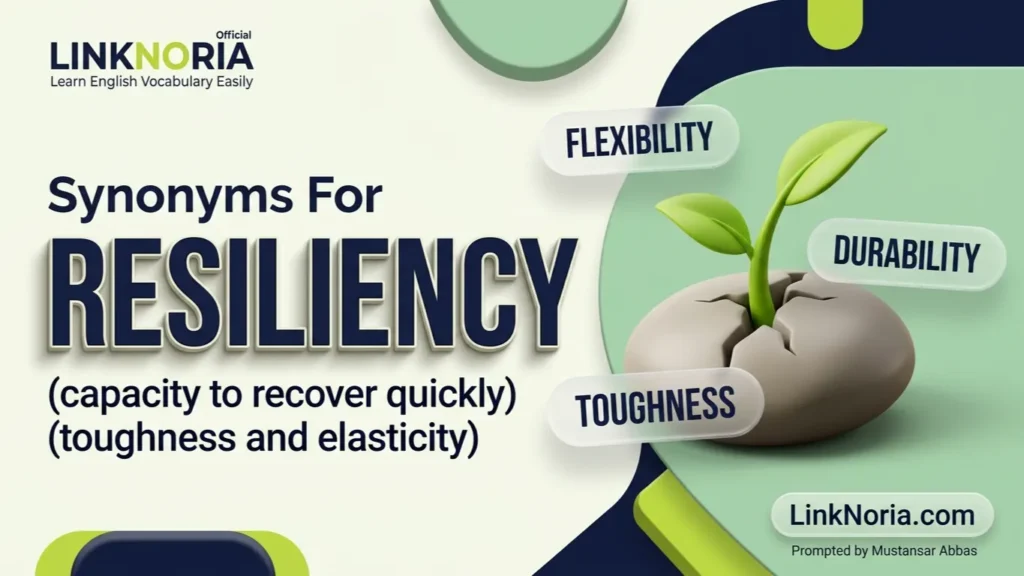
Resiliency is the capacity to recover quickly from difficulties or adapt smoothly to change.
Imagine an athlete recovering from a severe injury to win a championship. That ability to bounce back demonstrates personal resiliency in action.
The term resiliency applies to human psychology, physical materials, ecological systems, and economic structures.
Using specific synonyms for resiliency allows writers to describe recovery, strength, and elasticity with precise detail.
This article explains the meaning of “resiliency,” its emotional tone, history, pronunciation, word parts, and 30 useful synonyms with clear examples. By the end, you will know how to talk about it like a confident English speaker.
Meaning of Resiliency
Definition
Resiliency is the quality or property of being able to recover quickly from misfortune, strain, or physical deformation.
Simple Meaning
It is the ability to bounce back after facing trouble or pressure.
Connotation
The word carries a strong positive connotation, suggesting strength, adaptability, and emotional endurance.
Examples
- The community showed remarkable resiliency while rebuilding after the storm.
- Physical materials tested in the laboratory demonstrated high resiliency under extreme pressure.
Etymology
It derives from the Latin verb resilire, which means “to leap back” or “to recoil,” formed from re- (back) and salire (to leap).
Short History
- Middle English (1100–1500): The underlying Latin roots existed in scholastic legal and philosophical texts, though the English noun had not yet formed.
- Modern English (1500–Present): Entered English in the 17th century to describe physical elasticity, later expanding into psychological and social recovery during the 20th century.
Quick Synonym Comparison Table
| Term | Formality Level | Core Shade of Meaning |
| Resiliency | Formal / Technical | General capacity to bounce back or spring back |
| Flexibility | Neutral | Ability to bend or adapt without breaking |
| Toughness | Neutral | Physical or mental resistance to hardship |
| Elasticity | Technical | Material property of returning to original shape |
Pronunciation and Syllables
- US IPA: /rɪˈzɪl.jən.si/
- UK IPA: /rɪˈzɪl.i.ən.si/
- Syllables: 4 syllables (re-sil-ien-cy)
30 Synonyms for Resiliency
Human character, materials, and systems show recovery through distinct forms of strength and flexibility.
1. Resilience (noun)
/rɪˈzɪl.jəns/ | UK /rɪˈzɪl.i.əns/
Meaning: The capacity to recover quickly from difficulties or toughness.
- The team showed resilience after losing the first game of the tournament.
- Her psychological resilience helped her overcome career obstacles.
2. Flexibility (noun)
/ˌflɛk.səˈbɪl.ə.ti/ | UK /ˌflek.səˈbɪl.ə.ti/
Meaning: The quality of bending easily without breaking or adapting to new conditions.
- Schedule flexibility allows employees to manage personal commitments.
- The bamboo trees survived the gale because of their physical flexibility.
3. Toughness (noun)
/ˈtʌf.nəs/ | UK /ˈtʌf.nəs/
Meaning: The ability to withstand adverse conditions or rough handling.
- The leather boots are famous for their exceptional durability and toughness.
- Mental toughness helps marathon runners cross the finish line.
4. Elasticity (noun)
/iˌlæsˈtɪs.ə.ti/ | UK /ˌe.læsˈtɪs.ə.ti/
Meaning: The ability of an object or material to resume its normal shape after stretch.
- The rubber band lost its elasticity after years in the sun.
- Economic elasticity measures how market demand responds to price changes.
5. Durability (noun)
/ˌdʊr.əˈbɪl.ə.ti/ | UK /ˌdjʊə.rəˈbɪl.ə.ti/
Meaning: The ability to withstand wear, pressure, or damage over time.
- Engineers chose steel to ensure the long-term durability of the bridge.
- Heavy fabric gives the work jacket superior durability.
6. Fortitude (noun)
/ˈfɔːr.tə.tuːd/ | UK /ˈfɔː.tɪ.tjuːd/
Meaning: Mental and emotional strength in facing difficulty, adversity, or danger.
- She faced her medical treatments with quiet fortitude.
- The soldiers displayed great fortitude during the harsh winter.
7. Adaptability (noun)
/əˌdæp.təˈbɪl.ə.ti/ | UK /əˌdæp.təˈbɪl.ə.ti/
Meaning: The quality of being able to adjust to new conditions or environments.
- Success in a fast-paced market requires constant workplace adaptability.
- Species survival depends on evolutionary adaptability.
8. Grit (noun)
/ɡrɪt/ | UK /ɡrɪt/
Meaning: Courage, resolve, and strength of character.
- Success required years of hard work, passion, and personal grit.
- The young entrepreneur showed true grit during financial setbacks.
9. Endurance (noun)
/ɛnˈdʊr.əns/ | UK /ɪnˈdjʊə.rəns/
Meaning: The power of enduring an unpleasant or difficult process without giving up.
- Distance running tests physical endurance and mental focus.
- The expedition required remarkable human endurance against freezing winds.
10. Hardiness (noun)
/ˈhɑːr.di.nəs/ | UK /ˈhɑː.di.nəs/
Meaning: The capacity to endure harsh conditions or fatigue.
- Desert plants exhibit natural hardiness in dry environments.
- His physical hardiness allowed him to work long hours outdoors.
11. Strength (noun)
/strɛŋkθ/ | UK /streŋθ/
Meaning: The quality or state of being physically, mentally, or morally strong.
- The structural strength of the pillar supports the entire roof.
- Inner strength guided her through challenging life decisions.
12. Stamina (noun)
/ˈstæm.ə.nə/ | UK /ˈstæm.ɪ.nə/
Meaning: The ability to sustain prolonged physical or mental effort.
- Cyclists build endurance and stamina through daily training rides.
- Developing legal arguments requires deep focus and mental stamina.
13. Pluck (noun)
/plʌk/ | UK /plʌk/
Meaning: Spirited and determined courage when facing difficulty.
- The small startup showed pluck by competing against giant corporations.
- She admired the young athlete for her courage and pluck.
14. Tenacity (noun)
/təˈnæs.ə.ti/ | UK /təˈnæs.ə.ti/
Meaning: The quality of holding persistently to something like a goal or belief.
- Her research tenacity led to a groundbreaking medical discovery.
- Investigating journalists need tenacity to uncover complex stories.
15. Perseverance (noun)
/ˌpɜːr.səˈvɪr.əns/ | UK /ˌpɜː.sɪˈvɪə.rəns/
Meaning: Continued effort to achieve something despite difficulties or failure.
- Medical scientific discoveries require patience and steady perseverance.
- Through sheer perseverance, he learned to speak three languages.
16. Bounciness (noun)
/ˈbaʊn.si.nəs/ | UK /ˈbaʊn.si.nəs/
Meaning: The physical quality of springing back after impact.
- Children enjoyed the playful bounciness of the new trampoline.
- The natural rubber retained its original bounciness.
17. Springiness (noun)
/ˈsprɪŋ.i.nəs/ | UK /ˈsprɪŋ.i.nəs/
Meaning: The physical property of returning quickly to an original shape.
- High quality mattress foam provides optimal support and springiness.
- Walking on damp moss gave the forest floor a soft springiness.
18. Suppleness (noun)
/ˈsʌp.əl.nəs/ | UK /ˈsʌp.əl.nəs/
Meaning: The quality of bending easily, remaining limber, or showing flexibility.
- Regular stretching exercises maintain joint health and muscle suppleness.
- The leather jacket retained its natural softness and suppleness.
19. Malleability (noun)
/ˌmæl.i.əˈbɪl.ə.ti/ | UK /ˌmæl.i.əˈbɪl.ə.ti/
Meaning: The capacity of a material to be shaped or extended by hammering or pressure.
- Gold is famous for its high malleability and lustrous shine.
- The malleability of clay allows sculptors to form detailed figures.
20. Plasticity (noun)
/plæˈstɪs.ə.ti/ | UK /plæˈstɪs.ə.ti/
Meaning: The adaptability or capacity of an organism or material to be altered.
- Neuroscientists study brain plasticity after neurological injury.
- The wet clay possessed high plasticity for wheel throwing.
21. Buoyancy (noun)
/ˈbɔɪ.ən.si/ | UK /ˈbɔɪ.ən.si/
Meaning: The capacity to float or maintain a cheerful, resilient attitude.
- Her cheerful optimism gave her mental buoyancy during tough weeks.
- Life jackets provide physical buoyancy in deep open water.
22. Resoluteness (noun)
/ˈrɛz.ə.luːt.nəs/ | UK /ˈrez.ə.luːt.nəs/
Meaning: The state of being purposeful, determined, and unwavering.
- The commander displayed absolute resoluteness during the crisis.
- Her political resoluteness helped pass the reforms.
23. Indomitability (noun)
/ɪnˌdɑː.mɪ.təˈbɪl.ə.ti/ | UK /ɪnˌdɒm.ɪ.təˈbɪl.ə.ti/
Meaning: The quality of being impossible to subdue, defeat, or discourage.
- Historical figures are celebrated for their personal indomitability.
- The team displayed sheer indomitability despite facing overwhelming odds.
24. Robustness (noun)
/roʊˈbʌst.nəs/ | UK /rəʊˈbʌst.nəs/
Meaning: The state of being strong, healthy, or capable of performing under strain.
- Programmers tested the software for system stability and robustness.
- The engine showed impressive robustness on long cross-country drives.
25. Vigor (noun)
/ˈvɪɡ.ər/ | UK /ˈvɪɡ.ər/
Meaning: Physical strength, good health, and active energy.
- He tackled the morning garden chores with youthful vigor.
- Economic policies restored vigor to the local manufacturing sector.
26. Backbone (noun)
/ˈbæk.boʊn/ | UK /ˈbæk.bəʊn/
Meaning: Courage and strength of character.
- Standing up to corporate unfairness took genuine backbone.
- Small business owners form the economic backbone of the community.
27. Persistence (noun)
/pərˈsɪs.təns/ | UK /pəˈsɪs.təns/
Meaning: Firm or obstinate continuance in a course of action despite obstacles.
- Persistent research yielded accurate historical data.
- Her commercial persistence convinced the investor to fund the project.
28. Inflexibility (Technical Context) (noun)
/ɪnˌflɛk.səˈbɪl.ə.ti/ | UK /ɪnˌflek.səˈbɪl.ə.ti/
Meaning: Resistance to deformation or stress under structural load.
- Structural engineers designed high inflexibility into the foundation pillars.
- The rigid metal frame demonstrated total mechanical inflexibility.
29. Spunk (noun)
/spʌŋk/ | UK /spʌŋk/
Meaning: Courage, spirit, and determination in an informal setting.
- The young protagonist showed impressive spunk in the face of danger.
- Her lively spunk made her a natural leader on the field.
30. Elastic Limit (Technical) (noun)
/iˈlæs.tɪk ˈlɪm.ɪt/ | UK /ɪˈlæs.tɪk ˈlɪm.ɪt/
Meaning: The maximum extent to which a solid can be stretched without permanent deformation.
- Engineers calculated the elastic limit of the steel cables.
- Testing revealed the elastic limit of the composite material.
Quick Synonym Comparison Table
| Synonym | Formality | Nuance / Context | Example |
| Resiliency | Formal / Technical | General capacity to spring back | Climate resiliency project |
| Resilience | Neutral | Standard usage for psychological recovery | Personal mental resilience |
| Grit | Informal / Popular | Passion and long-term perseverance | Unyielding personal grit |
| Fortitude | Formal / Literary | Moral and emotional strength under pain | Silent spiritual fortitude |
| Elasticity | Technical / Scientific | Physical property of materials | Rubber elasticity tests |
| Tenacity | Professional | Persistent holding to a goal | Relentless research tenacity |
| Springiness | Informal | Physical responsiveness or bounce | Soft carpet springiness |
Synonyms by Context / Usage
Formal & Academic
- Fortitude: Used in literary analysis, philosophy, and moral discussions.
- Indomitability: Used in historical narratives to describe heroic perseverance.
- Plasticity: Used in biological sciences to describe neural or cellular adaptation.
Professional & Scientific
- Robustness: Used in software engineering, statistics, and system design.
- Elasticity: Used in physics and economics to measure physical or market response.
- Adaptability: Used in business strategy and career development.
Informal & Conversational
- Grit: Used in self-help discussions and sports reporting.
- Spunk: Used informally to describe a lively, courageous personality.
- Backbone: Used in general conversation to describe moral courage.
Example Sentences Using the Synonyms
- Fortitude: The community faced economic hardship with moral fortitude.
- Grit: Her inner grit helped her finish the grueling mountain climb.
- Elasticity: Synthetic rubber exhibits high elasticity under cold conditions.
- Robustness: Cyber security experts tested the robustness of the network infrastructure.
- Tenacity: The lawyer pursued the evidence with unwavering tenacity.
Parts of Speech
| Form | Word | Function in Sentence | Example |
| Noun | Resiliency | Subject or Object | The resiliency of the system prevented failure. |
| Adjective | Resilient | Modifies a Noun | She is a resilient leader. |
| Adverb | Resiliently | Modifies a Verb | The plant grew resiliently in rocky soil. |
Antonyms of Resiliency
- Fragility (noun): The state of being easily broken, damaged, or destroyed.
- Vulnerability (noun): The state of being exposed to the possibility of harm or attack.
- Weakness (noun): The lack of physical, mental, or structural strength.
- Rigidity (noun): Inability to bend or be forced out of shape.
- Brittleness (noun): The tendency of a material to fracture or break easily under stress.
When to Use Which Synonym
| Word | Opposite Choice | Context |
| Resiliency | Fragility | General recovery capability vs easy destruction |
| Elasticity | Brittleness | Physical spring back vs physical snapping |
| Fortitude | Vulnerability | Moral strength vs exposure to psychological harm |
Affixation Pattern
- Root: Resili (Latin resilire to leap back)
- Prefix: Re- (back or again)
- Suffix: -ency (noun suffix indicating a state or quality)
Word Formation
- Resilient (adjective): /rɪˈzɪl.jənt/ | UK /rɪˈzɪl.i.ənt/ | 4 Syllables
- Resiliently (adverb): /rɪˈzɪl.jənt.li/ | UK /rɪˈzɪl.i.ənt.li/ | 5 Syllables
- Resilience (noun variant): /rɪˈzɪl.jəns/ | UK /rɪˈzɪl.i.əns/ | 4 Syllables
Prototype Meaning
The mental prototype native speakers picture for “resiliency” is an object or person taking a heavy hit, bending under pressure, and quickly bouncing back to original shape or status. It represents active recovery rather than passive resistance.
The word does not imply permanent damage, total rigidity, or complete immunity to stress. It focuses on recovery and elasticity following an impact.
Prototype Categorization
- Psychological & Emotional Strength: Fortitude, Grit, Tenacity, Perseverance
- Physical & Structural Endurance: Durability, Toughness, Hardiness, Robustness
- Material Elasticity & Flexibility: Elasticity, Springiness, Malleability, Plasticity
- Character & Spirit: Pluck, Spunk, Backbone, Buoyancy
Grouping these terms helps writers select precise words so physical properties are not confused with human character traits.
Common Usage Mistakes
- Confusing Resiliency with Resistance: Resistance prevents change completely, whereas resiliency means bending under stress and bouncing back afterward.
- Resilience vs. Resiliency: Both words mean the exact same thing, but “resilience” is far more common in modern American and British writing.
- Using Physical Terms for Character: Words like “malleability” describe material shape changes, whereas human character relies on words like “fortitude” or “grit.”
Connotative Meaning
- Positive: Adaptability, perseverance, courage, physical recovery, optimism.
- Negative: Rarely carries a negative tone, though extreme resilience might imply accepting unjust conditions without complaining.
- Neutral: Scientific material elasticity, system flexibility.
(Connotation refers to the emotional association or cultural feeling a word carries beyond its dictionary definition.)
Short Questions and Answers
What is the difference between resilience and resiliency?
Resilience and resiliency are spelling variants that share the exact same definition. Resilience is much more commonly used in modern written English.
What is a formal synonym for resilience in an academic essay?
“Fortitude” or “adaptability” serves as an excellent formal synonym for resilience depending on whether you mean moral strength or functional flexibility.
How do you describe a resilient woman in precise vocabulary?
A resilient woman can be described using synonyms like “indomitable,” “tenacious,” or possessing deep “fortitude.”
What is the best simple synonym for resilience?
“Toughness” or “flexibility” works best as a simple, clear synonym for resilience in everyday speech.
What is a positive synonym for resilient character?
“Grit” and “pluck” are strong positive synonyms that emphasize courage and active determination.
What are the primary antonyms of resilience?
“Fragility,” “brittleness,” and “vulnerability” act as the primary antonyms of resilience.
Can resiliency describe non-human objects?
Yes, scientists use resiliency to describe how materials, ecosystems, and economic markets bounce back after severe disruption.
Conclusion
Learning synonyms for resiliency expands your ability to describe strength, recovery, and flexibility accurately. Choosing between words like “grit,” “elasticity,” and “fortitude” improves the quality of your writing across academic and professional contexts.
Try using two new synonyms for resiliency in your conversations or writing projects today.
Topic Quiz
1. Which word serves as a formal synonym for emotional resilience in an essay?
- A) Spunk
- B) Fortitude
- C) Springiness
- D) Bounciness
2. What is the primary antonym of physical resilience?
- A) Adaptability
- B) Fragility
- C) Hardiness
- D) Robustness
3. Which term best describes a resilient woman with determined character?
- A) Brittle
- B) Tenacious
- C) Rigid
- D) Fragile
4. What is a simple synonym for resilience used in everyday speech?
- A) Indomitability
- B) Toughness
- C) Plasticity
- D) Malleability
5. Which term represents a positive synonym for resilient courage in personal character?
- A) Grit
- B) Weakness
- C) Vulnerability
- D) Inflexibility
6. Which word describes physical material returning to its original shape?
- A) Fortitude
- B) Elasticity
- C) Perseverance
- D) Backbone
7. How does a resilient man react when facing difficult obstacles?
- A) He breaks immediately under strain.
- B) He shows adaptability and bounces back.
- C) He remains completely rigid without moving.
- D) He surrenders without effort.
Answers
- (B)
- (B)
- (B)
- (B)
- (A)
- (B)
- (B)

Mustansar Abbas is the author and founder of Linknoria.com, where he writes practical, well-researched guides on technology, productivity, and digital tools to help readers make smarter, more informed decisions.