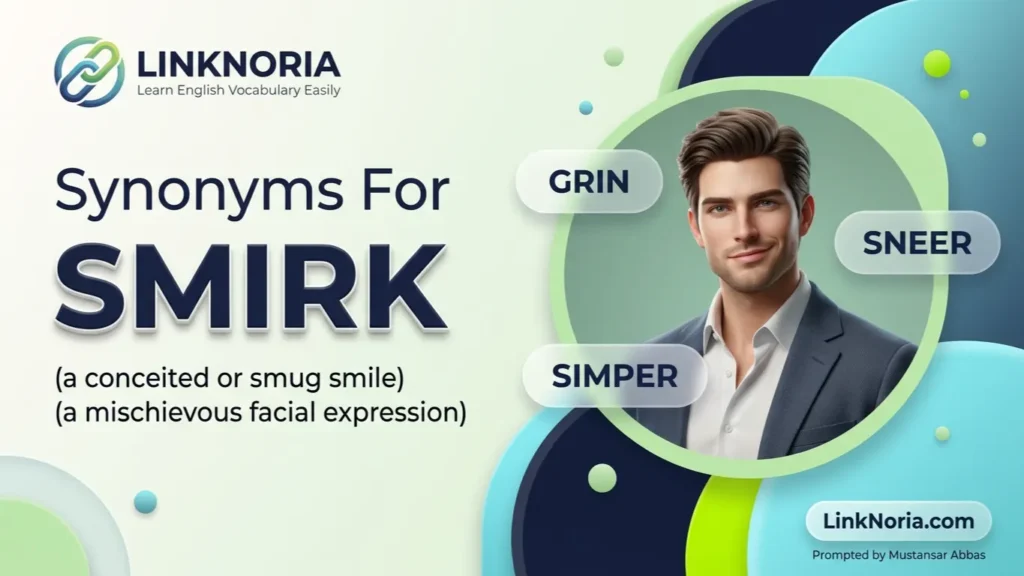
A smirk is an affected, smug, or offensively knowing smile.
Imagine a chess player making a winning move and glancing up with a self-satisfied expression. That facial look is a classic smirk.
The word refers to an insincere or arrogant grin that shows pride, amusement, or contempt. It usually applies to people who feel superior or pleased with themselves.
Learning words related to this facial expression helps you describe characters and emotions accurately in writing.
This article explains the meaning of “smirk,” its emotional tone, history, pronunciation, word parts, and 30 useful synonyms with clear examples. By the end, you will know how to talk about it like a confident English speaker.
Meaning of Smirk
Definition
A smirk is a smug, conceited, or silly smile.
Simple Meaning
An arrogant or self-satisfied grin.
Connotation
Negative to neutral. It usually implies vanity, mockery, or disrespect.
Examples
He could not hide his smirk when the teacher called his name for the award. She wiped the smirk off her face as soon as the manager walked into the office.
Etymology
Derived from Old English smearcian (“to smile”), linked to Proto-Germanic roots associated with mocking or scornful laughter.
Short History
- Old English (450–1100): Used as smearcian, which simply meant to smile.
- Middle English (1100–1500): Evolved into smirken, keeping a general meaning of smiling.
- Modern English (1500–Present): The word shifted to describe an unpleasant, arrogant, or self-satisfied facial expression.
Quick Synonym Comparison Table
| Word | Primary Tone | Typical Context |
| Smirk | Arrogant | Showing smug superiority |
| Sneer | Scornful | Expressing open contempt |
| Simper | Inane | Flirtatious or silly smiling |
| Grin | Neutral | Wide, genuine amusement |
Pronunciation
US: /smɝk/ | UK: /smɜːk/
Syllables: 1 (smirk)
30 Synonyms for Smirk
Selecting the right term depends on whether the expression conveys mockery, vanity, or subtle amusement.
1. Sneer (noun / verb)
/ snɪr / | UK / snɪə /
Meaning: A facial expression that shows contempt or scorn.
- The rival captain gave a cold sneer before walking off the field.
- She tends to sneer whenever someone makes a simple mistake.
2. Simper (noun / verb)
/ ˈsɪm.pɚ / | UK / ˈsɪm.pə /
Meaning: An affected, coy, or silly smile.
- He offered a silly simper when praised for the project.
- The actor began to simper for the photoflash cameras.
3. Leer (noun / verb)
/ lɪr / | UK / lɪə /
Meaning: An unpleasant, knowing, or malicious look.
- The villain gave a menacing leer from across the dark street.
- Do not leer at the visitors during the presentation.
4. Grimace (noun / verb)
/ ˈɡrɪm.əs / | UK / ˈɡrɪm.əs /
Meaning: An altered facial expression showing pain, disgust, or wry humor.
- A slight grimace replaced his smile when he heard the bad news.
- The boy tried not to grimace while swallowing the medicine.
5. Fleer (noun / verb)
/ flɪr / | UK / flɪə /
Meaning: A mocking look or laughing expression.
- The bully let out a rude fleer at the younger student.
- He chose to fleer instead of answering the question politely.
6. Grin (noun / verb)
/ ɡrɪn / | UK / ɡrɪn /
Meaning: A broad smile showing teeth.
- She wore a wide grin after receiving her test results.
- The kids started to grin when the clown entered the room.
7. Snicker (noun / verb)
/ ˈsnɪk.ɚ / | UK / ˈsnɪk.ər /
Meaning: A smothered or disrespectful laugh.
- A quiet snicker broke out in the back row of the auditorium.
- He tried to suppress a snicker during the quiet ceremony.
8. Snigger (noun / verb)
/ ˈsnɪɡ.ɚ / | UK / ˈsnɪɡ.ər /
Meaning: A sly or disrespectful half-laugh.
- The students began to snigger when the chalk broke in half.
- She heard a snigger behind her back in the hallway.
9. Smile (noun / verb)
/ smaɪl / | UK / smaɪl /
Meaning: A facial expression indicating pleasure, affection, or amusement.
- Her warm smile welcomed the visitors to the event.
- He could not help but smile at the playful puppy.
10. Beam (noun / verb)
/ biːm / | UK / biːm /
Meaning: A radiant and proud expression of joy.
- The mother gave a proud beam as her child graduated.
- His face began to beam when he saw the surprise cake.
11. Smug smile (noun)
/ smʌɡ smaɪl / | UK / smʌɡ smaɪl /
Meaning: An expression showing excessive self-satisfaction.
- Her smug smile revealed that she already knew the secret.
- He wiped the smug smile away when the results were corrected.
12. Conceited grin (noun)
/ kənˈsiː.t̬ɪd ɡrɪn / | UK / kənˈsiː.tɪd ɡrɪn /
Meaning: A broad expression marked by high self-opinion.
- The driver showed a conceited grin after winning the race.
- That conceited grin annoyed everyone sitting near him.
13. Smicker (verb)
/ ˈsmɪk.ɚ / | UK / ˈsnɪk.ər /
Meaning: To look or smile amorously or coyly.
- The character would snicker at the court guests to get attention.
- He began to snicker in a vain attempt to appear charming.
14. Smirtle (verb)
/ ˈsmɝː.təl / | UK / ˈsmɜː.təl /
Meaning: To restrain a giggle or smile in a coy manner.
- She tried to smirtle to avoid offending her host.
- The children started to smirtle behind their textbooks.
15. Mirk (verb)
/ mɝːk / | UK / mɜːk /
Meaning: An archaic variant meaning to look sly or smile smugly.
- The old text describes how the knave would mirk at travelers.
- He chose to mirk silently rather than speak his mind.
16. Mocking smile (noun)
/ ˈmɑː.kɪŋ smaɪl / | UK / ˈmɒk.ɪŋ smaɪl /
Meaning: An expression intended to ridicule someone.
- A mocking smile flashed across his face during the debate.
- She ignored his mocking smile and continued speaking.
17. Disparaging smile (noun)
/ dɪˈspær.ɪ.dʒɪŋ smaɪl / | UK / dɪˈspær.ɪ.dʒɪŋ smaɪl /
Meaning: A look that expresses belittlement.
- The judge offered a disparaging smile toward the weak defense.
- His disparaging smile hurt her confidence during the trial.
18. Superior look (noun)
/ səˈpɪr.i.ɚ lʊk / | UK / suːˈpɪə.ri.ər lʊk /
Meaning: A expression showing a feeling of higher status.
- The store clerk gave a superior look to the young customer.
- She maintained a superior look throughout the meeting.
19. Knowing look (noun)
/ ˈnoʊ.ɪŋ lʊk / | UK / ˈnəʊ.ɪŋ lʊk /
Meaning: An expression showing secret understanding.
- The two friends exchanged a knowing look across the table.
- He gave a knowing look when the topic was mentioned.
20. Sly smile (noun)
/ slaɪ smaɪl / | UK / slaɪ smaɪl /
Meaning: A cunning or secretive facial expression.
- The fox-like character had a sly smile in the illustration.
- She flashed a sly smile before making her move.
21. Arrogant grin (noun)
/ ˈær.ə.ɡənt ɡrɪn / | UK / ˈær.ə.ɡənt ɡrɪn /
Meaning: A wide look marked by unearned pride.
- His arrogant grin faded when the score was tied.
- The team disliked the captain’s arrogant grin.
22. Sardonic smile (noun)
/ sɑːrˈdɑː.nɪk smaɪl / | UK / sɑːˈdɒn.ɪk smaɪl /
Meaning: A cynical or grimly mocking facial expression.
- He offered a sardonic smile after the project failed.
- Her sardonic smile showed she expected the worst outcome.
23. Scornful look (noun)
/ ˈskɔːrn.fəl lʊk / | UK / ˈskɔːn.fəl lʊk /
Meaning: An expression showing total lack of respect.
- The teacher gave a scornful look to the late student.
- He turned away with a scornful look on his face.
24. Wry smile (noun)
/ raɪ smaɪl / | UK / raɪ smaɪl /
Meaning: A dry, mocking, or slightly twisted expression.
- She greeted the bad news with a wry smile.
- He gave a wry smile at the ironic turn of events.
25. Chortle (noun / verb)
/ ˈtʃɔːr.t̬əl / | UK / ˈtʃɔː.təl /
Meaning: A gleeful, muffled laugh or smile.
- A soft chortle escaped his mouth during the movie.
- The grandfather would chortle at his own old jokes.
26. Cackle (noun / verb)
/ ˈkæk.əl / | UK / ˈkæk.əl /
Meaning: A harsh, sharp laugh or mocking grin.
- The witch let out a loud cackle in the play.
- She responded with a short cackle to his absurd claim.
27. Gibe (noun / verb)
/ dʒaɪb / | UK / dʒaɪb /
Meaning: An insulting remark accompanied by a sneering look.
- His cruel gibe brought silence to the room.
- Do not gibe at people who are trying their best.
28. Smirkle (verb)
/ ˈsmɝː.kəl / | UK / ˈsmɜː.kəl /
Meaning: A minor or frequent smirk.
- The child began to smirkle when he hid the key.
- He would smirkle every time his brother missed a catch.
29. Scoff (noun / verb)
/ skɑːf / | UK / skɒf /
Meaning: An expression of mockery or scorn.
- She gave a quick scoff at the ridiculous plan.
- He chose to scoff rather than offer useful feedback.
30. Twit (verb)
/ twɪt / | UK / twɪt /
Meaning: To taunt or tease with a mocking look.
- He began to twit his friend about the minor mistake.
- She did not mean to twit him in front of the group.
Quick Synonym Comparison Table
| Synonym | Formality Level | Emotion Expressed | Best Used For |
| Sneer | Neutral | Scorn, disrespect | Showing open disapproval |
| Simper | Literary | Vanity, coyness | Describing artificial charm |
| Grimace | Neutral | Disgust, pain | Showing physical or mental discomfort |
| Sardonic smile | Formal | Cynicism, irony | Reacting to unfortunate situations |
| Grin | Informal | Genuine joy | Expressing broad happiness |
Synonyms by Context / Usage
Formal
- Sardonic smile
- Disparaging smile
- Scornful look
Informal
- Smug smile
- Snicker
- Snigger
Literary
- Simper
- Fleer
- Smicker
Professional
- Superior look
- Knowing look
- Wry smile
Example Sentences Using the Synonyms
- His sneer made it clear he did not respect the committee’s final choice.
- She gave a quiet simper when the host complimented her dress.
- The boy attempted to hide his snicker during the serious speech.
- After winning the game, he wore an arrogant grin that upset his opponent.
- She responded with a wry smile upon learning about the delay.
Parts of Speech
| Base Word | Part of Speech | Example Sentence |
| Smirk | Verb | He will smirk whenever he wins a debate. |
| Smirk | Noun | She noticed the smirk on his face immediately. |
| Smirking | Adjective | The smirking child refused to admit his mistake. |
| Smirkingly | Adverb | He walked away smirkingly after making the joke. |
Antonyms of Smirk
- Frown (noun / verb): A facial expression showing displeasure, anger, or deep concentration.
- Scowl (noun / verb): An angry or bad-tempered facial expression.
- Pout (noun / verb): Pushing out one’s lips to show annoyance or sadness.
- Gloom (noun): A feeling or appearance of deep sadness and depression.
- Glower (noun / verb): An angry or sullen look on one’s face.
When to Use Which Synonym
| Situation | Recommended Term | Avoid Using |
| Showing pure happiness | Beam, Smile | Smirk, Sneer |
| Expressing deep hatred | Scowl, Glower | Simper, Smirkingly |
| Describing foolish vanity | Simper, Smug smile | Beam, Grin |
Affixation Pattern
- Root: Smirk (to smile smugly)
- Prefix: None
- Suffix: -ing (forming adjectives/participles), -ingly (forming adverbs)
Word Formation
- Smirk (Noun / Verb) — US: /smɝk/ | UK: /smɜːk/ | Syllables: 1
- Smirker (Noun) — US: /ˈsmɝː.kɚ/ | UK: /ˈsmɜː.kər/ | Syllables: 2
- Smirking (Adjective / Participle) — US: /ˈsmɝː.kɪŋ/ | UK: /ˈsmɜː.kɪŋ/ | Syllables: 2
- Smirkingly (Adverb) — US: /ˈsmɝː.kɪŋ.li/ | UK: /ˈsmɜː.kɪŋ.li/ | Syllables: 3
Prototype Meaning
The prototype image of a smirk is a person tilting their head slightly back, raising one corner of their mouth, and looking down at someone else. It represents self-satisfaction combined with mild contempt. It does not imply open laughter, violent anger, physical distress, or genuine affection.
Prototype Categorization
- Smug expressions: Smirk, smug smile, conceited grin.
- Scornful expressions: Sneer, fleer, scoff, gibe.
- Silly expressions: Simper, smicker, smirtle.
- Suppressed laughter: Snicker, snigger, chortle.
Grouping synonyms by their intent helps writers choose the exact shade of meaning needed for narrative prose.
Common Usage Mistakes
- Confusing smirk with a genuine smile: A smile shows warmth or happiness, whereas a smirk shows conceit or mockery.
- Confusing smirk with a scowl: A scowl displays anger or annoyance, while a smirk displays smug pleasure.
- Using smirk for intense cruelty: A smirk indicates mild mockery or vanity; stronger words like sneer fit severe contempt.
Connotative Meaning
- Positive: Rarely positive; can sometimes mean playfully mischievous in informal romantic fiction.
- Negative: Highly negative; implies vanity, arrogance, disrespect, and superiority.
- Neutral: Used objectively in descriptive literature to show character traits without moral judgment.
(Connotation refers to the emotional feeling or cultural association attached to a word beyond its literal definition.)
Short Questions and Answers
What is the main difference between a smile and a smirk?
A smile expresses genuine pleasure or friendliness. A smirk expresses self-satisfaction, conceit, or mockery.
Can a smirk ever be positive?
It is almost always negative or smug. In creative fiction, it might occasionally describe playful teasing between close friends.
Is smirk a formal or informal word?
It is a neutral word suitable for both formal writing and casual conversation.
How does a smirk differ from a sneer?
A smirk focuses on feeling pleased with oneself. A sneer focuses on showing active hatred or contempt for someone else.
What does it mean when someone smirks at you?
It usually means they feel superior, know a secret, or are amused by your situation.
What part of speech is a smirk?
Smirk can function as both a noun and a verb.
What is the antonym of a smirk?
A direct antonym is a frown or a scowl, which shows displeasure rather than smugness.
Conclusion
Understanding the word “smirk” and its related terms helps you describe human facial expressions with greater detail and accuracy. Expanding your vocabulary allows you to choose the exact word that fits your character or situation.
Practice using these synonyms in your daily writing to improve your vocabulary. Try writing three sentences today using different synonyms for a smirk.
Topic Quiz
- Which word best acts as a synonym for smirk when describing an arrogant expression?
(A) Beam
(B) Smug smile
(C) Frown
(D) Scowl - Is a smirk generally considered a positive or negative expression?
(A) Always positive
(B) Mostly negative
(C) Strictly neutral
(D) Expresses deep sorrow - Which of the following is a direct antonym of smirk?
(A) Sneer
(B) Simper
(C) Frown
(D) Fleer - How is a smile different from a smirk?
(A) A smile is genuine, while a smirk is smug
(B) A smile shows anger
(C) A smirk shows pain
(D) They mean the exact same thing - Which part of speech can the word “smirk” be?
(A) Only an adjective
(B) Noun and Verb
(C) Only an adverb
(D) Preposition - How do authors describe a smirk in creative writing?
(A) A warm act of kindness
(B) A lopsided, arrogant grin
(C) A loud cry of distress
(D) A blank, emotionless look - Which of these is a synonym for smile rather than smirk?
(A) Sneer
(B) Beam
(C) Fleer
(D) Leer
Answer Key:
- (B)
- (B)
- (C)
- (A)
- (B)
- (B)
- (B)

Mustansar Abbas is the author and founder of Linknoria.com, where he writes practical, well-researched guides on technology, productivity, and digital tools to help readers make smarter, more informed decisions.