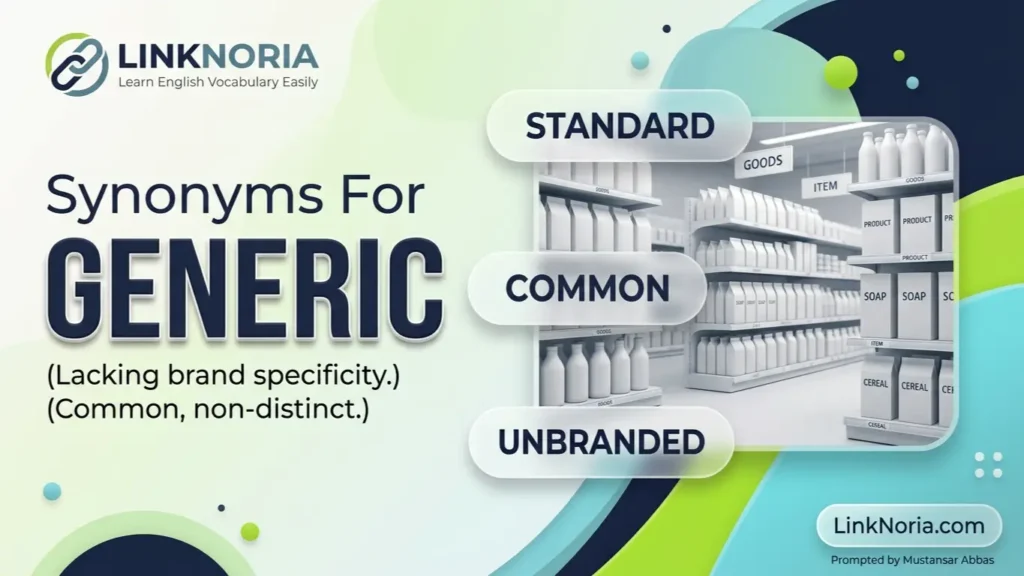
The word generic means something that is common, general, or not specific. It refers to items, ideas, or words that do not have a special brand or unique features.
Top synonyms include common, general, standard, and unbranded. Students, writers, and daily speakers can use these simple words to make their sentences clear and easy to understand.
The synonyms for generic are common, general, standard, unbranded, plain, basic, ordinary, normal, universal, collective, broad, non-specific, wide, blanket, overall, sweeping, comprehensive, customary, regular, usual, stock, conventional, typical, unremarkable, everyday, boilerplate, non-proprietary, off-brand, store-brand, and characterless.
Parts of Speech
| Word | Part of Speech | Simple Meaning |
| Generic | Adjective | Common or not specific |
| Common | Adjective | Shared by many or ordinary |
| General | Adjective | Covering main points, not specific |
| Standard | Adjective | Following a normal rule or level |
| Unbranded | Adjective | Without a famous brand name |
| Plain | Adjective | Simple and without extra decoration |
| Basic | Adjective | Forming the simplest part of something |
| Ordinary | Adjective | Normal and not special |
| Normal | Adjective | Usual or expected |
| Universal | Adjective | Related to everyone or everything |
| Collective | Adjective | Shared by all members of a group |
| Broad | Adjective | Wide and covering many things |
| Non-specific | Adjective | Not detailed or exact |
| Wide | Adjective | Including many different items |
| Blanket | Adjective | Applying to all cases or rules |
| Overall | Adjective | Including everything altogether |
| Sweeping | Adjective | Very broad and general |
| Comprehensive | Adjective | Including all important parts |
| Customary | Adjective | Done according to habit or custom |
| Regular | Adjective | Following a fixed pattern |
| Usual | Adjective | Done or seen most of the time |
| Stock | Adjective | Commonly used and easily available |
| Conventional | Adjective | Following traditional rules |
| Typical | Adjective | Showing the usual features of a group |
| Unremarkable | Adjective | Not special enough to be noticed |
| Everyday | Adjective | Used for normal daily life |
| Boilerplate | Adjective | Standard text used repeatedly |
| Non-proprietary | Adjective | Not protected by trademark or copyright |
| Off-brand | Adjective | Made by an unfamiliar manufacturer |
| Store-brand | Adjective | Sold under a specific market’s name |
| Characterless | Adjective | Lacking interesting features |
1. Common
- Meaning: Found often or shared by many people.
- Examples:
- Colds are a common illness in winter.
- They share a common interest in music.
2. General
- Meaning: Including main ideas rather than small details.
- Examples:
- He gave a general answer to the teacher.
- The map shows the general shape of the park.
3. Standard
- Meaning: Following normal rules or basic quality levels.
- Examples:
- This car comes with standard safety features.
- We use standard paper for printing letters.
4. Unbranded
- Meaning: Sold without a famous trade name.
- Examples:
- She bought an unbranded shirt at the market.
- Unbranded boxes cost less than fancy ones.
5. Plain
- Meaning: Simple without fancy designs or extra decorations.
- Examples:
- He wore a plain white t-shirt to school.
- She likes plain yogurt for breakfast.
6. Basic
- Meaning: Very simple and necessary for starting something.
- Examples:
- Water is a basic need for human life.
- The tool kit contains basic fixing items.
7. Ordinary
- Meaning: Normal with no special or unusual features.
- Examples:
- It was just an ordinary Tuesday morning.
- She lives in an ordinary brick house.
8. Normal
- Meaning: Matching what is regular or expected.
- Examples:
- Her body temperature is completely normal.
- It is normal to feel nervous before a test.
9. Universal
- Meaning: Applying to all people or places everywhere.
- Examples:
- Smiling is a universal sign of friendliness.
- Music brings universal joy to many cultures.
10. Collective
- Meaning: Shared or done by a group of individuals together.
- Examples:
- The team made a collective decision to win.
- Clean water is our collective responsibility.
11. Broad
- Meaning: Covering a wide range of subjects or areas.
- Examples:
- The book gives a broad view of world history.
- He has a broad understanding of science.
12. Non-specific
- Meaning: Not focusing on one exact item or detail.
- Examples:
- The doctor gave non-specific health advice.
- She had a non-specific feeling of sadness.
13. Wide
- Meaning: Including a large number of different things.
- Examples:
- The store sells a wide variety of shoes.
- He offers a wide selection of fruit choices.
14. Blanket
- Meaning: Covering every person or situation in a group.
- Examples:
- The principal made a blanket rule against running.
- They offered a blanket apology to all guests.
15. Overall
- Meaning: Considering all parts together as one total picture.
- Examples:
- The overall cost of the trip was very low.
- Her overall work score showed great improvement.
16. Sweeping
- Meaning: Affecting many things in a single large action.
- Examples:
- The mayor announced sweeping changes for the city.
- He made a sweeping statement about sports.
17. Comprehensive
- Meaning: Including all or almost all necessary elements.
- Examples:
- The guide provides a comprehensive list of rules.
- They did a comprehensive review of the project.
18. Customary
- Meaning: Done as a regular habit or traditional practice.
- Examples:
- It is customary to shake hands when meeting.
- She gave the customary holiday gift to her teacher.
19. Regular
- Meaning: Happening at fixed times or following standard patterns.
- Examples:
- He eats three regular meals every day.
- The bus arrives at its regular stop.
20. Usual
- Meaning: Most common or expected in normal situations.
- Examples:
- She ordered her usual lunch at the cafe.
- They met at their usual spot after school.
21. Stock
- Meaning: Kept regularly on hand for standard usage.
- Examples:
- The speaker gave a stock response to the question.
- He used stock images for his class slide show.
22. Conventional
- Meaning: Following traditional standards or customary ways.
- Examples:
- She prefers conventional learning over online classes.
- He uses conventional methods to grow crops.
23. Typical
- Meaning: Showing the main qualities of a group or type.
- Examples:
- This hot weather is typical for summer days.
- She had a typical reaction to the surprise news.
24. Unremarkable
- Meaning: Plain and not interesting enough to attract attention.
- Examples:
- The movie had an unremarkable ending.
- He lived an unremarkable but happy life.
25. Everyday
- Meaning: Suitable for ordinary daily use and activities.
- Examples:
- These are my comfortable everyday shoes.
- She uses everyday words so everyone understands.
26. Boilerplate
- Meaning: Standard written text that gets reused repeatedly.
- Examples:
- The form contained boilerplate legal text.
- He sent a boilerplate message to all applicants.
27. Non-proprietary
- Meaning: Not owned or controlled by a single company.
- Examples:
- Non-proprietary software is free for public use.
- The doctor prescribed a non-proprietary drug.
28. Off-brand
- Meaning: Made by a smaller, less famous manufacturer.
- Examples:
- He bought off-brand cereal to save money.
- Off-brand toys can work just as well.
29. Store-brand
- Meaning: Produced and sold directly by a supermarket.
- Examples:
- Store-brand milk costs less than name-brand milk.
- She bought store-brand paper towels today.
30. Characterless
- Meaning: Lacking special qualities that make something interesting.
- Examples:
- The new office building looks plain and characterless.
- He described the landscape as flat and characterless.
Antonyms of Generic
- Specific – Relating to one exact thing.
- Unique – Being the only one of its kind.
- Branded – Made by a famous company.
- Specialized – Made for one particular purpose.
- Distinct – Clearly different from other things.
- Exclusive – Limited to a specific person or group.
- Custom – Made specially for an individual buyer.
- Original – First of its kind and not copied.
When to Use Which Synonym
| Synonym | Best Used When | Example Situation |
| Unbranded | Talking about items without commercial names | Buying plain clothes without logos |
| Non-proprietary | Referring to open or shared formula drugs | Choosing a chemical drug name |
| Store-brand | Describing grocery market products | Purchasing local supermarket items |
| Boilerplate | Referring to standard repeated documents | Reading standard contract pages |
| Off-brand | Comparing lower-cost manufactured goods | Picking cheaper alternative items |
Affixation Pattern
- Root: Gener (Latin root meaning “kind,” “type,” or “race”)
- Prefix: None
- Suffix: -ic (Meaning “related to” or “having the quality of”)
Note: The word generic comes from the Latin word genericus, which means belonging to a whole group or class rather than a single item.
Word Formation
- Noun Form: Generics, Genericness
- Adverb Form: Generically
- US Pronunciation: /dʒəˈnɛrɪk/
- UK Pronunciation: /dʒəˈnɛrɪk/
- Number of Syllables: 3 (ge-ner-ic)
Prototype Meaning
When native speakers hear the word generic, they visualize a plain white package on a store shelf with simple black lettering and no fancy logo. It creates a mental picture of something functional, ordinary, and mass-produced rather than custom-made.
The word generic does not imply that an item is broken, illegal, or completely useless. It simply means it lacks individual style or specific branding.
Prototype Categorization
- Product and Brand Words: Unbranded, Off-brand, Store-brand, Non-proprietary
- Broad and Universal Words: General, Broad, Universal, Non-specific
- Ordinary and Simple Words: Common, Plain, Basic, Ordinary, Typical
- Repeated and Fixed Words: Stock, Standard, Boilerplate, Conventional
Categorizing synonyms helps writers select the right word based on context. It ensures your word choice matches whether you mean cheaper goods, broad ideas, or plain writing.
Common Usage Mistakes
- Assuming generic means bad quality: Generic items often work just as well as name-brand items. Do not use generic if you mean broken or ruined.
- Using generic instead of generative: Generic means general or unbranded, while generative means capable of creating or producing something new.
- Adding wrong prepositions: Say “a generic term for medicine,” not “a generic term of medicine.”
FAQ
What is a synonym for generative?
A synonym for generative is productive or creative. It is different from generic because generative means producing new things.
What does “generic” mean?
Generic means common, general, or not linked to a specific brand name.
What are some synonyms and antonyms for the word “generic”?
Synonyms include common, general, and unbranded. Antonyms include specific, unique, and branded.
What is a generic word?
A generic word is an overall term that describes a whole category instead of a specific brand item, like “tissue” instead of a brand name.
What is a synonym for generic medicine?
Common synonyms for generic medicine are non-proprietary drugs, unbranded medicine, or store-brand medication.
What is another word for generic brand?
Another word for a generic brand is an off-brand, store-brand, or house-brand product.
Can generic have a negative meaning?
Yes, calling a story or person generic can mean they are dull, unoriginal, or lacking personal character.
Topic Quiz
- What is the primary meaning of generic?
(A) Very expensive (B) Not specific or unbranded (C) Extremely small (D) Highly dangerous
- Which word is an antonym for generic?
(A) Common (B) Plain (C) Unique (D) Basic
- Which term refers to medicine sold without a brand name?
(A) Non-proprietary (B) Boilerplate (C) Sweeping (D) Characterless
- How many syllables are in the word generic?
(A) 1 (B) 2 (C) 3 (D) 4
- Which synonym best describes repeated standard legal text?
(A) Off-brand (B) Boilerplate (C) Broad (D) Store-brand
Answer Key:
- (B)
- (C)
- (A)
- (C)
- (B)
Conclusion
Building your vocabulary with new words is a fantastic way to improve your writing and speaking skills. When you understand different synonyms, you can share your ideas with better precision and confidence.
Using clear options like generic makes your daily conversations and class papers much easier for readers to follow. Learning these simple terms helps you choose the perfect word for every situation.
Keep reviewing these words every day to expand your vocabulary step by step. Try using a few of these new synonyms in your next assignment!

Mustansar Abbas is the author and founder of Linknoria.com, where he writes practical, well-researched guides on technology, productivity, and digital tools to help readers make smarter, more informed decisions.