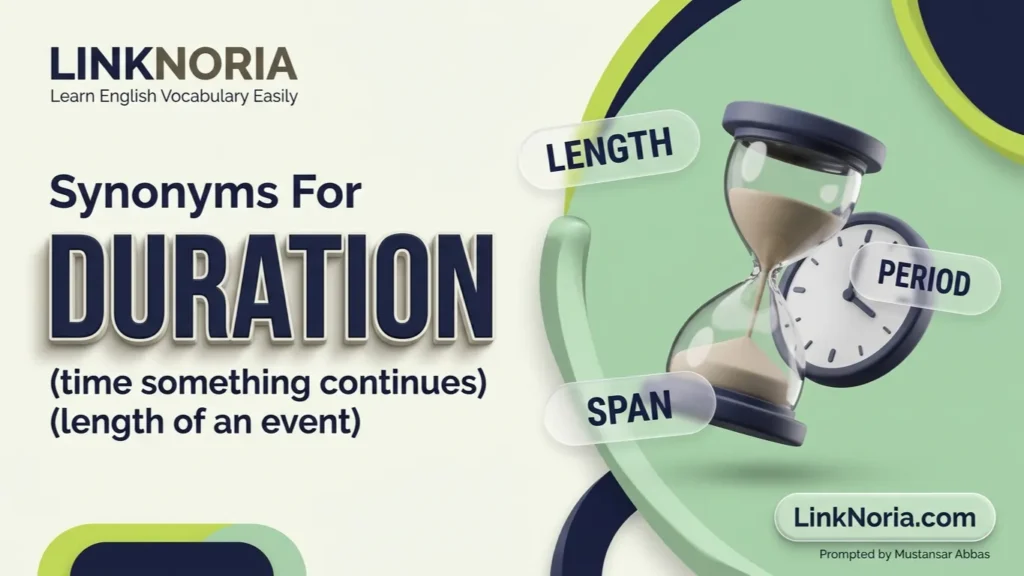
Duration refers to the total period of time during which something continues or exists.
Imagine setting a timer for a 30-minute workout session or waiting for a two-hour movie to end. That measurable stretch of time represents the duration of the activity in your daily schedule.
The word “duration” comes from Latin roots meaning “to last” or “to harden.” It applies to physical events, employment contracts, medical conditions, and musical notes.
Learning varied synonyms for duration allows writers and speakers to describe time spans with exact precision, tone, and professional clarity.
This article explains the meaning of “duration,” its emotional tone, history, pronunciation, word parts, and 30 useful synonyms with clear examples. By the end, you will know how to talk about it like a confident English speaker.
Meaning of Duration
Definition
Duration is a noun that denotes the length or continuance of time during which an action, process, or condition persists.
Simple Meaning
It simply means how long something lasts from its start to its finish.
Connotation
The word neutral in tone, carrying neither strictly positive nor negative feelings.
Examples
- The entire duration of the flight took approximately four hours from takeoff to landing.
- Passengers must keep their seatbelts fastened for the duration of the journey.
Etymology
It derives from the Old French duracion, which comes from Medieval Latin dūrātiō (a continuance), rooted in Latin dūrāre meaning “to last” or “to harden.”
Short History
- Middle English (1100–1500): Entered the language around the late 14th century via Old French and Anglo-Norman legal texts.
- Modern English (1500–Present): Expanded from formal legal agreements to general use in science, finance, and everyday language.
Quick Synonym Comparison Table
| Term | Formality Level | Core Shade of Meaning |
| Duration | Formal / Neutral | Measured total span of time |
| Length | Neutral | Simple spatial or temporal distance |
| Term | Formal / Legal | Fixed or agreed period |
| Span | Neutral | Distance covered across two points in time |
Pronunciation and Syllables
- US IPA: /duːˈreɪ.ʃən/
- UK IPA: /djʊəˈreɪ.ʃən/ or /dʒʊəˈreɪ.ʃən/
- Syllables: 3 syllables (du-ra-tion)
30 Synonyms for Duration
Choosing the right word depends on whether you are measuring time in seconds, years, or fixed contractual terms.
1. Length (noun)
/ˈlɛŋkθ/ | UK /ˈlɛŋθ/
Meaning: The extent or amount of time something takes.
- The length of the movie surprised the audience because it exceeded three hours.
- She adjusted the length of her presentation to fit the ten-minute limit.
2. Span (noun)
/spæn/ | UK /spæn/
Meaning: The full extent or period between two points in time.
- Human life span has increased significantly over the past century due to better medicine.
- The span of his career covered four decades in public service.
3. Period (noun)
/ˈpɪriəd/ | UK /ˈpɪəriəd/
Meaning: A particular length of time marked by specific events or conditions.
- The country experienced a long period of economic growth.
- She spent a brief period living in Paris during college.
4. Term (noun)
/tɜːrm/ | UK /tɜːm/
Meaning: A limited or fixed period of time, such as in office or contract.
- The president served a four-year term before retiring.
- The term of the lease expires at the end of December.
5. Interval (noun)
/ˈɪntərvəl/ | UK /ˈɪntəvəl/
Meaning: The time between two specific events or states.
- There was a short interval between the first and second acts of the play.
- The trains run at regular intervals of fifteen minutes.
6. Stretch (noun)
/strɛtʃ/ | UK /strɛtʃ/
Meaning: An continuous or uninterrupted period of time.
- He drove for a six-hour stretch without stopping for gasoline.
- She worked through a long stretch of night shifts this month.
7. Tenure (noun)
/ˈtɛnjər/ | UK /ˈtɛnjʊə/
Meaning: The period during which a person holds an official position or job.
- During her tenure as CEO, company revenues doubled.
- His academic tenure lasted over thirty years at the university.
8. Continuance (noun)
/kənˈtɪnjuəns/ | UK /kənˈtɪnjuəns/
Meaning: The state of continuing in time or remaining in existence.
- The continuance of the peace talks gave diplomats hope for a resolution.
- Her continuance in office depended on the upcoming election results.
9. Extent (noun)
/ɪkˈstɛnt/ | UK /ɪkˈstɛnt/
Meaning: The space, area, or temporal range over which something extends.
- The extent of the power outage lasted well into the next morning.
- We did not realize the full extent of the delay until noon.
10. Time (noun)
/taɪm/ | UK /taɪm/
Meaning: A general measurement or limited quantity of system hours/days.
- The time required to complete the exam is two hours.
- She spent a great deal of time practicing the piano.
11. Elapse (noun)
/ɪˈlæps/ | UK /ɪˈlæps/
Meaning: The passage or running out of a measured unit of time.
- The elapse of three years brought major technological changes to the firm.
- Track the elapse of time carefully during the science experiment.
12. Run (noun)
/rʌn/ | UK /rʌn/
Meaning: A continuous period of performance, operation, or success.
- The Broadway show had a successful ten-year run.
- A long run of bad weather ruined our summer camping plans.
13. Spell (noun)
/spɛl/ | UK /spɛl/
Meaning: A short, distinct period of time characterized by a specific condition.
- The region suffered through a severe dry spell this summer.
- She experienced a sudden spell of dizziness during work.
14. Stint (noun)
/stɪnt/ | UK /stɪnt/
Meaning: An assigned period of work or duty.
- After a brief stint in the navy, he returned to college.
- Her stint as team manager improved team morale significantly.
15. Continuity (noun)
/ˌkɑːntɪˈnuːəti/ | UK /ˌkɒntɪˈnjuːəti/
Meaning: The unbroken and consistent operation of something over time.
- The continuous flow of water maintained the continuity of power generation.
- Leadership focused on operational continuity during the corporate transition.
16. Lifetime (noun)
/ˈlaɪftaɪm/ | UK /ˈlaɪftaɪm/
Meaning: The duration of a person’s life or an object’s usefulness.
- It was a once-in-a-lifetime opportunity to travel around the world.
- The battery has an estimated lifetime of five full years.
17. Space (noun)
/speɪs/ | UK /speɪs/
Meaning: A period of time between events or within an era.
- Much progress was made in the space of a few months.
- Within the space of an hour, the weather turned from sunny to stormy.
18. Phase (noun)
/feɪz/ | UK /feɪz/
Meaning: A distinct stage in a series of events or development process.
- The construction team finished the initial phase of building on schedule.
- Childhood is a critical development phase for language acquisition.
19. Session (noun)
/ˈsɛʃən/ | UK /ˈsɛʃən/
Meaning: A period devoted to a particular activity or meeting.
- The training session lasted three hours on Monday morning.
- Parliament met for an emergency session to debate the law.
20. Cycle (noun)
/ˈsaɪkəl/ | UK /ˈsaɪkəl/
Meaning: A recurring series or period of time in which events repeat.
- The biological cycle of the plant resets every spring season.
- Economic markets go through regular growth and recession cycles.
21. Window (noun)
/ˈwɪndoʊ/ | UK /ˈwɪndəʊ/
Meaning: An available frame or period of opportunity.
- We have a narrow window of weather to launch the rocket safely.
- The doctor found a small window in his schedule to see the patient.
22. Course (noun)
/kɔːrs/ | UK /kɔːs/
Meaning: The continuous passage or development through a period of time.
- Over the course of the week, temperatures dropped sharply.
- Events took a unexpected shift during the course of the investigation.
23. Innings (noun)
/ˈɪnɪŋz/ | UK /ˈɪnɪŋz/
Meaning: A period of opportunity, activity, or life span (British/Commonwealth usage).
- The old politician enjoyed a long and productive innings in government.
- After a good innings, the company founder decided to retire.
24. Season (noun)
/ˈsiːzən/ | UK /ˈsiːzən/
Meaning: A period of the year characterized by particular climate or activity.
- The rainy season brought much needed water to local crops.
- Football season begins in early autumn each year.
25. Duration of Stay (compound noun)
/duːˈreɪʃən ʌv steɪ/ | UK /djʊəˈreɪʃən ɒv steɪ/
Meaning: The length of time a person spends residing in a specific location.
- Tourists must specify their duration of stay on the visa application.
- The hotel confirmed her duration of stay was three nights.
26. Life (noun)
/laɪf/ | UK /laɪf/
Meaning: The period from creation or birth to the end of usefulness or existence.
- The shelf life of milk is usually around two weeks.
- Engineers extended the working life of the old bridge.
27. Eon / Aeon (noun)
/ˈiːən/ | UK /ˈiːən/
Meaning: An indefinitely long or immense period of time.
- Mountain formations change over eons of geological activity.
- It felt like an eon passed while waiting in the long line.
28. Era (noun)
/ˈɪrə/ | UK /ˈɪərə/
Meaning: A long and distinct period of history with a particular feature.
- The industrial era transformed modern manufacturing methods.
- Digital technology marked the start of a new educational era.
29. Epoch (noun)
/ˈɛpək/ | UK /ˈiːpɒk/
Meaning: A notable period of time marked by distinctive features or events.
- The discovery of electricity marked a major epoch in human history.
- Scientists study fossil records from the Pleistocene epoch.
30. Duration Gap (technical noun)
/duːˈreɪʃən ɡæp/ | UK /djʊəˈreɪʃən ɡæp/
Meaning: A financial measure of interest rate risk sensitivity.
- The bank manager analyzed the duration gap to protect assets.
- Minimizing the duration gap prevents financial loss when rates shift.
Quick Synonym Comparison Table
| Synonym | Formality | Nuance / Context | Example |
| Duration | Formal / Neutral | Measured total time | Duration of the flight |
| Span | Neutral | Total breadth between start and end | Attention span |
| Stretch | Informal | Continuous, uninterrupted period | A long stretch of work |
| Tenure | Formal | Official holding of an office | Tenure as mayor |
| Spell | Informal | Brief, temporary state | A dry spell |
| Stint | Neutral | Specific assigned duty period | A stint in the army |
| Window | Professional | Opportunity frame | Window of opportunity |
Synonyms by Context / Usage
Formal & Professional
- Tenure: Used for executive or academic positions.
- Continuance: Used in legal filings and formal court proceedings.
- Term: Used for contractual obligations and political service.
Informal & Conversational
- Stretch: Used for driving distances or work sessions.
- Spell: Used for brief weather changes or feelings.
- Stint: Used for temporary jobs or tasks.
Academic & Technical
- Duration Gap: Used in bond portfolio management and banking.
- Epoch: Used in geology and history.
- Cycle: Used in biology, physics, and economics.
Example Sentences Using the Synonyms
- Span: The bridge had a functional span of seventy years before repairs were needed.
- Tenure: Her academic tenure was marked by outstanding research papers.
- Stretch: Driving across the desert required a four-hour stretch without radio signal.
- Interval: The heart rate monitor records time at one-second intervals.
- Window: Surgeons had a narrow window to complete the operation safely.
Parts of Speech
| Form | Word | Function in Sentence | Example |
| Noun | Duration | Subject or Object | The duration was short. |
| Adjective | Durational | Modifies a noun | They studied durational changes. |
| Adverb | Durationally | Modifies a verb/adjective | The piece was planned durationally. |
| Verb Root | Endure / Durationate | Expresses action/state | The material will endure. |
Antonyms of Duration
- Instant (noun): An extremely short or precise point in time.
- Moment (noun): A brief, almost imperceptible period.
- Cessation (noun): The complete stopping or ending of an activity.
- Termination (noun): The bringing to an end of a period or contract.
- Transience (noun): The state of lasting for only a very short time.
When to Use Which Synonym
| Word | Opposite Choice | Context |
| Duration | Instant | Continuous time vs single moment |
| Continuance | Cessation | Ongoing action vs total stopping |
| Permanence | Transience | Lasting forever vs fleeting state |
Affixation Pattern
- Root: Dur (Latin dūrāre to last, to harden)
- Prefix: None
- Suffix: -ation (Latin suffix indicating an action, state, or process)
Word Formation
- Endure (verb): /ɪnˈdʊr/ | UK /ɪnˈdjʊə/ | 2 Syllables
- Durable (adjective): /ˈdʊrəbəl/ | UK /ˈdjʊərəbəl/ | 3 Syllables
- Durability (noun): /ˌdʊrəˈbɪləti/ | UK /ˌdjʊərəˈbɪlɪti/ | 5 Syllables
- Durational (adjective): /duːˈreɪʃənəl/ | UK /djʊəˈreɪʃənəl/ | 4 Syllables
Prototype Meaning
The mental prototype native speakers associate with “duration” is an ongoing timeline with a clear starting point and an ending point. People picture a clock ticking or a progress bar filling up across an activity, such as a movie, flight, or class.
The word does not imply permanent existence, sudden surprise, or spatial length. It strictly focuses on the quantity of continuous time expended between beginning and conclusion.
Prototype Categorization
- Fixed Contractual Time: Term, Tenure, Stint
- Bounded Operational Time: Period, Session, Phase, Stretch
- Geological & Historical Time: Era, Epoch, Eon
- Short/Flexible Time: Spell, Window, Interval
Categorizing these words helps writers select precise terms so legal obligations are not confused with casual, temporary events.
Common Usage Mistakes
- Confusing Duration with Distance: Incorrect: The duration from Boston to New York is 200 miles. Correct: The distance is 200 miles; the duration of the drive is four hours.
- Redundant Phrases: Avoid saying “total duration of time.” “Duration” already includes the concept of time.
- Misusing Since/For: Use “for” with duration (for a duration of three days), not “since.”
Connotative Meaning
- Positive: Stability, endurance, thoroughness.
- Negative: Tedium, excessive length, dragging time.
- Neutral: Scientific measurements, schedule lengths, contractual terms.
(Connotation refers to the emotional association or cultural feeling a word carries beyond its dictionary definition.)
Short Questions and Answers
What is another word for “long duration”?
“Extended period,” “prolonged stretch,” or “marathon” all describe a long duration effectively. These terms emphasize that an activity or state continues much longer than standard expectations.
What is a synonym for “time duration”?
“Time span” or “length of time” serves as the best direct synonym for time duration. The phrase “time duration” is technically redundant, so using “duration” or “time frame” alone is preferred in clear writing.
What does “duration” mean?
Duration means the total length of time during which an event, action, or condition continues. It measures the complete temporal distance from start to finish.
What is another word for long period?
“Era,” “epoch,” or “extended stretch” can replace “long period” depending on context. For historical scales use “era,” while for daily activities use “long stretch.”
How is duration used in financial analysis?
In finance, duration measures how sensitive a bond’s price is to changes in interest rates. It represents a weighted average maturity of cash flows rather than just simple calendar days.
What is the formal tone level of duration?
Duration carries a formal to neutral tone appropriate for academic papers, legal contracts, and professional reports. Casual speech often replaces it with simpler words like “length” or “time.”
How do duration and interval differ?
Duration covers the entire span of an event from start to finish. An interval refers to the break or space between two distinct events.
Conclusion
Mastering “duration” and its synonyms equips you to describe time with precision across academic, professional, and casual settings. Understanding subtle differences between words like “tenure,” “stretch,” and “interval” elevates the clarity of your writing.
Try incorporating two new synonyms for duration into your conversations or writing exercises today.
Quiz about “Duration”
1. What is the main definition of duration?
- A) Physical length of an object
- B) Total length of time something lasts
- C) Speed of a moving vehicle
- D) Break between two events
2. Which synonym best fits a president’s fixed time in office?
- A) Spell
- B) Tenure
- C) Stretch
- D) Eon
3. What is the standard abbreviation for duration in notes or schedules?
- A) dur.
- B) drn.
- C) du.
- D) dtn.
4. What is a primary antonym of duration?
- A) Stretch
- B) Instant
- C) Span
- D) Period
5. Complete the sentence: “The storm lasted for a short ______ of two hours.”
- A) spell
- B) tenure
- C) century
- D) duration gap
6. Which word represents time duration in long historical or geological terms?
- A) Stint
- B) Epoch
- C) Session
- D) Interval
7. How would you write “duration” in a clear example sentence showing time duration meaning?
- A) The duration of the concert was two hours.
- B) The duration of the table was five feet.
- C) She durationed her walk across the park.
- D) Duration is faster than speed.
Answers
- B Duration refers to the length of time an event persists.
- B Tenure refers to an official period holding office.
- A “dur.” is the accepted dictionary abbreviation for duration.
- B Instant represents an immediate point, opposing continuous duration.
- A Spell indicates a short, temporary period.
- B Epoch designates major geological or historical periods.
- A Option A correctly uses duration to measure temporal length.

Mustansar Abbas is the author and founder of Linknoria.com, where he writes practical, well-researched guides on technology, productivity, and digital tools to help readers make smarter, more informed decisions.