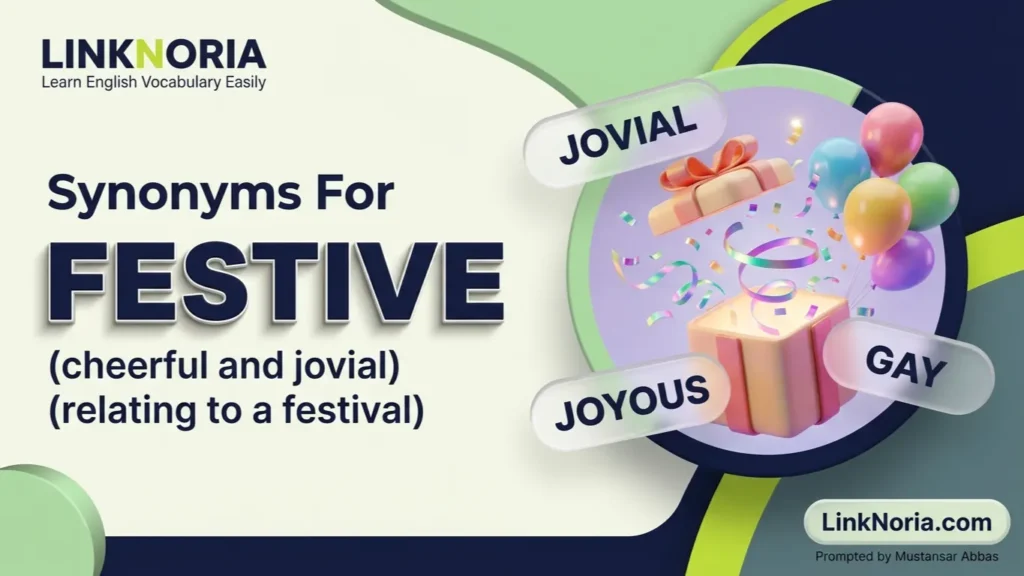
Festive means relating to a feast, holiday, or celebration, characterized by joy, decorations, and lively social gathering.
When walking into a town square decorated with glowing lights, colorful banners, and cheerful music during the holidays, you experience an atmosphere that feels distinctly festive.
The word “festive” applies to holidays, social parties, joyful attitudes, and vibrant seasonal decorations.
Learning synonyms for festive helps writers, students, and speakers capture precise shades of joy, formal celebration, or informal cheerfulness.
This article explains the meaning of “festive,” its emotional tone, history, pronunciation, word parts, and 30 useful synonyms with clear examples. By the end, you will know how to talk about it like a confident English speaker.
Meaning of Festive
Definition
Festive is an adjective that describes a joyful atmosphere, event, or mood typical of a celebration or holiday.
YouTube
Simple Meaning
It describes something that feels cheerful, bright, and ready for a party.
Connotation
The word carries a strongly positive connotation, evoking feelings of warmth, happiness, community, and excitement.
Examples
- The entire neighborhood had a festive mood as families gathered for the holiday parade.
- She decorated the dining hall with colorful garlands to give it a festive appearance.
Etymology
It comes from the Old French festif, derived from Medieval Latin festivus meaning “pertaining to a feast, joyous, or lively”. This traces back to the Latin root festum, meaning “feast” or “holiday”.
Wiktionary, the free dictionary+ 1
Short History
- Middle English (1100–1500): Early forms entered the language via Anglo-Norman French in connection with religious feasts.
- Modern English (1500–Present): Adopted broadly to describe secular holidays, cheerful moods, and bright party decorations.
Quick Synonym Comparison Table
| Term | Formality Level | Core Shade of Meaning |
| Festive | Neutral | Related to celebrations, holidays, or joyful parties |
| Merry | Informal / Traditional | Joyful, lighthearted, and cheerful |
| Convivial | Formal / Literary | Friendly, lively, and fond of eating and drinking |
| Jubilant | Formal | Showing extreme joy after a victory or success |
Pronunciation and Syllables
- US IPA: /ˈfɛs.tɪv/
Cambridge Dictionary – Cambridge University Press & Assessment - UK IPA: /ˈfes.tɪv/
Cambridge Dictionary – Cambridge University Press & Assessment - Syllables: 2 syllables (fes-tive)
30 Synonyms for Festive
Choosing the right word depends on whether you are describing a wild party, a religious ceremony, or a quiet holiday mood.
1. Celebratory (adjective)
/ˌsɛl.əˈbræ.tɔːr.i/ | UK /ˌsɛl.ɪˈbreɪ.tər.i/ Meaning: Used for or related to celebrating an event.
- The team gathered for a celebratory dinner after winning the regional championship.
- They baked a layered cake for the celebratory party.
2. Joyous (adjective)
/ˈdʒɔɪ.əs/ | UK /ˈdʒɔɪ.əs/ Meaning: Full of happiness and deep joy.
- The town bell rang to announce the joyous news of peace.
- Family members shared a joyous reunion after years apart.
3. Merry (adjective)
/ˈmɛr.i/ | UK /ˈmɛr.i/ Meaning: Cheerful, lively, and full of good humor.
- Carolers sang merry songs throughout the winter evening.
- The children played merry games during the afternoon picnic.
4. Jolly (adjective)
/ˈdʒɑː.li/ | UK /ˈdʒɒl.i/ Meaning: Happy, bright, and cheerful in spirit.
- A jolly host welcomed guests at the front door.
- Loud laughter filled the jolly gathering.
5. Festal (adjective)
/ˈfɛs.təl/ | UK /ˈfes.təl/ Meaning: Related to a festival or feast day in a traditional or formal sense.
- The choir wore their festal robes for the anniversary service.
- Banners hung across the square for the festal gathering.
6. Convivial (adjective)
/kənˈvɪv.i.əl/ | UK /kənˈvɪv.i.əl/ Meaning: Friendly, lively, and enjoyable during social gatherings.
- The restaurant provided a convivial atmosphere for long conversations.
- Guests enjoyed a convivial evening of storytelling and dining.
7. Jubilant (adjective)
/ˈdʒuː.bəl.ənt/ | UK /ˈdʒuː.bəl.ənt/ Meaning: Expressing great happiness because of success or triumph.
- The jubilant crowd cheered as the parade crossed the finish line.
- Workers felt jubilant upon finishing the difficult project ahead of schedule.
8. Cheery (adjective)
/ˈtʃɪr.i/ | UK /ˈtʃɪə.ri/ Meaning: Bright, happy, and causing good feelings.
- Bright yellow curtains gave the room a cheery appearance.
- She greeted everyone with a cheery good morning.
9. Gala (adjective)
/ˈɡæ.lə/ | UK /ˈɡɑː.lə/ Meaning: Showy, special, and related to a major public celebration.
- Dancers performed in gala costumes during the festival opener.
- The museum hosted a gala evening to raise funds.
10. Christmassy (adjective)
/ˈkrɪs.məs.i/ | UK /ˈkrɪs.məs.i/ Meaning: Having the specific atmosphere or spirit associated with Christmas.
- Pine garlands and cinnamon candle scents made the home feel very Christmassy.
- Snowfall gave the town a Christmassy look in late December.
11. Mir
thful (adjective) /ˈmɜːrθ.fəl/ | UK /ˈmɜːθ.fəl/ Meaning: Full of laughter and amusement.
- Mirthful laughter echoed down the hallway during the game.
- The comedian entertained a mirthful crowd.
12. Gleeful (adjective)
/ˈɡliː.fəl/ | UK /ˈɡliː.fəl/ Meaning: Full of high-spirited joy and delight.
- The children gave a gleeful shout when they saw the snow.
- He unwrapped the present with a gleeful expression.
13. Jovial (adjective)
/ˈdʒoʊ.vi.əl/ | UK /ˈdʒəʊ.vi.əl/ Meaning: Friendly, cheerful, and full of good humor.
- The jovial shopkeeper always offered free treats to children.
- Storytellers kept the group in a jovial mood all night.
14. Gladsome (adjective)
/ˈɡlæd.səm/ | UK /ˈɡlæd.səm/ Meaning: Giving or expressing joy in a traditional or literary way.
- Morning daylight brought a gladsome feeling to the village.
- Singers offered gladsome tunes during the spring festival.
15. Upbeat (adjective)
/ˈʌp.biːt/ | UK /ˈʌp.biːt/ Meaning: Positive, cheerful, and full of energy.
- Upbeat music played over the speakers in the market.
- The manager gave an upbeat presentation about future goals.
16. Carnivalesque (adjective)
/ˌkɑːr.nə.vəˈlɛsk/ | UK /ˌkɑː.nɪ.vəlˈesk/ Meaning: Resembling a carnival with wild, colorful, and noisy excitement.
- Street performers created a carnivalesque scene along the boardwalk.
- Costumed dancers led a carnivalesque parade through town.
17. Elated (adjective)
/iˈleɪ.t̬ɪd/ | UK /iˈleɪ.tɪd/ Meaning: Extremely happy and proud.
- The elated winner held the trophy up high.
- She felt elated after receiving her university acceptance letter.
18. Exuberant (adjective)
/ɪɡˈzuː.bɚ.ənt/ | UK /ɪɡˈzjuː.bər.ənt/ Meaning: Full of unrestrained energy and enthusiasm.
- Exuberant puppies ran across the park grass.
- The crowd offered an exuberant ovation at the concert end.
19. Buoyant (adjective)
/ˈbɔɪ.ənt/ | UK /ˈbɔɪ.ənt/ Meaning: Lighthearted, cheerful, and resilient in spirit.
- Her buoyant personality cheered up the tired workers.
- Investors remained in a buoyant mood after positive reports.
20. Party-like (adjective)
/ˈpɑːr.ti.laɪk/ | UK /ˈpɑː.ti.laɪk/ Meaning: Having the characteristics or informal mood of a party.
- Streamers gave the classroom a party-like atmosphere.
- The outdoor barbecue had a relaxed, party-like feel.
21. Holiday (adjective)
/ˈhɑː.lə.deɪ/ | UK /ˈhɒl.ə.deɪ/ Meaning: Suitable for or characteristic of a holiday season.
- Stores displayed holiday lights in early November.
- Travelers enjoyed a peaceful holiday spirit at the resort.
22. Radiant (adjective)
/ˈreɪ.di.ənt/ | UK /ˈreɪ.di.ənt/ Meaning: Glowing with warmth, love, or happiness.
- The bride showed a radiant smile during the ceremony.
- Sunshine added a radiant touch to the garden festival.
23. Ecstatic (adjective)
/ɛkˈstæt.ɪk/ | UK /ɪkˈstæt.ɪk/ Meaning: Overwhelmed with intense joy and excitement.
- Fans were ecstatic when their team scored the winning goal.
- She was ecstatic to meet her favorite author.
24. Lively (adjective)
/ˈlaɪv.li/ | UK /ˈlaɪv.li/ Meaning: Full of life, energy, and activity.
- Musicians kept the evening lively with fast tempos.
- A lively debate took place during the meeting.
25. Happy (adjective)
/ˈhæp.i/ | UK /ˈhæp.i/ Meaning: Feeling or showing pleasure and contentment.
- Happy children played along the sandy beach.
- The news put everyone in a happy state of mind.
26. Blithe (adjective)
/blaɪð/ | UK /blaɪð/ Meaning: Showing a casual, cheerful indifference or lightheartedness.
- He spoke with a blithe confidence about his upcoming trip.
- She walked through the park with blithe steps.
27. Sprightly (adjective)
/ˈspraɪt.li/ | UK /ˈspraɪt.li/ Meaning: Energetic and full of life, especially regarding older people.
- The sprightly dancer performed with impressive grace.
- Grandfather remained sprightly despite his advanced age.
28. Vibrant (adjective)
/ˈvaɪ.brənt/ | UK /ˈvaɪ.brənt/ Meaning: Bright, striking, and full of energy.
- Bright flowers created a vibrant display in the courtyard.
- The city features a vibrant nightlife district.
29. Feastful (adjective)
/ˈfiːst.fəl/ | UK /ˈfiːst.fəl/ Meaning: Archaic word meaning rich, plentiful, and suited for a banquet.
Wiktionary, the free dictionary
- The royal court prepared a feastful banquet for the guests.
- Poets wrote about feastful tables loaded with food.
30. Party-hard (slang adjective)
/ˈpɑːr.ti.hɑːrd/ | UK /ˈpɑː.ti.hɑːd/ Meaning: Slang for intensely focused on wild celebrating and nightlife.
- The college town developed a party-hard reputation during spring break.
- Tourists looked forward to a party-hard weekend at the music festival.
Quick Synonym Comparison Table
| Synonym | Formality | Nuance / Context | Example |
| Festive | Neutral | Atmosphere, decorations, or events related to holidays | Festive lights in the square |
| Celebratory | Professional | Directly tied to a specific milestone or victory | Celebratory dinner after winning |
| Convivial | Formal | Warm social eating and drinking with friends | Convivial dinner party |
| Jubilant | Formal | Extreme joy following success | Jubilant athletic team |
| Merry | Informal | Lighthearted and traditional holiday cheer | Merry carolers in winter |
| Christmassy | Informal | Specifically related to Christmas season styling | Christmassy pine decorations |
| Carnivalesque | Literary | Wild, noisy, and colorful street celebration | Carnivalesque street parade |
Synonyms by Context / Usage
Formal & Professional
- Celebratory: Used in corporate settings for team milestones or anniversaries.
- Convivial: Used in literature and formal event reviews to describe pleasant social hostings.
- Festal: Used in liturgical or historical writing to describe traditional feasts.
Informal & Conversational
- Merry: Used in everyday seasonal greetings and light descriptions.
- Upbeat: Used to describe positive moods, music, and attitudes.
- Christmassy: Used casually for decorations and winter atmospheres.
Slang & Contemporary
- Party-hard: Used informally among young adults to describe wild celebration habits.
Example Sentences Using the Synonyms
- Celebratory: Executives held a celebratory meeting after signing the deal.
- Convivial: The dining room offered a convivial setting for evening conversations.
- Carnivalesque: Loud brass bands transformed the street into a carnivalesque spectacle.
- Jubilant: Jubilant fans rushed the field after the final whistle blew.
- Christmassy: The scent of cinnamon made the bakery feel very Christmassy.
Parts of Speech
| Form | Word | Function in Sentence | Example |
| Noun | Festivity | Subject or Object | The festivity lasted late into the night. |
| Adjective | Festive | Modifies a Noun | They put up festive decorations. |
| Adverb | Festively | Modifies a Verb | The hall was festively decorated. |
| Verb | Festoon | Expresses Action | Workers festooned the room with ribbon. |
Antonyms of Festive
- Gloomy (adjective): Dark, depressing, and lacking cheer.
- Solemn (adjective): Deeply serious, formal, and somber.
- Mournful (adjective): Expressing sorrow or grief.
- Dismal (adjective): Dreary, cheerless, and depressing.
- Somber (adjective): Dark, dull, and serious in tone.
When to Use Which Synonym
| Word | Opposite Choice | Context |
| Festive | Gloomy | Bright party vs depressing room |
| Celebratory | Solemn | Happy achievement vs serious funeral |
| Jovial | Somber | Cheerful host vs sad speaker |
Affixation Pattern
- Root: Fest (Latin festum feast or holiday)
Wiktionary, the free dictionary - Prefix: None
- Suffix: -ive (Adjective-forming suffix meaning “having the quality of”)
Word Formation
- Festivity (noun): /fɛsˈtɪv.ə.ti/ | UK /fesˈtɪv.ə.ti/ | 4 Syllables
- Festively (adverb): /ˈfɛs.tɪv.li/ | UK /ˈfes.tɪv.li/ | 3 Syllables
- Festiveness (noun): /ˈfɛs.tɪv.nəs/ | UK /ˈfes.tɪv.nəs/ | 3 Syllables
- Festival (noun): /ˈfɛs.tə.vəl/ | UK /ˈfes.tɪ.vəl/ | 3 Syllables
Wiktionary, the free dictionary
Prototype Meaning
The mental prototype for “festive” is a holiday gathering filled with bright lights, colorful garlands, lively music, food, and smiling people. It represents a warm atmosphere structured around shared joy and special events.
It does not imply daily routine, quiet individual work, serious legal proceedings, or sad occasions. The core image focuses entirely on vibrant group happiness and decorative celebration.
Prototype Categorization
- Seasonal & Holiday Spirits: Merry, Jolly, Christmassy, Festal
- Social Hostings & Dining: Convivial, Party-like, Feastful
- Victory & High Energy: Jubilant, Celebratory, Elated, Ecstatic
- Visual Brightness & Vibe: Vibrant, Radiant, Cheery, Carnivalesque
Grouping these words helps writers select the right term so a quiet dinner is not described with wild words like “carnivalesque.”
Common Usage Mistakes
- Using Festive for Sad Events: Incorrect: They held a festive memorial service. Correct: They held a solemn memorial service.
- Confusing Festive with Festival: “Festive” is an adjective describing mood, while “festival” is a noun describing the event. Incorrect: We went to the festive. Correct: We went to the festival.
YouTube - Overusing Festive for Simple Good Weather: Use “pleasant” or “sunny” instead of “festive” when describing simple weather without a holiday context.
Connotative Meaning
- Positive: Happiness, togetherness, excitement, warmth, and holiday spirit.
- Negative: Rarely negative, though can feel overwhelming if someone prefers quiet environments.
- Neutral: Technical descriptions of seasonal marketing campaigns.
(Connotation refers to the emotional association or cultural feeling a word carries beyond its dictionary definition.)
Short Questions and Answers
What does festive mean?
Festive means having a joyful, bright atmosphere typical of a holiday or party celebration. It describes things that make an event feel special and cheerful.
Wiktionary, the free dictionary+ 1
What is another word for festivities?
“Celebrations,” “revelry,” “gala events,” or “merrymaking” serve as direct synonyms for the plural noun festivities. These terms describe the actual activities occurring during a holiday or party.
What is a synonym for festival?
“Fiesta,” “gala,” “fair,” or “carnival” are top synonyms for the noun festival. These refer to organized public events featuring music, food, and games.
What is a synonym for “festive occasion”?
“Gala,” “celebration,” or “jubilee” describes a festive occasion accurately. These terms highlight that a specific date or gathering is dedicated to joyful events.
What is the difference between festive and cheerful?
Festive implies a holiday or party context with decorations and social celebration. Cheerful simply means feeling or showing happiness in any daily situation.
YouTube
How is festive used in a formal tone?
In formal contexts, festive describes seasonal events or public cultural celebrations without sounding overly casual. Writers often pair it with nouns like “atmosphere,” “season,” or “attire.”
Is Christmassy an official synonym for festive?
Yes, dictionaries recognize Christmassy as an informal adjective specifically meaning festive in a Christmas context. It focuses on winter holiday traditions, pine scents, and festive lights.
Conclusion
Learning “festive” and its synonyms gives you the vocabulary to describe parties, holidays, and joyful moments with exact precision. Whether choosing formal words like “convivial” or casual terms like “merry,” your writing will become richer and more descriptive.
Try using two new synonyms for festive in your writing or speech today.
Quiz about “Festive”
1. What is the core definition of “festive”?
- A) Dark and serious
- B) Relating to a holiday, feast, or cheerful celebration
YouTube - C) Fast and moving quickly
- D) Quiet and reflective
2. Which word serves as a direct synonym for festival?
- A) Gala
- B) Gloom
- C) Silence
- D) Labor
3. Which term is an informal christmassy synonym used for winter holiday spirits?
- A) Somber
- B) Christmassy
- C) Festal
- D) Solemn
4. What is a primary festive antonym?
- A) Merry
- B) Somber
- C) Convivial
- D) Jubilant
5. What is a popular slang or informal term associated with wild festive celebrations?
- A) Party-hard
- B) Festal
- C) Gladsome
- D) Convivial
6. Which term represents a synonym for “festive occasion”?
- A) Funeral
- B) Jubilee
- C) Solitude
- D) Interval
7. Fill in the blank with the correct festive word: “The choir sang ______ songs during the holiday concert.”
- A) mournful
- B) merry
- C) dismal
- D) somber
Answers
- B Festive means relating to a holiday or celebration.
YouTube - A Gala is a synonym for festival or large public celebration.
- B Christmassy describes winter holiday festive qualities.
- B Somber is a direct antonym meaning dark and serious.
- A Party-hard is an informal slang expression for intense party habits.
- B Jubilee denotes a major festive occasion or anniversary.
- B Merry correctly fits the sentence context for holiday choir songs.

Mustansar Abbas is the author and founder of Linknoria.com, where he writes practical, well-researched guides on technology, productivity, and digital tools to help readers make smarter, more informed decisions.