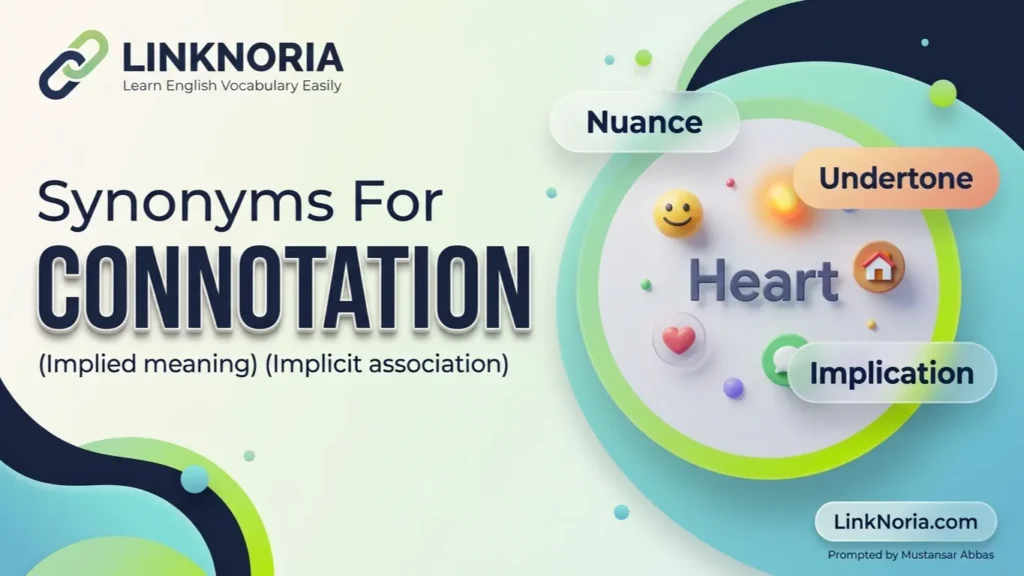
A connotation is an extra feeling or idea that a word brings to your mind alongside its main dictionary meaning. It is the hidden emotion or mood attached to a word.
Common synonyms for connotation include nuance, suggestion, undertone, implication, overtone, and association. Students, writers, and daily speakers can use these synonyms to talk about word choices and hidden meanings easily.
A connotation can be called an implication, nuance, suggestion, undertone, overtone, association, feeling, hint, vibe, flavor, coloring, echo, shadow, whisper, impression, angle, tone, slant, note, touch, spirit, significance, atmosphere, resonance, meaning, weight, sense, aura, leaning, or bias.
Parts of Speech
| Word | Part of Speech | Simple Meaning |
| Connotation | Noun | An added feeling or idea attached to a word |
| Implication | Noun | Something suggested without being directly said |
| Nuance | Noun | A small and subtle difference in meaning |
| Suggestion | Noun | An idea brought to mind indirectly |
| Undertone | Noun | A hidden or quiet feeling under the surface |
| Overtone | Noun | An additional quality or subtle idea |
| Association | Noun | A connected idea or feeling linked to a word |
| Feeling | Noun | An emotional response or reaction |
| Hint | Noun | A small indirect clue or sign |
| Vibe | Noun | A mood or emotional atmosphere |
| Flavor | Noun | A special character or quality |
| Coloring | Noun | A subtle influence that shapes meaning |
| Echo | Noun | A faint reminder of another idea |
| Shadow | Noun | A faint presence or slight trace |
| Whisper | Noun | A very quiet or subtle message |
| Impression | Noun | A feeling or mental picture created in mind |
| Angle | Noun | A special way of looking at a word |
| Tone | Noun | The mood or attitude conveyed by words |
| Slant | Noun | A personal point of view or bias |
| Note | Noun | A specific quality or single element of feeling |
| Touch | Noun | A tiny detail or slight amount of something |
| Spirit | Noun | The general real meaning behind words |
| Significance | Noun | Important inner meaning or value |
| Atmosphere | Noun | The overall mood surrounding a statement |
| Resonance | Noun | A deep feeling or lasting connection |
| Meaning | Noun | The message or sense behind words |
| Weight | Noun | The emotional force or heavy importance |
| Sense | Noun | The general understanding or feeling |
| Aura | Noun | A distinct feeling surrounding a word |
| Leaning | Noun | A small preference or directional pull |
| Bias | Noun | An unfair tilt toward one emotion or side |
1. Implication
- Meaning: Implication means an idea that is suggested without being stated directly.
- Examples:
- The teacher explained the hidden implication behind the poem.
- Her quiet smile had a positive implication for all of us.
2. Nuance
- Meaning: Nuance is a very small and subtle difference in meaning or tone.
- Examples:
- Good writers notice every small nuance when picking new words.
- The translator captured every delicate nuance of the story.
3. Suggestion
- Meaning: Suggestion is an indirect thought or image brought to mind.
- Examples:
- The word home carries a sweet suggestion of safety.
- Dark clouds bring a cold suggestion of coming rain.
4. Undertone
- Meaning: Undertone means a hidden or quiet feeling underneath the main statement.
- Examples:
- His polite speech had a slight undertone of anger.
- The old song has a soft undertone of sadness.
5. Overtone
- Meaning: Overtone is an extra quality or subtle idea connected to a main point.
- Examples:
- The news report had a serious political overtone.
- Her words carried a soft overtone of affection.
6. Association
- Meaning: Association is a mental link between a word and a personal feeling.
- Examples:
- Most people have a warm association with the word summer.
- The word snake has a negative association for many readers.
7. Feeling
- Meaning: Feeling refers to the emotional reaction that a specific word creates.
- Examples:
- The word sunshine brings a bright feeling to everyone.
- Pick words that create a peaceful feeling in your story.
8. Hint
- Meaning: Hint is a small and gentle sign pointing to a hidden meaning.
- Examples:
- There was a slight hint of humor in his answer.
- The choice of words gives a helpful hint about the end.
9. Vibe
- Meaning: Vibe is an informal word for the mood or feeling a word gives off.
- Examples:
- The word mansion has a very fancy vibe.
- Using simple words gives the essay a friendly vibe.
10. Flavor
- Meaning: Flavor refers to the unique style or character a word adds.
- Examples:
- Old proverbs give a poetic flavor to daily speech.
- Action verbs add an exciting flavor to your writing.
11. Coloring
- Meaning: Coloring means the emotional tint or influence added to a word.
- Examples:
- The speaker used strong words to give his talk a emotional coloring.
- Her story had a dark coloring because of the sad word choices.
12. Echo
- Meaning: Echo is a faint reminder of an older or related idea.
- Examples:
- The modern fable contains an echo of ancient fairy tales.
- His speech had a strong echo of hope and peace.
13. Shadow
- Meaning: Shadow means a faint trace or slight presence of another meaning.
- Examples:
- The word cheap carries a slight shadow of poor quality.
- There was a shadow of worry in her gentle voice.
14. Whisper
- Meaning: Whisper is a very soft and subtle hint of an idea.
- Examples:
- The poem ends with a sweet whisper of romance.
- Her note contained a whisper of secret hope.
15. Impression
- Meaning: Impression is the mental image or feeling left after reading words.
- Examples:
- The strong adjectives left a lasting impression on the class.
- Strong words create a sharp impression in reader minds.
16. Angle
- Meaning: Angle means a particular viewpoint or way of shaping a message.
- Examples:
- The reporter wrote the story with a positive angle.
- Try looking at the poem from a different angle.
17. Tone
- Meaning: Tone is the general mood or attitude expressed through language.
- Examples:
- The official letter maintained a polite and professional tone.
- Changing one word can alter the whole tone of a sentence.
18. Slant
- Meaning: Slant refers to a personal bias or leaning in word choice.
- Examples:
- The author gave the article a strong personal slant.
- Be careful not to use words with an unfair slant.
19. Note
- Meaning: Note is a single specific quality or feeling within a statement.
- Examples:
- His letter ended on a cheerful note today.
- The teacher struck a serious note about homework.
20. Touch
- Meaning: Touch means a small or delicate amount of a specific feeling.
- Examples:
- The story had a sweet touch of childhood magic.
- Add a touch of humor to make your speech fun.
21. Spirit
- Meaning: Spirit refers to the true inner meaning or feeling behind language.
- Examples:
- Writers must keep the true spirit of the original text.
- Her words were kind in spirit and purpose.
22. Significance
- Meaning: Significance means the deeper importance or extra meaning inside a word.
- Examples:
- The historical word holds great significance for the culture.
- Explain the full significance of this metaphor.
23. Atmosphere
- Meaning: Atmosphere is the overall emotional mood created by surrounding words.
- Examples:
- Ghost stories use scary words to build a spooky atmosphere.
- Soft music and warm words create a calm atmosphere.
24. Resonance
- Meaning: Resonance is a deep emotional connection that lingers in the mind.
- Examples:
- The word freedom has a strong emotional resonance for everyone.
- Her powerful speech had great resonance with the audience.
25. Meaning
- Meaning: Meaning is the central message or sense expressed by language.
- Examples:
- Words can change their secondary meaning over many years.
- Look beyond the basic dictionary meaning of the term.
26. Weight
- Meaning: Weight refers to the heavy emotional importance carried by a word.
- Examples:
- Words like promise hold a lot of moral weight.
- Consider the emotional weight of your words before speaking.
27. Sense
- Meaning: Sense is the general feeling or direction of an expression.
- Examples:
- The word gives a clear sense of speed and action.
- In a broad sense, both terms mean the same thing.
28. Aura
- Meaning: Aura means the special feeling or mood that surrounds a word.
- Examples:
- The word mystery has a strange and exciting aura.
- She spoke with a calm aura that relaxed the room.
29. Leaning
- Meaning: Leaning is a slight preference or tendency toward one feeling.
- Examples:
- The article shows a distinct political leaning in its vocabulary.
- Her comments had a clear leaning toward optimism.
30. Bias
- Meaning: Bias is an emotional tilt that leads toward an unfair judgment.
- Examples:
- Loaded words can introduce unwanted bias into news reports.
- Try to describe facts without any emotional bias.
Antonyms of connotation
- Denotation
- Literal meaning
- Definition
- Explicit statement
- Direct meaning
- Fact
- Plain text
- Substance
When to Use Which Synonym
| Synonym | Best Used When | Example Situation |
| Denotation | Contrasting explicit dictionary meanings with emotions | “The denotation is a house, but the connotation is home.” |
| Nuance | Discussing small subtle differences in word choices | “A poet chooses words carefully to capture every nuance.” |
| Undertone | Describing hidden or subtle emotions in speech | “His cheerful congratulation had a bitter undertone.” |
| Association | Linking words to feelings or memories | “Red has a strong association with heat and danger.” |
| Tone | Describing the general mood of a whole text | “The author uses a funny tone throughout the essay.” |
| Bias | Pointing out unfair emotional tilts in writing | “Avoid using words that show unfair political bias.” |
Affixation Pattern
- Root Word: Note (from Latin notare, meaning to mark)
- Prefix: Con- (meaning together or with)
- Suffix: -ation (meaning process or state)
- Word Origin Note: Connotation comes from Latin connotare, which means to mark along with something else.
Word Formation
- Noun Form: Connotation
- Verb Form: Connotate, Connote
- Adjective Form: Connotative
- Adverb Form: Connotatively
- US Pronunciation: /ˌkɑː.nəˈteɪ.ʃən/
- UK Pronunciation: /ˌkɒn.əˈteɪ.ʃən/
- Number of Syllables: 4
Prototype Meaning
When native speakers hear the word connotation, they picture an invisible cloud of feelings, memories, and ideas floating around a word. They imagine a word bringing its own emotional light or shadow into a sentence. The word does not imply the exact dictionary definition, plain facts, direct statements, or official legal descriptions that have no emotional tone.
Prototype Categorization
Groupings help writers choose the exact right word for their context:
- Subtle and Hidden Feelings: Nuance, Undertone, Overtone, Whisper, Shadow, Hint
- Direct Emotional Links: Association, Feeling, Resonance, Aura, Vibe
- Overall Text Mood: Tone, Atmosphere, Flavor, Coloring, Spirit
- Point of View and Tilt: Angle, Slant, Leaning, Bias
- Core Sense and Impact: Implication, Significance, Weight, Meaning
Grouping these terms helps students and writers select precise words based on context and emotion.
Common Usage Mistakes
- Confusing Connotation and Denotation: Connotation is the extra feeling, while denotation is the strict dictionary definition.
- Using Connotation as a Verb: Connotation is a noun. Use “connote” or “connotate” when you need a verb.
- Thinking All Connotations Are Negative: Connotations can be positive, negative, or neutral depending on the word.
FAQ
What does connotation mean?
Connotation means the secondary feeling, idea, or emotion that a word suggests beyond its direct dictionary definition.
What are some synonyms for “connotative”?
Synonyms for “connotative” include suggestive, implied, figurative, expressive, hintful, and evocative.
What are 5 examples of connotation?
Examples include “home” (warmth), “thrifty” (smart with money), “cheap” (poor quality), “hollywood” (glamour), and “childish” (immature).
What is a synonym for “connotate”?
Synonyms for “connotate” include connote, imply, suggest, hint, intimate, and signify.
What are synonyms for denotation?
Synonyms for denotation include literal meaning, dictionary definition, explicit sense, and exact meaning.
What are synonyms for connotation in literature?
In literature, synonyms for connotation include literary undertone, motif, subtext, nuance, suggestion, and mood.
What is a synonym for negative connotation?
A synonym for a negative connotation is a bad impression, pejorative tone, negative slant, or unfavorable overtone.
How do synonyms have different connotations?
Words like “slim” and “skinny” mean thin, but “slim” has a positive connotation while “skinny” can sound negative.
Topic Quiz
- What is the main difference between connotation and denotation?
- (A) Connotation is the direct dictionary definition.
- (B) Connotation is the emotional feeling attached to a word.
- (C) Connotation refers to the spelling of a word.
- (D) Connotation is only used in mathematics.
- Which word is a direct antonym of connotation?
- (A) Undertone
- (B) Denotation
- (C) Nuance
- (D) Suggestion
- Which word has a positive connotation compared to “cheap”?
- (A) Skinny
- (B) Thrifty
- (C) Bossy
- (D) Stubborn
- What part of speech is the word connotation?
- (A) Verb
- (B) Adjective
- (C) Noun
- (D) Adverb
- In literature, what does “subtext” mean as a synonym for connotation?
- (A) The title of the book
- (B) The underlying hidden meaning
- (C) The page numbers
- (D) The author’s name
Answer Key:
- (B)
- (B)
- (B)
- (C)
- (B)
Conclusion
Understanding different synonyms for word feelings helps you choose your vocabulary more carefully. Whether you are analyzing a poem, writing a story, or giving a talk, knowing these words allows you to describe hidden meanings clearly.
Using precise words to talk about connotations makes your writing and speech more accurate. Pay attention to how small word changes can shift the overall mood of a sentence.
Try identifying emotional tones in your daily reading to build your vocabulary and improve your writing skills.

Mustansar Abbas is the author and founder of Linknoria.com, where he writes practical, well-researched guides on technology, productivity, and digital tools to help readers make smarter, more informed decisions.