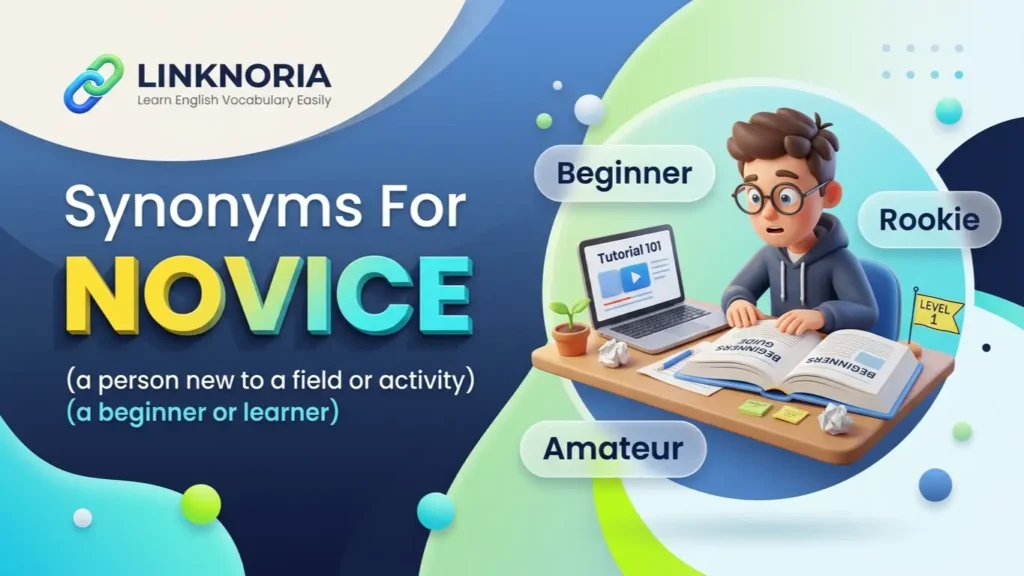
Have you ever tried something new and felt unsure about what to do next? You might be learning to drive, using new software, or starting your first job. In each case, you are a novice.
The word novice describes someone who is new to an activity or has little experience with it. It can describe a student, worker, artist, gamer, or person learning a skill.
Using the same word again and again can make writing sound dull. Learning synonyms helps you choose words that fit the situation more clearly. Some alternatives describe a complete beginner, while others suggest a trainee, learner, or inexperienced person.
This guide explains 30 useful synonyms for novice, their meanings, everyday examples, antonyms, word forms, common mistakes, and practical ways to choose the right word.
Quick Answer: What Are Synonyms for Novice?
Common synonyms for novice include beginner, newcomer, learner, trainee, rookie, amateur, neophyte, greenhorn, apprentice, and inexperienced person. Each word describes someone who is new to an activity or has limited experience, but some words fit particular situations better than others.
- Example 1: Maria is a beginner at swimming and is learning the basic strokes.
- Example 2: The new employee is a trainee who is learning how to use the company’s software.
Table of 30 Synonyms for Novice
| No. | Synonym | Part of Speech | Simple Meaning |
| 1 | Beginner | Noun | Someone just starting |
| 2 | Newcomer | Noun | Someone new to a place or group |
| 3 | Learner | Noun | Someone gaining knowledge or skill |
| 4 | Trainee | Noun | Someone receiving practical training |
| 5 | Rookie | Noun | Someone new to a job or activity |
| 6 | Amateur | Noun | Someone who does something nonprofessionally |
| 7 | Neophyte | Noun | Someone newly introduced to something |
| 8 | Greenhorn | Noun | An inexperienced person |
| 9 | Apprentice | Noun | Someone learning a trade under guidance |
| 10 | Inexperienced person | Noun phrase | Someone with little practical experience |
| 11 | Initiate | Noun | Someone newly introduced to a group or subject |
| 12 | Tyro | Noun | A beginner with little experience |
| 13 | Starter | Noun | Someone beginning an activity |
| 14 | First-timer | Noun | Someone doing something for the first time |
| 15 | Freshman | Noun | A first-year student |
| 16 | Student | Noun | Someone who studies a subject |
| 17 | Pupil | Noun | Someone learning from a teacher |
| 18 | Probationer | Noun | Someone being assessed during a trial period |
| 19 | Apprentice worker | Noun phrase | A worker learning a trade |
| 20 | Intern | Noun | Someone gaining work experience |
| 21 | Junior | Noun | Someone with a lower level of experience |
| 22 | Amateur learner | Noun phrase | A nonprofessional learning a skill |
| 23 | Layperson | Noun | Someone without specialist knowledge |
| 24 | Green | Adjective | New and inexperienced |
| 25 | Unskilled | Adjective | Lacking a particular skill |
| 26 | Untested | Adjective | Not yet proven through experience |
| 27 | Untrained | Adjective | Not taught a particular skill |
| 28 | Inexpert | Adjective | Not skilled or experienced |
| 29 | Raw recruit | Noun phrase | A new member with little training |
| 30 | Tenderfoot | Noun | An inexperienced person, especially outdoors |
Note: These alternatives are not interchangeable in every sentence. Some refer to people in specific roles, while others describe a person’s level of skill or experience.
Detailed Synonyms for Novice
1. Beginner
Meaning: A beginner is someone who has just started learning an activity or skill.
Examples:
- Jack is a beginner at playing the guitar.
- This cooking class is suitable for beginners.
2. Newcomer
Meaning: A newcomer is someone who has recently joined a place, group, or activity.
Examples:
- The newcomer asked her classmates for help.
- Our team welcomed a newcomer from another city.
Usage Note: This word focuses on being new to a group or place, not always on having poor skills.
3. Learner
Meaning: A learner is someone who is gaining knowledge or developing a skill.
Examples:
- Every learner needs time to improve.
- The language app helps learners practice English.
4. Trainee
Meaning: A trainee is someone receiving instruction or practice for a job or task.
Examples:
- The trainee learned how to operate the machine.
- A senior nurse helped the new trainee.
5. Rookie
Meaning: A rookie is someone new to a job, sport, or activity.
Examples:
- The rookie scored his first goal.
- Our rookie reporter covered a local event.
Usage Note: This word is common in sports, workplaces, and informal speech.
6. Amateur
Meaning: An amateur does an activity without being a professional.
Examples:
- She is an amateur photographer who enjoys taking nature pictures.
- The amateur chef prepared a delicious meal.
Usage Note: An amateur may have considerable skill. The word does not always mean beginner.
7. Neophyte
Meaning: A neophyte is someone who has recently started learning about a subject or activity.
Examples:
- The neophyte needed help understanding the software.
- As a neophyte gardener, Omar started with easy plants.
Usage Note: This word is more formal than beginner.
8. Greenhorn
Meaning: A greenhorn is a person who lacks experience in a particular activity.
Examples:
- The greenhorn struggled with his first day on the farm.
- An experienced guide showed the greenhorn how to use the equipment.
Usage Note: This informal word can sound teasing or insulting.
9. Apprentice
Meaning: An apprentice learns a trade or skill by working under an experienced person.
Examples:
- The apprentice watched the carpenter make a wooden chair.
- She became an apprentice electrician after finishing school.
Usage Note: An apprentice usually receives practical training in a particular occupation.
10. Inexperienced Person
Meaning: An inexperienced person has limited knowledge or practice in a situation.
Examples:
- An inexperienced person may need help with the first task.
- The manager gave extra guidance to the inexperienced worker.
11. Initiate
Meaning: An initiate is someone who has recently entered a group, activity, or field of knowledge.
Examples:
- The new initiate learned the group’s basic rules.
- As an initiate in the study group, Ben listened carefully.
Usage Note: The word can refer to formal membership or entry into specialized knowledge.
12. Tyro
Meaning: A tyro is a beginner who has little experience in a particular field.
Examples:
- The young tyro practiced chess every evening.
- Even a tyro can learn the basics with regular practice.
Usage Note: Tyro is uncommon in everyday conversation. It is useful in vocabulary exercises and word puzzles.
13. Starter
Meaning: A starter is someone who begins an activity or takes part at the beginning.
Examples:
- The starter joined a local running club this month.
- As a starter in the course, Nina learned the basic rules.
Usage Note: Starter is not always a direct synonym for novice. It can also refer to someone who begins a race or game.
14. First-Timer
Meaning: A first-timer is someone doing something for the first time.
Examples:
- The first-timer asked how to register for the race.
- As a first-timer at the festival, I enjoyed every activity.
15. Freshman
Meaning: A freshman is a student in the first year of a school or college program.
Examples:
- The freshman attended an orientation meeting.
- Her brother is a freshman at a local university.
Usage Note: This term is especially common in American English. It describes a student’s year, not necessarily their skill level.
16. Student
Meaning: A student is someone who studies a subject or learns from a teacher.
Examples:
- The student practiced basic computer skills after class.
- Each student received a workbook.
17. Pupil
Meaning: A pupil is a person who learns from a teacher, often at school.
Examples:
- The pupil asked her teacher to explain the lesson.
- Each pupil completed a reading exercise.
Usage Note: Pupil is common in British English for schoolchildren and can also mean someone taught by an instructor.
18. Probationer
Meaning: A probationer is someone serving a trial period during which their suitability is assessed.
Examples:
- The probationer received feedback from the supervisor.
- A senior officer guided the new probationer through the first week.
Usage Note: A probationer is not necessarily a novice. The word describes a trial or assessment period.
19. Apprentice Worker
Meaning: An apprentice worker learns an occupation through supervised practical work.
Examples:
- The apprentice worker learned to repair basic plumbing problems.
- An experienced mechanic trained the apprentice worker.
Usage Note: Apprentice is usually the more natural, shorter choice.
20. Intern
Meaning: An intern is someone who gains practical experience by working in an organization for a limited period.
Examples:
- The intern helped prepare a report for the marketing team.
- Our company hired an intern for the summer.
Usage Note: Interns may already have useful knowledge. The term describes their work arrangement rather than proving they are beginners.
21. Junior
Meaning: A junior is someone with a lower rank or less experience in a role.
Examples:
- The junior designer asked a senior colleague for feedback.
- A junior technician checked the equipment under supervision.
Usage Note: The word can describe rank, age, or school year, depending on context.
22. Amateur Learner
Meaning: An amateur learner studies or practices a skill without doing it professionally.
Examples:
- The amateur learner practiced painting on weekends.
- An amateur learner can develop strong skills through regular practice.
Usage Note: This phrase is less natural than beginner in many everyday sentences.
23. Layperson
Meaning: A layperson is someone without professional or specialist knowledge of a subject.
Examples:
- The doctor explained the results in language a layperson could understand.
- The guide made the technical topic clear to a layperson.
Usage Note: A layperson may be experienced in other areas. The word refers to a lack of specialist knowledge, not general inexperience.
24. Green
Meaning: Green describes someone who is new and inexperienced in a particular situation.
Examples:
- The green employee needed help with the new system.
- He was still green when he joined the sales team.
Usage Note: Green is an adjective, not a noun meaning a novice.
25. Unskilled
Meaning: Unskilled describes someone who lacks a particular skill or specialized training.
Examples:
- The unskilled worker received basic safety training.
- She felt unskilled at public speaking before joining the club.
Usage Note: This word can sound negative and does not always mean the person is new.
26. Untested
Meaning: Untested describes someone or something whose ability has not yet been proven in practice.
Examples:
- The untested player faced a difficult first match.
- The company gave the untested candidate a supervised task.
Usage Note: An untested person may be skilled but has not yet demonstrated that ability in the situation.
27. Untrained
Meaning: Untrained describes someone who has not received instruction for a particular task.
Examples:
- An untrained person should not operate the dangerous equipment.
- The untrained volunteer received a safety briefing.
28. Inexpert
Meaning: Inexpert describes someone who lacks skill or experience in a particular activity.
Examples:
- His inexpert handling of the camera affected the photos.
- The inexpert gardener needed advice about plant care.
Usage Note: This adjective is more formal and less common than inexperienced.
29. Raw Recruit
Meaning: A raw recruit is a new member who has received little training or practical experience.
Examples:
- The raw recruit learned the basic procedures during training.
- The instructor guided each raw recruit through the first exercise.
Usage Note: This phrase is often associated with military or structured training settings.
30. Tenderfoot
Meaning: A tenderfoot is an inexperienced person, especially someone unfamiliar with outdoor life.
Examples:
- The tenderfoot needed help setting up the camping tent.
- An experienced hiker showed the tenderfoot how to follow the trail.
Usage Note: This word is informal and can sound old-fashioned. It is less suitable for formal writing.
Antonyms of Novice
Antonyms are words with opposite or contrasting meanings. For novice, the best antonym depends on the context. Some describe a highly skilled person, while others describe someone with long experience.
- Expert — someone with great knowledge or skill.
- Veteran — someone with extensive experience in a field.
- Professional — someone who works in a field for a living or meets its professional standards.
- Master — someone with exceptional skill.
- Specialist — someone with deep knowledge of a particular subject.
- Authority — a person with recognized knowledge or expertise.
- Seasoned — experienced through long practice.
- Skilled — having the ability to perform a task well.
When to Use Which Synonym
| Synonym | Best Used When | Example Situation |
| Beginner | Someone is just starting | Learning to swim |
| Newcomer | Someone has recently joined | Joining a new club |
| Learner | Someone is gaining knowledge | Studying English |
| Trainee | Someone receives job instruction | Learning company software |
| Rookie | Someone is new to a role or sport | Playing a first season |
| Amateur | Someone is not a professional | Taking photos as a hobby |
| Neophyte | A slightly formal description is suitable | Entering a new field |
| Greenhorn | Informal language fits | Describing a new farm worker |
| Apprentice | Someone learns a trade under guidance | Training as a carpenter |
| First-timer | Someone does an activity for the first time | Attending a festival |
| Freshman | A first-year student is meant | Starting college in the US |
| Pupil | Someone learns from a teacher | A child at school |
| Intern | Someone gains workplace experience | Joining a summer internship |
| Junior | A lower experience level or rank matters | A junior designer |
| Layperson | Specialist knowledge is missing | Reading medical information |
| Green | Someone is inexperienced | A new employee |
| Untrained | Someone has not received instruction | Operating unfamiliar equipment |
| Veteran | An experienced person is the contrast | A veteran coach guiding a new player |
Affixation Pattern
| Word Part | Form | Explanation |
| Root | novice | The complete word is used as the base. |
| Prefix | None | No prefix is added in the standard word. |
| Suffix | None | No suffix is added in the standard word. |
The English word novice came through Old French from Latin novicius, meaning new or newly introduced. Its history connects it with the idea of being new to a role, activity, or group.
Word Formation
The word novice is mainly used as a noun. English does not commonly form a regular verb or adjective directly from it.
- Noun: novice
- Plural noun: novices
- Related adjective: novice-level, as in novice-level lessons
- US pronunciation: /ˈnɑːvɪs/
- UK pronunciation: /ˈnɒvɪs/
- Number of syllables: 2 — nov-ice
The adjective novice-level is a compound form used to describe something designed for beginners. Words such as novice-like may appear in specific contexts, but they are less common.
Prototype Meaning
When native English speakers hear novice, they often picture someone at the early stage of learning a skill. This person may need instructions, practice, or support from someone more experienced. A novice might be learning to cook, play an instrument, write code, or perform a new job. The word does not mean the person is unintelligent or unable to improve. It describes limited experience in a particular area, not a lack of ability in every part of life.
Prototype Categorization
Grouping synonyms by meaning helps you select a word that matches the person, activity, and tone. The closest alternative is not always the most natural one.
1. General beginners
- Beginner
- Learner
- First-timer
- Starter
These words suit people at the beginning of an activity or learning process.
2. New members
- Newcomer
- Initiate
- Rookie
- Raw recruit
These terms focus on entering a group, role, or new environment.
3. People receiving training
- Trainee
- Apprentice
- Intern
- Probationer
These words fit education, workplace learning, or structured training.
4. Informal or uncommon terms
- Greenhorn
- Tyro
- Tenderfoot
- Neophyte
These alternatives can add variety, but some are old-fashioned, specialized, or less common.
5. Words about skill or experience
- Inexperienced person
- Green
- Untrained
- Inexpert
- Untested
- Unskilled
These terms describe a lack of experience, instruction, or proven ability. Their meanings are not identical.
6. Education and specialist knowledge
- Student
- Pupil
- Freshman
- Layperson
These words are suitable for learning environments or situations involving specialist knowledge.
Common Usage Mistakes
- Using novice for every new person: A newcomer may be new to a group but experienced in the work. Use beginner when the person is learning the activity itself.
- Confusing amateur with beginner: An amateur may have years of practice. The word often refers to someone who does not work professionally.
- Using trainee for every learner: A trainee usually receives organized instruction, often for a job.
- Calling every student a novice: A student may be advanced. Use novice only when limited experience is relevant.
- Treating green as a noun: Write “She is green at the job,” not “She is a green.”
- Using unskilled as a polite replacement: It can sound harsh. New to the task may be kinder and more accurate.
- Confusing layperson with beginner: A layperson lacks specialist knowledge, but may have practical experience.
- Using freshman for every beginner: This word usually refers to a first-year student in a school or college system.
- Assuming veteran is always a direct antonym: It fits when long experience contrasts with being a novice, but it can also have military meanings.
- Choosing an uncommon word for simple writing: Tyro and tenderfoot may confuse readers. Beginner is usually clearer.
FAQ
What is another word for being a novice?
Inexperience is a common word for the state of being a novice. You can also say being a beginner or having little experience, depending on the sentence.
What is a synonym for beginner?
Novice is a direct synonym for beginner. Other choices include learner, newcomer, and first-timer. Use trainee when the person is receiving structured instruction.
What is a 4-letter synonym for “novice”?
Tyro is a four-letter synonym for novice. It means a beginner with little experience in a particular field. The word is uncommon in everyday conversation but may appear in vocabulary exercises and word puzzles.
What does “novice” mean?
A novice is someone who is new to an activity or has little experience with it. The word often describes someone learning a skill, job, sport, or subject.
What is the opposite of novice?
Expert is a common opposite of novice. Other options include veteran, master, and seasoned professional. The best choice depends on the context and the kind of experience being described.
What adjective can describe a novice?
Novice-level is a useful adjective for something intended for beginners, as in “novice-level training.” You can also describe a person as inexperienced, untrained, or green, depending on the meaning.
What is a novice in a sentence?
“She was a novice at gardening, so she began with easy plants.” In this sentence, novice shows that she had little gardening experience and was still learning the basics.
Is there a synonym for novice that starts with “pl”?
There is no common, exact synonym for novice beginning with pl. Player may fit a specific gaming or sports context, but it does not generally mean beginner. Tyro is a better four-letter alternative.
Topic Quiz
1. Which word is the closest synonym for novice?
A. Expert B. Beginner C. Master D. Veteran
2. Which word describes someone learning a trade under an experienced worker?
A. Layperson B. Amateur C. Apprentice D. Authority
3. Which four-letter word means a beginner?
A. Tyro B. Wise C. Avid D. Able
4. Which word describes someone who lacks specialist knowledge?
A. Veteran B. Master C. Expert D. Layperson
5. Which word is a common antonym of novice?
A. Learner B. Trainee C. Expert D. Newcomer
Answer Key
- (B)
- (C)
- (A)
- (D)
- (C)
Conclusion
Learning synonyms for novice helps you describe people and their experience more accurately. Words such as beginner, learner, trainee, and rookie fit different situations, while expert and veteran describe people with greater experience.
The best word depends on the context, the person’s role, and the level of experience you want to express. Simple words often communicate your meaning more clearly than uncommon alternatives.
Keep practicing these words in everyday sentences, school assignments, and conversations. Choose a few favorites and try using them in your own writing.

Mustansar Abbas is the author and founder of Linknoria.com, where he writes practical, well-researched guides on technology, productivity, and digital tools to help readers make smarter, more informed decisions.