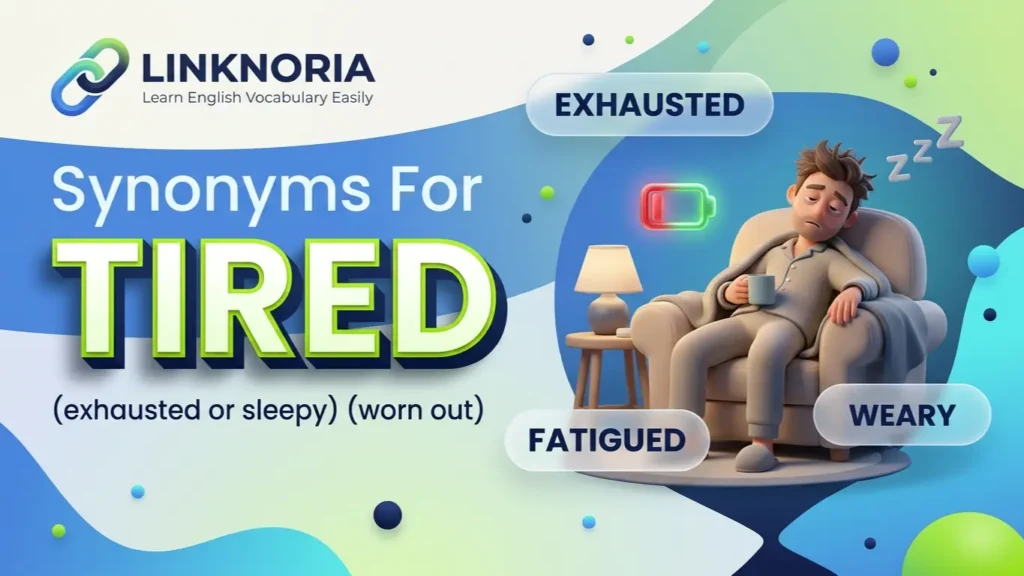
Have you ever yawned through a long meeting, struggled to keep your eyes open, or felt too drained to finish a simple task? The word tired describes these familiar feelings. We use it after a busy day, a poor night’s sleep, hard exercise, or a stressful experience.
Repeating the same word can make your writing sound plain. Learning synonyms helps you describe your feelings more clearly. Exhausted suggests extreme tiredness, sleepy describes a desire to sleep, and weary often expresses tiredness after a long struggle. This guide explains 29 synonyms for tired, with simple meanings, everyday examples, pronunciation, and practical tips to help you choose the right word.
Quick Answer: What Are Synonyms for Tired?
Common synonyms for tired include exhausted, weary, fatigued, sleepy, drained, worn-out, drowsy, spent, beat, and weary. These words describe different levels and types of tiredness, from wanting to sleep to having almost no energy left.
- After working a double shift, Maria felt exhausted.
- After lunch, James felt sleepy and wanted a short nap.
Choose a word that matches the cause and strength of the feeling. Some alternatives work well in formal writing, while others suit casual conversations.
Table of 29 Synonyms for Tired
| No. | Synonym | Part of Speech | Simple Meaning |
|---|---|---|---|
| 1 | Exhausted | Adjective | Extremely tired |
| 2 | Weary | Adjective | Tired after effort |
| 3 | Fatigued | Adjective | Physically or mentally tired |
| 4 | Sleepy | Adjective | Ready or wanting to sleep |
| 5 | Drained | Adjective | Having little energy left |
| 6 | Worn-out | Adjective | Very tired from use or effort |
| 7 | Drowsy | Adjective | Sleepy and less alert |
| 8 | Spent | Adjective | Having used all your energy |
| 9 | Beat | Adjective, informal | Very tired |
| 10 | Knackered | Adjective, informal | Extremely tired |
| 11 | Pooped | Adjective, informal | Tired and low on energy |
| 12 | Bushed | Adjective, informal | Very tired after activity |
| 13 | Weighed down | Adjective phrase | Burdened by stress or fatigue |
| 14 | Lethargic | Adjective | Lacking energy or interest |
| 15 | Listless | Adjective | Lacking energy or enthusiasm |
| 16 | Sluggish | Adjective | Moving or thinking slowly |
| 17 | Run-down | Adjective | Feeling weak and tired |
| 18 | Burned out | Adjective phrase | Exhausted by prolonged stress |
| 19 | Overworked | Adjective | Tired from too much work |
| 20 | Overexerted | Adjective | Tired from excessive effort |
| 21 | Jaded | Adjective | Tired of repeated experiences |
| 22 | Fed up | Adjective phrase | Annoyed and tired of something |
| 23 | Depleted | Adjective | Greatly reduced in energy |
| 24 | Enervated | Adjective | Weakened or lacking energy |
| 25 | Enfeebled | Adjective | Made weak or frail |
| 26 | Dog-tired | Adjective, informal | Extremely tired |
| 27 | Dead on your feet | Idiom | Almost too tired to continue |
| 28 | Half-asleep | Adjective | Barely awake |
| 29 | Fatigued out | Informal phrase | Very tired from effort |
Detailed Synonyms for Tired
1. Exhausted
Meaning: Extremely tired after using a great deal of physical or mental energy.
Examples:
- The nurses felt exhausted after their long shift.
- I was exhausted after carrying boxes up three flights of stairs.
Usage Note: Use exhausted when ordinary tiredness does not fully describe how little energy remains.
2. Weary
Meaning: Tired after a long period of effort, worry, or difficulty.
Examples:
- The weary travelers rested beside the road.
- She felt weary after weeks of caring for her sick father.
Usage Note: Weary can describe emotional tiredness as well as physical fatigue. It often sounds more literary than tired.
3. Fatigued
Meaning: Physically or mentally tired after activity or effort.
Examples:
- The runner felt fatigued near the end of the race.
- I become mentally fatigued after hours of studying.
Usage Note: This word appears often in health, fitness, and formal writing.
4. Sleepy
Meaning: Feeling that you want or need to sleep.
Examples:
- The baby became sleepy after drinking milk.
- I feel sleepy whenever I read in a warm room.
Usage Note: Sleepy describes the desire to sleep, not necessarily extreme physical exhaustion.
5. Drained
Meaning: Feeling that most of your physical or emotional energy has disappeared.
Examples:
- The difficult conversation left me emotionally drained.
- She felt drained after organizing the family celebration.
Usage Note: Use drained when an event or task seems to take away your energy.
6. Worn-out
Meaning: Extremely tired from effort, activity, or lack of rest.
Examples:
- I felt worn-out after cleaning the entire house.
- The children were worn-out after a full day at the park.
Usage Note: Worn-out can also describe an object that has become damaged through use, such as worn-out shoes.
7. Drowsy
Meaning: Sleepy and less alert than usual.
Examples:
- The warm room made everyone feel drowsy.
- He felt drowsy after taking his prescribed medicine.
Usage Note: Drowsiness can affect alertness. Avoid driving or operating machinery when you feel too sleepy to do so safely.
8. Spent
Meaning: Having used nearly all your available energy.
Examples:
- After the final match, the players were completely spent.
- I felt spent after dealing with several urgent problems.
Usage Note: Spent is a concise way to describe a person who has little energy left.
9. Beat
Meaning: Very tired, especially after a busy day or hard activity.
Examples:
- I’m beat after working in the garden all afternoon.
- She felt beat after the long drive home.
Usage Note: Beat is informal and common in everyday American English.
10. Knackered
Meaning: Extremely tired.
Examples:
- I’m knackered after working a double shift.
- They were knackered after hiking up the hill.
Usage Note: This informal word is especially common in British English.
11. Pooped
Meaning: Tired and short of energy.
Examples:
- Dad was pooped after mowing the lawn.
- The children felt pooped after swimming all morning.
Usage Note: Pooped is casual and slightly playful. Avoid it in formal reports.
12. Bushed
Meaning: Very tired after physical activity or a demanding day.
Examples:
- We were bushed after walking around the city.
- She felt bushed after helping her friend move house.
Usage Note: This informal expression is often used in American English.
13. Weighed Down
Meaning: Burdened by problems, responsibilities, or emotional pressure.
Examples:
- He felt weighed down by the pressure of his exams.
- She was weighed down by family responsibilities.
Usage Note: This phrase does not always mean physical tiredness. It often describes emotional or mental strain.
14. Lethargic
Meaning: Lacking energy and moving or acting more slowly than usual.
Examples:
- I felt lethargic after eating a very heavy lunch.
- The hot weather made the dog seem lethargic.
Usage Note: Lethargy can have several causes. Persistent or unexplained low energy may deserve medical attention.
15. Listless
Meaning: Lacking energy, interest, or enthusiasm.
Examples:
- He felt listless after several nights of poor sleep.
- The class seemed listless during the afternoon lesson.
Usage Note: Listless focuses on a lack of energy or interest rather than the need to sleep.
16. Sluggish
Meaning: Moving, reacting, or thinking more slowly than usual.
Examples:
- I felt sluggish after staying up too late.
- The computer seemed sluggish when too many programs were open.
Usage Note: This word describes people, animals, and systems that respond or move slowly.
17. Run-down
Meaning: Feeling weak, tired, or generally unwell.
Examples:
- I have been feeling run-down after several busy weeks.
- She took a quiet weekend because she felt run-down.
Usage Note: Run-down often suggests that someone needs rest or recovery.
18. Burned Out
Meaning: Emotionally or physically exhausted after prolonged stress or excessive demands.
Examples:
- He felt burned out after months of unpaid overtime.
- She took time off because she was burned out from work.
Usage Note: Burnout is more than ordinary tiredness. It often develops over time because of ongoing stress.
19. Overworked
Meaning: Tired or strained because of having too much work.
Examples:
- The overworked staff needed more time to rest.
- She felt overworked after accepting too many projects.
Usage Note: This word emphasizes excessive work rather than tiredness from every possible cause.
20. Overexerted
Meaning: Tired or strained because you have pushed yourself too hard.
Examples:
- He felt overexerted after lifting heavy furniture alone.
- The hikers stopped when they realized they had overexerted themselves.
Usage Note: Use overexerted when excessive physical or mental effort causes the problem.
21. Jaded
Meaning: Tired of something because it has become repetitive or less enjoyable.
Examples:
- After years of the same routine, she felt jaded.
- The reviewer had become jaded by predictable movie plots.
Usage Note: Jaded usually describes boredom or reduced enthusiasm, not simply a lack of sleep.
22. Fed Up
Meaning: Annoyed, frustrated, or tired of dealing with something.
Examples:
- I’m fed up with the constant noise outside.
- He was fed up with having to repeat the same instructions.
Usage Note: This phrase expresses frustration more than physical fatigue.
23. Depleted
Meaning: Having greatly reduced supplies of energy or strength.
Examples:
- Her energy was depleted after the long race.
- The team felt depleted after several demanding games.
Usage Note: Depleted can also describe supplies, resources, and natural reserves.
24. Enervated
Meaning: Weakened or left with little energy.
Examples:
- The humid weather left us feeling enervated.
- She felt enervated after a stressful week.
Usage Note: This is a relatively uncommon, formal word. It means weakened, not energized.
25. Enfeebled
Meaning: Made weak, often through age, illness, or prolonged hardship.
Examples:
- The illness left him physically enfeebled.
- Years of hardship had left the old man enfeebled.
Usage Note: Enfeebled emphasizes weakness rather than the everyday feeling of needing sleep.
26. Dog-Tired
Meaning: Extremely tired.
Examples:
- We were dog-tired after the camping trip.
- She came home dog-tired after a twelve-hour shift.
Usage Note: This informal expression strongly emphasizes exhaustion.
27. Dead on Your Feet
Meaning: So tired that continuing to stand or work feels difficult.
Examples:
- By midnight, I was dead on my feet.
- The workers were dead on their feet after the busy weekend.
Usage Note: This is an idiom, not a literal description of death.
28. Half-Asleep
Meaning: Not fully awake, often because of sleepiness.
Examples:
- I was half-asleep when the alarm rang.
- He walked into the kitchen half-asleep and made coffee.
Usage Note: Use this phrase when someone is barely awake, especially early in the morning or late at night.
29. Fatigued Out
Meaning: Very tired from effort; an informal phrase that some speakers use to emphasize exhaustion.
Examples:
- I felt fatigued out after the long training session.
- The team was fatigued out after hours of practice.
Usage Note: Fatigued out is less standard and less natural than exhausted, worn out, or completely fatigued. For clear everyday English, prefer those alternatives.
Antonyms of Tired
Antonyms are words with opposite meanings. The best opposite of tired depends on whether you mean physical energy, alertness, or enthusiasm.
- Energetic: Full of energy and activity.
- Rested: Refreshed after enough rest.
- Refreshed: Feeling renewed and ready to continue.
- Alert: Awake and able to pay attention.
- Lively: Full of energy and spirit.
- Active: Engaged in movement or activity.
- Vigorous: Strong, energetic, and forceful.
- Invigorated: Filled with fresh energy.
- Wide-awake: Fully awake and alert.
Examples:
- After eight hours of sleep, I felt rested and refreshed.
- The energetic children ran around the playground.
When to Use Which Synonym
| Synonym | Best Used When | Example Situation |
|---|---|---|
| Exhausted | You have almost no energy left | After a long shift |
| Sleepy | You want to sleep | Late at night |
| Drained | Emotional or mental energy feels low | After a difficult conversation |
| Weary | You feel tired after a long struggle | After weeks of hard work |
| Fatigued | You need a neutral or formal term | In a fitness report |
| Beat | You are speaking casually | After a busy day |
| Knackered | You want informal British English | After a long journey |
| Burned out | Stress has continued for a long time | After months of overwork |
| Sluggish | You feel slow or inactive | After poor sleep |
| Jaded | Repetition has reduced your interest | After years of routine work |
| Fed up | You feel annoyed with a situation | After repeated delays |
| Drowsy | You are sleepy and less alert | Before bedtime |
Affixation Pattern
| Word | Root | Prefix | Suffix |
|---|---|---|---|
| Tired | Tire | None | -ed |
| Tiring | Tire | None | -ing |
| Tiredness | Tired | None | -ness |
| Fatigued | Fatigue | None | -ed |
| Exhausted | Exhaust | None | -ed |
| Sleepiness | Sleepy | None | -ness |
The word tire comes through Old English and French forms associated with becoming weary. The ending -ed helps form an adjective describing a state, while -ness turns an adjective into a noun. For example, tired describes a feeling, and tiredness names that condition.
Word Formation
Common forms related to tired include:
- Tire (verb): To make someone feel tired.
- Tired (adjective): Feeling a need for rest.
- Tiring (adjective): Causing tiredness.
- Tiredness (noun): The state of feeling tired.
- Tirelessly (adverb): With great effort and without appearing to tire.
Pronunciation of tired
- US: /ˈtaɪərd/
- UK: /ˈtaɪəd/
- Syllables: Usually one syllable in everyday speech; some speakers pronounce it with two.
Prototype Meaning
When native English speakers hear tired, they usually picture someone who has used energy and needs rest. The person might yawn, move slowly, struggle to focus, or want to sit down. Tiredness can come from work, exercise, stress, or lack of sleep. The word does not automatically mean illness, laziness, or extreme exhaustion. Context helps show how strong the feeling is and what caused it.
Prototype Categorization
Grouping synonyms by their main meaning helps you choose a word that fits your sentence. These categories show the difference between physical fatigue, sleepiness, emotional strain, and frustration.
Category 1: Strong Physical Tiredness
Exhausted, spent, worn-out, dog-tired, beat, knackered, pooped, bushed.
Category 2: Sleepiness and Low Alertness
Sleepy, drowsy, half-asleep, sluggish.
Category 3: Emotional or Mental Fatigue
Weary, drained, weighed down, burned out, run-down, enervated.
Category 4: Weakness or Reduced Energy
Fatigued, lethargic, listless, depleted, enfeebled, overexerted.
Category 5: Work-Related Tiredness
Overworked, exhausted, worn-out, burned out, fatigued.
Category 6: Boredom or Frustration
Jaded, fed up.
Common Usage Mistakes
- Using sleepy for every type of tiredness: Sleepy means wanting to sleep. Use drained for emotional fatigue.
- Treating jaded as a direct synonym in every sentence: Jaded usually means tired of repeated experiences.
- Confusing fed up with physical exhaustion: Fed up expresses frustration or annoyance.
- Using burned out for a single busy afternoon: Burnout usually develops through prolonged stress or excessive demands.
- Using informal slang in formal writing: Words such as beat, pooped, and knackered suit casual speech better than academic work.
- Writing tiring when you mean tired: A tiring task causes fatigue; a tired person feels fatigue.
- Using enervated to mean energized: Enervated means weakened or lacking energy.
- Treating every synonym as interchangeable: Choose a word based on the cause and degree of tiredness.
FAQ
What is the most common synonym for tired?
Exhausted is a common choice when someone feels extremely tired. Weary, sleepy, and fatigued are also useful, depending on the situation.
What is a polite way to say I am tired?
You can say, “I’m feeling a little tired,” “I need some rest,” or “I’m running low on energy.” These expressions sound natural in everyday conversation.
What is a stronger word than tired?
Exhausted, spent, and worn-out suggest stronger tiredness. Dog-tired and dead on your feet are informal expressions for extreme fatigue.
What is the difference between tired and fatigued?
Tired is a common everyday word. Fatigued sounds more formal and often appears in discussions of physical effort, mental strain, or health.
What is the opposite of tired?
Words such as energetic, rested, refreshed, and alert can express the opposite of tired. The best choice depends on the intended meaning.
How can I describe emotional tiredness?
Use drained, weary, or burned out when emotional strain is the main issue. Fed up works when you mean frustration rather than a lack of energy.
Topic Quiz
1. Which word means extremely tired after a long day?
A. Alert
B. Exhausted
C. Lively
D. Refreshed
2. Which word best describes wanting to sleep?
A. Jaded
B. Overworked
C. Sleepy
D. Vigorous
3. What does “fed up” usually express?
A. Physical strength
B. Deep sleep
C. High energy
D. Frustration or annoyance
4. Which word often describes tiredness caused by prolonged stress?
A. Burned out
B. Active
C. Captivated
D. Wide-awake
5. Which word is especially common in informal British English?
A. Invigorated
B. Knackered
C. Alert
D. Vigorous
Answer Key
- (B)
- (C)
- (D)
- (A)
- (B)
Conclusion
English has many ways to describe tiredness. Words such as sleepy, weary, drained, and exhausted help you explain how you feel with greater accuracy. Informal expressions such as beat and knackered add a conversational touch.
Choose the alternative that matches your situation. A person who needs sleep may feel drowsy, while someone under long-term stress may feel burned out. Small word choices can make your writing clearer and more natural.
Keep this list nearby when you write, study, or practice English. Try using a new synonym in your next sentence and build your vocabulary at your own pace.

Mustansar Abbas is the author and founder of Linknoria.com, where he writes practical, well-researched guides on technology, productivity, and digital tools to help readers make smarter, more informed decisions.