Have you ever met someone who solves a difficult problem in seconds? Perhaps a classmate understands a lesson quickly, or a friend finds a simple solution when everyone else feels stuck. You might describe that person as smart.
The word smart has several meanings. It can describe intelligence, quick thinking, practical judgment, knowledge, or skill. People also use it for stylish clothing and advanced technology. Repeating the same word in every sentence can make your writing less interesting.
Learning synonyms helps you express each meaning more clearly. This guide explains 32 synonyms for smart, with simple definitions, everyday examples, antonyms, word forms, and tips for choosing the best alternative.
Quick Answer: What Are Synonyms for Smart?
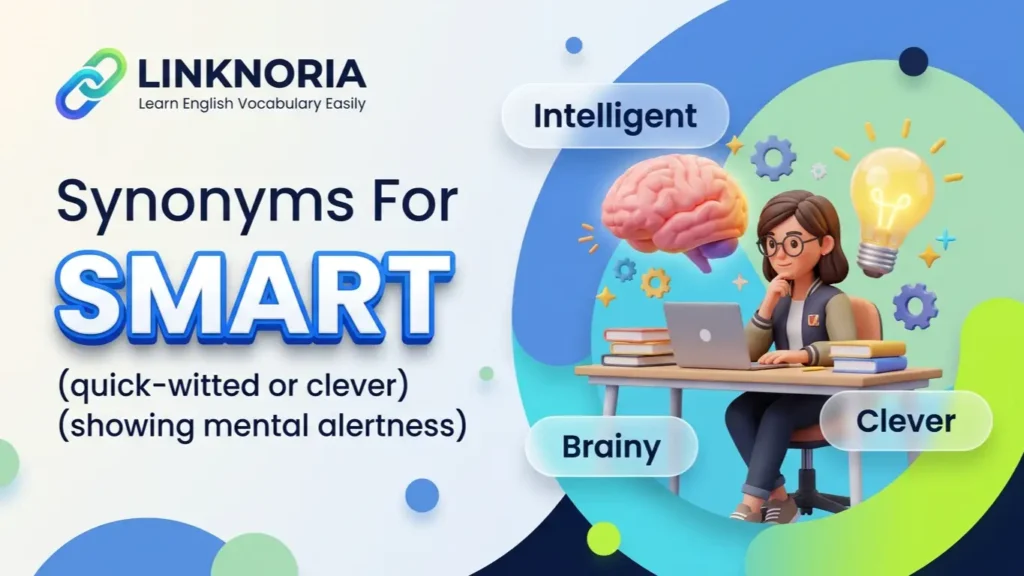
Common synonyms for smart include intelligent, clever, bright, brilliant, sharp, astute, wise, brainy, quick-witted, and perceptive. Some describe natural intelligence, while others highlight good judgment, knowledge, creativity, or practical skills.
- Intelligent: The intelligent student understood the difficult lesson quickly.
- Resourceful: She found a resourceful way to fix the broken chair with the tools available.
Table of 32 Synonyms for Smart
| No. | Synonym | Part of Speech | Simple Meaning |
|---|---|---|---|
| 1 | Intelligent | Adjective | Able to learn and understand well |
| 2 | Clever | Adjective | Quick at thinking and solving problems |
| 3 | Bright | Adjective | Quick to learn and understand |
| 4 | Brilliant | Adjective | Exceptionally intelligent or talented |
| 5 | Sharp | Adjective | Quick to notice and understand |
| 6 | Astute | Adjective | Good at judging situations accurately |
| 7 | Wise | Adjective | Showing good judgment and experience |
| 8 | Brainy | Adjective | Very intelligent |
| 9 | Quick-witted | Adjective | Able to think and reply quickly |
| 10 | Perceptive | Adjective | Quick to notice important details |
| 11 | Insightful | Adjective | Showing deep understanding |
| 12 | Shrewd | Adjective | Good at practical judgment |
| 13 | Knowledgeable | Adjective | Knowing a lot about a subject |
| 14 | Gifted | Adjective | Naturally able in a particular area |
| 15 | Talented | Adjective | Having a natural or developed skill |
| 16 | Ingenious | Adjective | Clever at creating solutions |
| 17 | Inventive | Adjective | Good at creating new ideas |
| 18 | Resourceful | Adjective | Good at solving problems with available means |
| 19 | Savvy | Adjective | Practical and well-informed |
| 20 | Sensible | Adjective | Showing sound, practical judgment |
| 21 | Alert | Adjective | Quick to notice changes or danger |
| 22 | Discerning | Adjective | Good at recognizing quality or differences |
| 23 | Intellectual | Adjective | Interested in ideas and careful thinking |
| 24 | Analytical | Adjective | Good at examining information logically |
| 25 | Logical | Adjective | Using clear and reasonable thinking |
| 26 | Rational | Adjective | Based on reason rather than emotion |
| 27 | Erudite | Adjective | Having extensive knowledge from study |
| 28 | Adept | Adjective | Highly skilled at doing something |
| 29 | Capable | Adjective | Able to do something well |
| 30 | Skillful | Adjective | Showing ability and control |
| 31 | Streetwise | Adjective | Skilled at handling real-life situations |
| 32 | Well-informed | Adjective | Having useful and accurate information |
Detailed Synonyms for Smart
1. Intelligent
Meaning: Intelligent describes someone who learns, understands, and solves problems well.
Examples:
- The intelligent student explained the science experiment clearly.
- An intelligent approach helped the team solve the problem.
2. Clever
Meaning: Clever describes someone who finds quick or original ways to solve problems.
Examples:
- Mia found a clever way to organize her crowded desk.
- His clever answer made the class laugh.
Usage Note: Clever can describe people, ideas, jokes, or solutions.
3. Bright
Meaning: Bright describes someone who learns and understands things quickly.
Examples:
- The bright child learned to read at an early age.
- Our new colleague is bright and eager to learn.
Usage Note: When describing intelligence, bright is informal and positive.
4. Brilliant
Meaning: Brilliant describes someone or something showing exceptional intelligence or ability.
Examples:
- The scientist developed a brilliant solution to the problem.
- Her brilliant performance impressed the judges.
Usage Note: People also use brilliant to mean excellent or wonderful.
5. Sharp
Meaning: Sharp describes someone who notices details and understands things quickly.
Examples:
- The sharp detective noticed a small clue near the door.
- You need a sharp mind to solve this puzzle.
Usage Note: Sharp can also describe physical edges, sounds, or sudden changes.
6. Astute
Meaning: Astute describes someone who understands situations and makes accurate judgments.
Examples:
- The astute manager noticed the mistake before the meeting.
- Her astute observation helped us understand the issue.
Usage Note: This word often suits business, planning, and decision-making.
7. Wise
Meaning: Wise describes someone who uses experience and good judgment to make decisions.
Examples:
- My grandfather gave me wise advice about saving money.
- It was wise to check the weather before leaving.
Usage Note: Wise focuses more on judgment than on quick learning.
8. Brainy
Meaning: Brainy describes someone who is very intelligent.
Examples:
- The brainy student enjoys solving difficult math problems.
- Everyone asks our brainy friend for help with science.
Usage Note: Brainy sounds casual and can feel playful.
9. Quick-Witted
Meaning: Quick-witted describes someone who thinks and responds quickly.
Examples:
- Her quick-witted reply saved the conversation from an awkward silence.
- The quick-witted host answered every unexpected question.
Usage Note: This word often describes fast thinking during conversations.
10. Perceptive
Meaning: Perceptive describes someone who notices details or feelings that others miss.
Examples:
- The perceptive teacher noticed that a student felt worried.
- His perceptive comments helped us see the problem differently.
11. Insightful
Meaning: Insightful describes someone who shows a deep understanding of an issue.
Examples:
- She shared an insightful point during the discussion.
- The book offers insightful advice about building good habits.
Usage Note: Insightful often describes comments, ideas, reviews, and observations.
12. Shrewd
Meaning: Shrewd describes someone who makes clever and practical judgments.
Examples:
- The shrewd buyer compared prices before choosing a phone.
- Her shrewd decision helped the small business save money.
Usage Note: Shrewd often relates to money, business, and practical choices. It can sometimes suggest that someone is calculating.
13. Knowledgeable
Meaning: Knowledgeable describes someone who knows a lot about a particular subject.
Examples:
- The knowledgeable guide explained the museum’s history.
- Ask a knowledgeable mechanic to check the engine.
Usage Note: Knowledge comes from learning or experience, so it is not exactly the same as intelligence.
14. Gifted
Meaning: Gifted describes someone with unusual natural ability in a particular area.
Examples:
- The gifted musician played the difficult piece beautifully.
- A gifted student can still benefit from regular practice.
Usage Note: People often use gifted for academic, artistic, musical, or athletic abilities.
15. Talented
Meaning: Talented describes someone who has a strong ability to do something well.
Examples:
- The talented artist painted a beautiful landscape.
- Our talented teammate scored the winning goal.
Usage Note: Talent can grow through practice and experience.
16. Ingenious
Meaning: Ingenious describes someone who creates clever and effective solutions.
Examples:
- He designed an ingenious holder for his bicycle tools.
- The engineers found an ingenious way to save water.
Usage Note: Use ingenious for creative ideas, designs, and problem-solving.
17. Inventive
Meaning: Inventive describes someone who often develops fresh ideas or methods.
Examples:
- The inventive chef created a new dish from simple ingredients.
- Her inventive approach made the school project stand out.
Usage Note: Inventive emphasizes creating something new.
18. Resourceful
Meaning: Resourceful describes someone who solves problems using what is available.
Examples:
- The resourceful camper used a spare cloth to repair the tent.
- A resourceful employee found a way to finish the task without extra supplies.
19. Savvy
Meaning: Savvy describes someone who has practical knowledge and understands how things work.
Examples:
- She is tech-savvy and can set up new software quickly.
- The savvy shopper checks reviews before buying a product.
Usage Note: Savvy often appears in phrases such as tech-savvy, business-savvy, and money-savvy.
20. Sensible
Meaning: Sensible describes someone who makes practical and reasonable decisions.
Examples:
- Wearing a coat was a sensible choice on the cold morning.
- The sensible student finished her homework before playing games.
Usage Note: Sensible focuses on sound judgment rather than high intelligence.
21. Alert
Meaning: Alert describes someone who notices what is happening around them.
Examples:
- The alert driver spotted the child near the road.
- Stay alert when crossing a busy street.
Usage Note: Alert can describe a temporary state of attention, not just a person’s usual ability.
22. Discerning
Meaning: Discerning describes someone who can recognize important differences and judge quality well.
Examples:
- The discerning reader noticed the weak argument in the article.
- A discerning customer can tell the difference between quality materials and cheap ones.
23. Intellectual
Meaning: Intellectual describes someone who enjoys ideas, learning, and careful thought.
Examples:
- The intellectual discussion covered history, science, and ethics.
- He enjoys intellectual challenges that make him question his ideas.
Usage Note: This word often describes interests, activities, or a person’s approach to ideas.
24. Analytical
Meaning: Analytical describes someone who examines information carefully to understand a problem.
Examples:
- Her analytical skills helped the team understand the survey results.
- An analytical reader checks the evidence before accepting a claim.
25. Logical
Meaning: Logical describes thinking that follows clear and reasonable steps.
Examples:
- His logical explanation helped us understand the answer.
- Use a logical order when presenting your main points.
26. Rational
Meaning: Rational describes someone who uses reason and evidence to make decisions.
Examples:
- She made a rational choice after comparing the costs.
- A rational discussion helped both sides find common ground.
Usage Note: Rational focuses on reason, while wise also considers experience and long-term effects.
27. Erudite
Meaning: Erudite describes someone who has extensive knowledge gained through study.
Examples:
- The erudite professor answered questions about ancient history.
- Her erudite essay showed a deep knowledge of literature.
Usage Note: This is a formal word, most often used in academic or literary settings.
28. Adept
Meaning: Adept describes someone who is highly skilled at a particular activity.
Examples:
- He is adept at explaining difficult topics in simple words.
- The adept designer created a clear and useful website.
Usage Note: Use adept at followed by a noun or an -ing verb, as in “adept at coding.”
29. Capable
Meaning: Capable describes someone who has the ability to do something successfully.
Examples:
- The capable assistant handled the schedule without help.
- She is capable of learning the new system quickly.
Usage Note: Capable means able to do something well, not necessarily exceptionally intelligent.
30. Skillful
Meaning: Skillful describes someone who performs an activity with ability and control.
Examples:
- The skillful carpenter made a sturdy wooden table.
- A skillful speaker keeps the audience interested.
Usage Note: Use skillful for abilities developed through practice, training, or experience.
31. Streetwise
Meaning: Streetwise describes someone who understands real-life situations and avoids common risks.
Examples:
- The streetwise teenager knew how to avoid unsafe situations.
- Her streetwise approach helped her handle the busy city.
Usage Note: Streetwise refers to practical awareness, not academic intelligence.
32. Well-Informed
Meaning: Well-informed describes someone who has accurate and useful information about a subject.
Examples:
- The well-informed voter researched the candidates before election day.
- A well-informed customer can compare the available options.
Usage Note: Being well-informed means having knowledge; it does not automatically mean someone has excellent judgment.
Antonyms of Smart
The best antonym depends on which meaning of smart you intend.
- Unintelligent: Not showing much ability to understand.
- Foolish: Showing poor judgment.
- Unwise: Not showing good judgment.
- Dull: Slow to understand or notice.
- Ignorant: Lacking knowledge about something.
- Unaware: Not knowing what is happening.
- Naive: Lacking experience or understanding.
- Unskilled: Lacking the ability to do something well.
When to Use Which Synonym
| Synonym | Best Used When | Example Situation |
|---|---|---|
| Intelligent | Describing learning ability | A student understands a hard lesson |
| Clever | Describing a quick solution | Finding a shortcut |
| Brilliant | Praising exceptional ability | Solving a complex problem |
| Astute | Describing accurate judgment | Spotting a business risk |
| Wise | Describing sound decisions | Giving thoughtful advice |
| Quick-witted | Describing fast replies | Handling a surprise question |
| Resourceful | Describing practical problem-solving | Fixing something with limited tools |
| Savvy | Describing practical knowledge | Choosing safe technology |
| Analytical | Describing careful examination | Reviewing survey results |
| Discerning | Describing good judgment of quality | Choosing a reliable product |
| Adept | Describing strong skill | Using software well |
| Streetwise | Describing real-world awareness | Staying safe in a city |
Affixation Pattern
| Element | Form |
|---|---|
| Root | Smart |
| Prefix | None |
| Suffix | -er, -est, -ly, -ness |
Meaning and origin: Smart has roots in older English words linked to sharpness and pain. Over time, it gained the meaning of being quick in mind or clever. Adding -er gives smarter, -est gives smartest, -ly forms smartly, and -ness forms smartness.
Word Formation
Common existing forms of smart include:
- Smart: The basic adjective.
- Smarter: The comparative form.
- Smartest: The superlative form.
- Smartly: An adverb that can mean cleverly or neatly.
- Smartness: A noun referring to intelligence, neatness, or stylishness.
US pronunciation: /smɑːrt/
UK pronunciation: /smɑːt/
Number of syllables: One
Prototype Meaning
When people hear smart, they often picture someone who understands things quickly, solves problems, or makes good decisions. The word can also describe someone who dresses neatly or a device that uses advanced technology. Its meaning depends on the context. Calling someone smart does not mean they know everything, never make mistakes, or have equal skill in every subject. Intelligence, knowledge, judgment, and practical skill are related but different qualities.
Prototype Categorization
These categories help you choose a synonym that matches the kind of intelligence or ability you want to describe.
1. General Intelligence
Intelligent, clever, bright, brilliant, brainy
2. Quick Thinking and Awareness
Sharp, quick-witted, perceptive, alert, insightful
3. Judgment and Practical Sense
Astute, wise, shrewd, sensible, discerning, rational
4. Creativity and Problem-Solving
Ingenious, inventive, resourceful, analytical, logical
5. Knowledge and Learning
Knowledgeable, intellectual, erudite, well-informed
6. Skill, Ability, and Experience
Gifted, talented, savvy, adept, capable, skillful, streetwise, confident
Common Usage Mistakes
- Treating every synonym as identical: Intelligent relates to understanding, while knowledgeable means knowing a lot about a subject.
- Confusing smart with wise: A smart person may solve a problem quickly; a wise person considers experience and consequences.
- Using brilliant for every small success: Brilliant often suggests an exceptional idea, performance, or ability.
- Using clever when you mean knowledgeable: Clever highlights quick thinking, not simply having facts.
- Calling someone smart only because they earn high grades: Intelligence can appear in practical, creative, and social problem-solving too.
- Confusing savvy with academic intelligence: Savvy usually means practical understanding of a subject or situation.
- Using adept without “at” or “in” correctly: “She is adept at coding” is a natural construction.
- Confusing smart technology with an intelligent person: In technology, smart often means that a device uses digital features or automatic functions.
- Using “very intelligent” in every sentence: Try highly intelligent, exceptionally bright, or brilliant when the meaning fits.
FAQ
What are fancy words for smart?
Fancy alternatives include astute, erudite, discerning, perceptive, and intellectually gifted. Use erudite for extensive learning and astute for sharp judgment.
What is a better word for clever?
Ingenious suits an original solution, while quick-witted describes fast thinking in conversation. Astute works well when someone makes a sharp judgment.
What is a smart word for better?
The best choice depends on the sentence. You might use superior for higher quality, improved for something made better, or more effective for something that works better.
What to say instead of “very intelligent”?
Try highly intelligent, exceptionally bright, brilliant, gifted, or profoundly knowledgeable. Choose gifted for a special ability and knowledgeable for strong knowledge of a subject.
What are synonyms for a smart person?
You can describe a smart person as intelligent, bright, clever, brainy, astute, or quick-witted. Choose the word that best matches the person’s strengths.
What are synonyms for smart that start with A or D?
Words starting with A include astute, analytical, adept, and acute. A useful word starting with D is discerning, which describes someone who judges differences well.
What are synonyms for smart that start with S?
Useful options include sharp, shrewd, savvy, sensible, skillful, and streetwise. Their meanings differ: sharp suggests quick understanding, while savvy suggests practical knowledge.
What does smart mean in smart technology?
In technology, smart often describes a device with digital features, connectivity, or automatic functions. A smart watch, for example, can track activity and connect to a phone.
Topic Quiz
1. Which word best describes someone who understands things quickly?
A. Intelligent
B. Unaware
C. Unskilled
D. Naive
2. Which synonym for smart starts with A and describes good judgment?
A. Alert
B. Astute
C. Adept
D. Audacious
3. Which word best describes someone with practical knowledge of technology?
A. Erudite
B. Dull
C. Tech-savvy
D. Foolish
4. Which word is an antonym of smart when it means intelligent?
A. Brilliant
B. Clever
C. Bright
D. Unintelligent
5. Which word describes someone who creates clever and effective solutions?
A. Ingenious
B. Ignorant
C. Timid
D. Unaware
Answer Key
- (A)
- (B)
- (C)
- (D)
- (A)
Conclusion
The best synonym depends on the quality you want to describe. Intelligent highlights understanding, clever suggests quick problem-solving, wise focuses on good judgment, and resourceful describes making the most of what you have.
Start with a few alternatives and practice using them in your own sentences. With regular reading and writing, you can build a stronger vocabulary and express your ideas more clearly.
Explore more simple-English vocabulary guides on LinkNoria.com whenever you want to learn new words.

Mustansar Abbas is the author and founder of Linknoria.com, where he writes practical, well-researched guides on technology, productivity, and digital tools to help readers make smarter, more informed decisions.