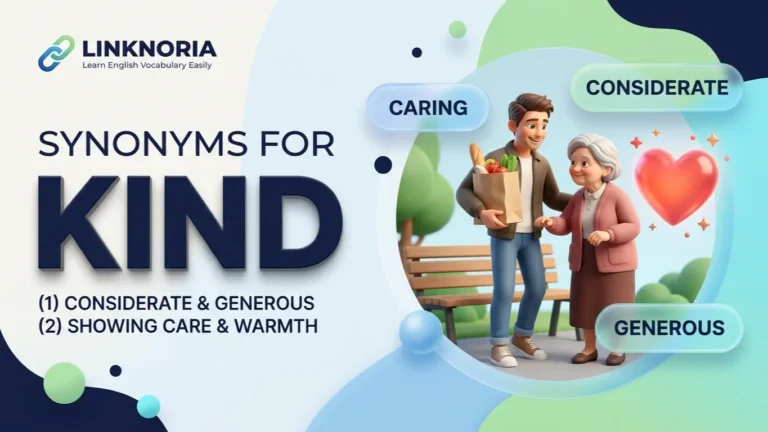
Kind means caring about other people, treating them well, and showing concern for their feelings or needs. Common synonyms for kind include caring, thoughtful, considerate, compassionate, gentle, generous, friendly, and benevolent. However, these words have slightly different meanings. For example, generous focuses on giving, while compassionate focuses on understanding another person’s pain.
This article explains the meaning of kind and presents 30 useful synonyms with simple definitions and example sentences. You will also learn when to use each word, how to avoid common mistakes, and which alternatives work best in everyday conversation, schoolwork, and formal writing.
What Does Kind Mean?
Kind is an adjective that describes someone who is caring, helpful, considerate, and thoughtful toward others. A kind person tries to make people feel respected, supported, and valued.
For example:
- She is kind to everyone in her class.
- The kind neighbor helped us carry our groceries.
- It was kind of him to visit his sick friend.
Kind can describe a person, an action, a comment, or a gesture. It does not always mean giving money or doing something big. Listening carefully, speaking politely, offering help, and respecting someone’s feelings can all be kind actions.
30 Synonyms for Kind
The following words are useful alternatives to kind. Some are close synonyms, while others describe a particular type of kindness. Choose the word that best fits the meaning you want to express.
1. Caring
Meaning: Showing concern for another person’s happiness, comfort, or well-being.
Caring is a close synonym for kind when you want to emphasize emotional concern and support.
Examples:
- She is a caring teacher who listens to every student.
- His caring nature makes people feel safe and understood.
2. Thoughtful
Meaning: Showing that you have considered another person’s feelings, needs, or preferences.
Use thoughtful when someone does something considerate, often without being asked.
Examples:
- It was thoughtful of you to remember my birthday.
- He left a thoughtful note to cheer up his friend.
3. Considerate
Meaning: Careful not to upset, inconvenience, or hurt other people.
Considerate is especially useful when kindness involves respecting other people’s time, feelings, or needs.
Examples:
- Our considerate neighbor keeps the noise down at night.
- It was considerate of her to ask before borrowing my book.
4. Compassionate
Meaning: Showing sympathy and concern for people who are suffering or facing difficulties.
Use compassionate when kindness comes from understanding another person’s pain.
Examples:
- The compassionate nurse comforted the frightened child.
- He gave a compassionate response to his friend’s problems.
5. Gentle
Meaning: Mild, calm, and careful in the way someone acts or speaks.
Gentle describes kindness that avoids harshness, force, or unnecessary pain.
Examples:
- She spoke in a gentle voice to calm the baby.
- The gentle teacher corrected the mistake without embarrassing the student.
6. Generous
Meaning: Willing to give time, money, help, or other things to benefit others.
Generous is a good alternative when kindness involves giving or sharing.
Examples:
- Our generous neighbor donated food to the family.
- He was generous with his time and helped us prepare for the event.
7. Friendly
Meaning: Acting in a pleasant, welcoming, and approachable way toward others.
Use friendly when kindness is expressed through warm behavior and social interaction.
Examples:
- The friendly receptionist welcomed every visitor with a smile.
- My new classmates were friendly and made me feel included.
8. Benevolent
Meaning: Wanting to do good and help other people.
Benevolent is more formal than kind and often describes people, leaders, organizations, or actions intended to benefit others.
Examples:
- The benevolent donor supported several local schools.
- Her benevolent leadership focused on helping the community.
9. Warmhearted
Meaning: Having a warm, caring, and affectionate nature.
Use warmhearted when you want to emphasize genuine affection and emotional warmth.
Examples:
- Our warmhearted aunt always makes visitors feel welcome.
- He is a warmhearted person who cares deeply about his friends.
10. Good-hearted
Meaning: Naturally kind, caring, and well-intentioned.
Good-hearted is an informal, positive way to describe someone’s character.
Examples:
- The good-hearted man helped the lost child find her parents.
- She is good-hearted and often volunteers to help others.
11. Helpful
Meaning: Willing or able to make a task easier or solve a problem for someone.
Helpful is appropriate when kindness takes the form of practical assistance.
Examples:
- The helpful student explained the homework to his classmate.
- It was helpful of you to carry those heavy bags.
12. Supportive
Meaning: Giving encouragement, reassurance, or practical help to someone.
Use supportive when kindness involves standing by a person during a challenge.
Examples:
- Her supportive family encouraged her to follow her dreams.
- My friend was supportive when I faced a difficult decision.
13. Sympathetic
Meaning: Showing understanding and concern for someone else’s problems or feelings.
Sympathetic often describes a response to another person’s sadness or difficulty.
Examples:
- The teacher was sympathetic when I explained my situation.
- She gave her friend a sympathetic smile after hearing the news.
14. Empathetic
Meaning: Able to understand or imagine how another person feels.
Empathetic emphasizes understanding someone’s feelings, while sympathetic emphasizes concern for their situation.
Examples:
- An empathetic listener tries to understand both sides of a problem.
- He was empathetic toward his colleague during a stressful week.
15. Charitable
Meaning: Willing to give help, money, or support to people in need.
Charitable is particularly suitable when kindness involves donations, community service, or helping disadvantaged people.
Examples:
- The charitable organization provided meals to families in need.
- She made a charitable donation to support the shelter.
16. Gracious
Meaning: Courteous, pleasant, and considerate, especially when dealing with other people.
Use gracious when kindness is shown through polite behavior, generosity of spirit, or a warm response.
Examples:
- Our host gave us a gracious welcome.
- She was gracious in accepting the award and thanked everyone who helped her.
17. Courteous
Meaning: Polite and respectful toward others.
Courteous focuses more on manners and respectful behavior than on deep emotional concern.
Examples:
- The courteous employee answered every question patiently.
- He remained courteous even during a disagreement.
18. Amiable
Meaning: Friendly, pleasant, and easy to get along with.
Amiable is useful when describing someone’s agreeable personality or manner.
Examples:
- Her amiable personality helped her make friends quickly.
- The amiable shopkeeper greeted regular customers warmly.
19. Affectionate
Meaning: Showing love, fondness, or tenderness toward someone.
Use affectionate when kindness includes an open expression of love or emotional closeness.
Examples:
- The affectionate grandfather hugged his grandchildren.
- She sent an affectionate message to her sister.
20. Tender
Meaning: Gentle, loving, and sensitive in the way someone treats another person.
Tender often describes emotional care or gentle affection.
Examples:
- He gave his frightened daughter a tender hug.
- She spoke with tender concern about her elderly neighbor.
21. Patient
Meaning: Able to remain calm and understanding when something takes time or becomes difficult.
Patient describes a particular form of kindness: giving others time instead of becoming irritated.
Examples:
- The patient tutor explained the lesson again.
- She was patient with her younger brother as he learned to read.
22. Understanding
Meaning: Willing to recognize and accept another person’s feelings, difficulties, or point of view.
Use understanding when kindness involves listening without rushing to judge.
Examples:
- My manager was understanding when I explained the delay.
- An understanding friend listens before offering advice.
23. Altruistic
Meaning: Concerned with helping others, sometimes without expecting anything in return.
Altruistic is more formal and emphasizes putting other people’s welfare ahead of personal gain.
Examples:
- Her altruistic work helped many families in the area.
- He made an altruistic decision to donate his prize money.
24. Humane
Meaning: Showing compassion and concern for people’s dignity and welfare.
Humane is often used when discussing the fair, compassionate treatment of people or animals.
Examples:
- The shelter follows humane practices when caring for animals.
- The committee supported a humane approach to the problem.
25. Merciful
Meaning: Showing compassion by choosing not to punish or harm someone as severely as possible.
Merciful is not a general substitute for kind. It is most suitable when forgiveness, punishment, or relief from suffering is involved.
Examples:
- The judge took a merciful approach after considering the circumstances.
- The coach was merciful and gave the exhausted team a longer break.
26. Lenient
Meaning: Not as strict or severe as someone could be, especially when enforcing rules or giving punishment.
Lenient can suggest kindness, but it mainly describes how strictly someone applies rules.
Examples:
- The teacher was lenient about the deadline because of the storm.
- The manager gave a lenient warning for a first mistake.
27. Obliging
Meaning: Willing to help or do something requested by another person.
Obliging is often used in polite or formal descriptions of helpful behavior.
Examples:
- The obliging assistant helped us find the correct form.
- Our obliging host arranged transportation for the guests.
28. Neighborly
Meaning: Friendly, helpful, and considerate toward people who live nearby or belong to one’s community.
Use neighborly for practical kindness and goodwill between neighbors.
Examples:
- It was neighborly of them to bring us a meal after our move.
- The residents showed neighborly support during the power outage.
29. Tactful
Meaning: Careful about what you say or do so that you do not unnecessarily upset or embarrass someone.
Tactful describes kindness expressed through sensitive communication, especially in difficult situations.
Examples:
- She gave tactful feedback without hurting his feelings.
- He was tactful when discussing the team’s mistakes.
30. Nurturing
Meaning: Providing care, encouragement, and support that help someone grow or develop.
Nurturing is especially useful for describing parents, teachers, caregivers, and supportive environments.
Examples:
- The nurturing teacher helped her students build confidence.
- He created a nurturing home where everyone felt supported.
Quick Comparison: Kind vs. Similar Words
Not every synonym works in every sentence. This table highlights the main differences.
| Word | Main focus | Best used when |
|---|---|---|
| Kind | General care and good treatment | Describing a caring action or person |
| Nice | Pleasant behavior | Everyday conversation |
| Caring | Concern for well-being | Describing emotional support |
| Considerate | Respect for others’ needs | Describing thoughtful behavior |
| Compassionate | Concern for suffering | Describing support during hardship |
| Generous | Giving or sharing | Describing gifts, time, or resources |
| Gentle | Mild and careful treatment | Describing tone or manner |
| Friendly | Warm social behavior | Describing welcoming interactions |
| Helpful | Practical assistance | Describing someone who makes a task easier |
| Benevolent | Goodwill and desire to do good | Formal writing about people or actions |
Different Types of Kindness
Kindness can appear in several forms. Understanding these categories helps you choose a more precise word.
Emotional kindness
Emotional kindness means caring about how another person feels and offering comfort or understanding.
Useful words: caring, compassionate, empathetic, sympathetic, understanding, warmhearted.
Example: Her compassionate response helped her friend feel less alone.
Practical kindness
Practical kindness means taking action to make someone’s life easier.
Useful words: helpful, considerate, obliging, generous, supportive, neighborly.
Example: Our helpful neighbor carried the groceries inside.
Gentle kindness
Gentle kindness involves patience, tenderness, and avoiding unnecessary harshness.
Useful words: gentle, tender, patient, affectionate, nurturing.
Example: The patient teacher gave each student time to learn.
Social kindness
Social kindness involves making people feel welcome and treating them with respect.
Useful words: friendly, amiable, courteous, gracious, tactful.
Example: The courteous receptionist greeted every visitor respectfully.
Charitable and selfless kindness
This form of kindness involves helping people in need, sometimes without expecting a personal reward.
Useful words: charitable, altruistic, benevolent, humane.
Example: The altruistic volunteer spent weekends helping families in need.
Kindness involving rules or forgiveness
Sometimes kindness means being less severe or showing mercy when someone makes a mistake.
Useful words: merciful, lenient.
Example: The teacher was lenient about the deadline after learning why the student was late.
These words are more specific than kind, so use them only when the situation fits.
Word Forms of Kind
Learning related word forms can help you use kind correctly in different sentences.
| Word form | Part of speech | Meaning | Example |
|---|---|---|---|
| Kind | Adjective | Caring and considerate | She is kind to new students. |
| Kindly | Adverb | In a kind manner | He spoke kindly to the child. |
| Kindness | Noun | The quality or act of being kind | Her kindness made a difference. |
| Unkind | Adjective | Not kind; hurtful or inconsiderate | That comment was unkind. |
| Unkindly | Adverb | In an unkind manner | He responded unkindly. |
Important: Kindly can also be used as an adjective in certain expressions, such as “a kindly old man.” It does not always replace kind in the same sentence.
For example:
- Correct: She kindly helped me with my work.
- Correct: She is a kind person.
- Incorrect: She is a kindly person who always helps me.
- Better: She is a kind person who always helps me.
The last sentence is not necessarily impossible in every context, but kind person is the more natural choice for most everyday writing.
Word Origin of Kind and Kindness
The adjective kind has roots in Old English gecynde, a word associated with nature, origin, or what is natural. Over time, the word developed the familiar sense of being caring or considerate.
The noun kindness is formed from kind and the suffix -ness. This suffix turns an adjective into a noun that describes a quality or state.
For example:
- Kind + -ness = kindness
- Dark + -ness = darkness
- Happy + -ness = happiness
Although kind can also mean a type or category, as in “What kind of book do you like?”, that meaning is different from the adjective meaning caring or considerate.
Common Mistakes When Using Synonyms for Kind
Choosing a synonym based only on a similar dictionary meaning can make a sentence sound unnatural. These common mistakes can help you avoid that problem.
1. Using generous when you mean considerate
Generous usually emphasizes giving, while considerate emphasizes thinking about another person’s needs.
- Less precise: It was generous of him to lower his voice in the library.
- Better: It was considerate of him to lower his voice in the library.
2. Using lenient for every kind action
Lenient is mainly used for rules, discipline, or punishment.
- Less precise: She was lenient when she comforted her sad friend.
- Better: She was compassionate when she comforted her sad friend.
3. Confusing sympathetic with empathetic
A sympathetic person shows concern for someone else’s difficulties. An empathetic person tries to understand how that person feels.
- Sympathetic: I was sympathetic when my friend lost his job.
- Empathetic: I could empathize with my friend because I had faced a similar loss.
Both words can be positive, but they emphasize different things.
4. Treating friendly and kind as identical
A friendly person is pleasant and welcoming. A kind person shows care or concern through words or actions. Someone can be friendly without offering meaningful help, and someone can be kind while remaining quiet or reserved.
5. Using kindly instead of kindness
Kindly is commonly an adverb, while kindness is a noun.
- Correct: She spoke kindly to the visitor.
- Correct: Her kindness impressed the visitor.
- Incorrect: Her kindly impressed the visitor.
6. Using benevolent in casual conversation
Benevolent is correct but more formal than kind. In everyday conversation, “She is a kind person” usually sounds more natural than “She is a benevolent person.”
Frequently Asked Questions
What are the best synonyms for kind?
The best general synonyms are caring, thoughtful, considerate, compassionate, gentle, generous, friendly, and helpful. The right choice depends on the situation. Use considerate for respect, generous for giving, and compassionate for concern about suffering.
What is another word for a kind person?
You can describe a kind person as caring, warmhearted, good-hearted, compassionate, thoughtful, or generous. Use warmhearted for someone who shows affection, thoughtful for someone who considers other people’s needs, and generous for someone willing to give or share.
What is a formal synonym for kind?
Formal alternatives include benevolent, compassionate, humane, altruistic, and gracious. These words are not interchangeable in every sentence. Benevolent emphasizes goodwill, altruistic emphasizes helping others without expecting personal gain, and humane emphasizes compassionate treatment.
What is a simple synonym for kind for students?
Simple alternatives include nice, caring, helpful, friendly, gentle, and thoughtful. These words are easy to understand, but their meanings differ slightly. For example, helpful describes someone who offers assistance, while gentle describes someone who acts or speaks in a mild way.
Are nice and kind the same?
They are similar, but not exactly the same. Nice often describes someone who is pleasant or agreeable. Kind more strongly suggests care, consideration, or helpful behavior. A person can be nice to talk to, while a kind person might go out of their way to help someone in need.
What is the noun form of kind?
The noun form is kindness. It refers to the quality or act of being caring and considerate. For example, “Her kindness helped the new student feel welcome.” The word kindly is generally an adverb, although it can also describe a person’s gentle or benevolent manner.
What is the opposite of kind?
Common opposites of kind include unkind, cruel, mean, harsh, inconsiderate, and heartless. The best antonym depends on the context. Inconsiderate means failing to think about other people’s needs, while cruel suggests causing pain or suffering without concern.
Quiz: Test Your Understanding
Choose the best word for each sentence.
1. She remembered his favorite snack and brought it to him. Her action was ______.
A. lenient
B. thoughtful
C. cruel
D. harsh
2. The volunteer gave food and money to families in need. He was ______.
A. generous
B. tactful
C. strict
D. impatient
3. The nurse understood how frightened the patient felt and comforted her. The nurse was ______.
A. lenient
B. compassionate
C. careless
D. severe
4. He lowered the music because his neighbors were sleeping. He was ______.
A. considerate
B. merciful
C. charitable
D. affectionate
5. The teacher calmly explained the same lesson several times. She was ______.
A. patient
B. harsh
C. unkind
D. selfish
6. The manager discussed a sensitive mistake without embarrassing the employee. The manager was ______.
A. tactful
B. generous
C. tender
D. lenient
7. Which word is most suitable for someone who treats people politely and respectfully?
A. Courteous
B. Altruistic
C. Merciful
D. Nurturing
8. Which word mainly describes someone who is less strict about rules or punishment?
A. Empathetic
B. Lenient
C. Amiable
D. Warmhearted
9. What is the noun form of kind?
A. Kindly
B. Kinder
C. Kindness
D. Unkindly
10. Which word best describes someone who tries to understand another person’s feelings?
A. Empathetic
B. Charitable
C. Courteous
D. Obliging
Quiz Answer Key
- B — Thoughtful
- A — Generous
- B — Compassionate
- A — Considerate
- A — Patient
- A — Tactful
- A — Courteous
- B — Lenient
- C — Kindness
- A — Empathetic
Conclusion
There are many useful synonyms for kind, including caring, thoughtful, considerate, compassionate, gentle, generous, friendly, and helpful. Each word describes a different part of kindness. Some focus on emotional support, while others emphasize practical help, polite behavior, patience, or generosity.
To choose the right synonym, think about what the person actually does. Use thoughtful for remembering someone’s needs, considerate for respecting others, compassionate for responding to suffering, and generous for giving or sharing. Words such as lenient and merciful are more specific and should be used in situations involving rules, punishment, or forgiveness.
Learning these distinctions will help you write more clearly, avoid repetition, and express your ideas with greater accuracy. The best synonym is not always the most formal or unusual word; it is the one that communicates your intended meaning naturally.

Mustansar Abbas is the author and founder of Linknoria.com, where he writes practical, well-researched guides on technology, productivity, and digital tools to help readers make smarter, more informed decisions.