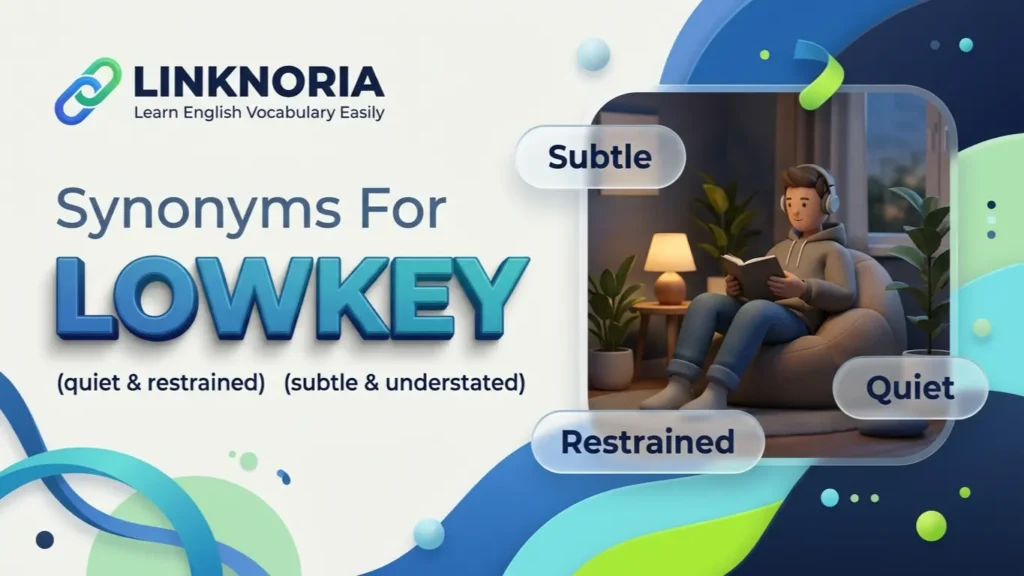
The word lowkey is popular in everyday conversations, texts, and social media. People use it to express feelings without making a big deal, describe something simple, or suggest that they feel something more than they openly admit. For example, “I lowkey love this song” means you like it, perhaps more than you want to show.
However, lowkey can have different meanings depending on the sentence. It may describe an understated event, a private situation, a mild feeling, or a relaxed atmosphere. That is why one synonym cannot replace it in every context.
This article explains the meaning of lowkey and introduces 30 useful synonyms, with pronunciations, simple definitions, and natural examples. You will also learn which alternatives work best in texts, captions, everyday conversations, and formal writing.
Meaning of Lowkey
Definition: Lowkey, also written as low-key or low key, can describe something quiet, understated, or not attracting much attention. In informal slang, it can also mean “slightly,” “kind of,” or “without emphasizing a feeling too strongly.”
Pronunciation:
- US: /ˌloʊˈkiː/
- UK: /ˌləʊˈkiː/
The word has two syllables: low-key.
Examples
- We planned a low-key birthday dinner with close friends.
- I lowkey want to watch that movie again.
- She prefers to keep her personal life low-key.
The first sentence describes a simple event. The second uses lowkey to soften a personal statement. The third means she avoids drawing attention to her private life.
The tone is usually casual and relaxed. Although low-key is also used in standard English, its slang use is especially common in informal conversations and online messages. In formal writing, choose an alternative that communicates the intended meaning more precisely.
30 Synonyms for Lowkey: Understated and Not Showy
These alternatives work when lowkey describes something simple, restrained, quiet, or unlikely to attract attention.
1. Understated (adjective)
US/UK IPA: /ˌʌndərˈsteɪtɪd/
Meaning: Simple and tasteful, without exaggeration.
Example: Her understated dress looked elegant.
2. Subtle (adjective)
US/UK IPA: /ˈsʌtəl/
Meaning: Not obvious or easy to notice.
Example: He made a subtle change to the design.
3. Subdued (adjective)
US: /səbˈduːd/ | UK: /səbˈdjuːd/
Meaning: Quiet or restrained in appearance, sound, or feeling.
Example: The room had subdued lighting.
4. Muted (adjective)
US/UK IPA: /ˈmjuːtɪd/
Meaning: Reduced in strength, brightness, or intensity.
Example: The painting used muted colors.
5. Unassuming (adjective)
US: /ˌʌnəˈsuːmɪŋ/ | UK: /ˌʌnəˈsjuːmɪŋ/
Meaning: Modest and not trying to impress others.
Example: He remained unassuming despite his success.
6. Modest (adjective)
US: /ˈmɑːdɪst/ | UK: /ˈmɒdɪst/
Meaning: Not showy, boastful, or overly large.
Example: They held a modest celebration at home.
7. Low-profile (adjective)
US/UK IPA: /ˌloʊ ˈproʊfaɪl/ (US); /ˌləʊ ˈprəʊfaɪl/ (UK)
Meaning: Avoiding public attention.
Example: The actor maintains a low-profile lifestyle.
8. Downplayed (verb form/adjective)
US/UK IPA: /ˌdaʊnˈpleɪd/
Meaning: Made to seem less important or serious.
Example: She downplayed her role in the project.
9. Restrained (adjective)
US/UK IPA: /rɪˈstreɪnd/
Meaning: Controlled rather than strong or emotional.
Example: His response was restrained and polite.
10. Simple (adjective)
US/UK IPA: /ˈsɪmpəl/
Meaning: Plain, uncomplicated, or without extra decoration.
Example: We planned a simple dinner for two.
11. Quiet (adjective)
US/UK IPA: /ˈkwaɪət/
Meaning: Calm, not loud, or not attracting attention.
Example: She enjoys quiet weekends at home.
12. Unobtrusive (adjective)
US/UK IPA: /ˌʌnəbˈtruːsɪv/
Meaning: Not noticeable or distracting.
Example: The small camera was unobtrusive.
13. Inconspicuous (adjective)
US/UK IPA: /ˌɪnkənˈspɪkjuəs/
Meaning: Not easily seen or noticed.
Example: He chose an inconspicuous seat at the back.
Synonyms for Lowkey Meaning Secret or Private
Use these words when lowkey refers to keeping information, plans, or activities private. They are not exact replacements in every sentence: some suggest secrecy more strongly than lowkey does.
14. Discreet (adjective)
US/UK IPA: /dɪˈskriːt/
Meaning: Careful not to reveal private information or attract attention.
Example: Please be discreet about the surprise.
15. Secretive (adjective)
US/UK IPA: /ˈsiːkrətɪv/
Meaning: Inclined to hide information from others.
Example: He became secretive about his plans.
16. Hush-hush (adjective, informal)
US/UK IPA: /ˌhʌʃˈhʌʃ/
Meaning: Kept very secret.
Example: The new project remained hush-hush.
17. On the down-low (informal expression)
US: /ɑːn ðə ˌdaʊnˈloʊ/ | UK: /ɒn ðə ˌdaʊnˈləʊ/
Meaning: Secretly or without public attention.
Example: They kept their plans on the down-low.
18. Undercover (adjective or adverb)
US: /ˌʌndərˈkʌvər/ | UK: /ˌʌndəˈkʌvə/
Meaning: Acting secretly to hide one’s identity or purpose.
Example: An undercover officer investigated the case.
19. Clandestine (adjective)
US/UK IPA: /klænˈdestɪn/
Meaning: Secret, often because the activity is unauthorized or intended to remain hidden.
Example: The group held clandestine meetings.
20. Confidential (adjective)
US: /ˌkɑːnfɪˈdenʃəl/ | UK: /ˌkɒnfɪˈdenʃəl/
Meaning: Intended to be kept private.
Example: The report contains confidential information.
Usage tip: Discreet usually describes careful behavior, while confidential describes information that should remain private. Undercover normally involves hiding an identity or purpose, so it is not a general synonym for lowkey.
Synonyms for Lowkey Meaning “Kind Of” or “Slightly”
In casual slang, lowkey can soften a statement or suggest that something is true to a limited degree. The following alternatives can express a similar idea, but the best choice depends on the sentence.
21. Somewhat (adverb)
US/UK IPA: /ˈsʌmwʌt/
Meaning: To a moderate degree.
Example: I am somewhat nervous about the interview.
22. Slightly (adverb)
US/UK IPA: /ˈslaɪtli/
Meaning: To a small degree.
Example: The soup is slightly too salty.
23. Kind of (informal adverb phrase)
US/UK IPA: /ˈkaɪnd əv/
Meaning: To some extent; in a way.
Example: I kind of want to stay home tonight.
24. Sort of (informal adverb phrase)
US: /ˈsɔːrt əv/ | UK: /ˈsɔːt əv/
Meaning: To some degree or in a certain way.
Example: I sort of understand what you mean.
25. Mildly (adverb)
US/UK IPA: /ˈmaɪldli/
Meaning: To a small or gentle degree.
Example: She was mildly surprised by the news.
26. A little (adverb phrase)
US/UK IPA: /ə ˈlɪtəl/
Meaning: To a small extent or amount.
Example: I feel a little tired today.
27. Faintly (adverb)
US/UK IPA: /ˈfeɪntli/
Meaning: Weakly or barely.
Example: He smiled faintly at the joke.
28. A touch (informal adverb phrase)
US/UK IPA: /ə ˈtʌtʃ/
Meaning: Slightly; by a small amount.
Example: The room feels a touch cold.
Usage tip: Somewhat, slightly, and mildly suit many neutral or formal sentences. Kind of and sort of sound more conversational. Faintly usually describes something weakly perceived or expressed, so it cannot replace lowkey in every slang sentence.
Synonyms for Lowkey Meaning Relaxed
These alternatives are useful when lowkey describes a relaxed person, an easygoing mood, or a casual event rather than secrecy or a slight degree.
29. Chill (adjective, informal)
US/UK IPA: /tʃɪl/
Meaning: Relaxed, easygoing, or not easily bothered.
Example: We had a chill evening watching movies.
30. Laid-back (adjective)
US/UK IPA: /ˌleɪdˈbæk/
Meaning: Calm, relaxed, and not easily stressed.
Example: Her laid-back personality makes her easy to work with.
Remember: Chill and laid-back describe relaxed people or situations. They do not usually mean “secretly” or “slightly.” For example, “a laid-back person” works naturally, but “I laid-back like this song” does not.
Best Synonyms for Lowkey by Context
The best synonym depends on what you want to express. Use this quick guide to avoid changing the meaning of your sentence.
| What you mean | Useful alternatives | Example |
| Not showy | Understated, subdued, modest | The event was understated. |
| Private or careful | Discreet, confidential | Keep the discussion discreet. |
| Secret | Hush-hush, on the down-low | They kept the news hush-hush. |
| To a small degree | Slightly, somewhat, mildly | I am slightly worried. |
| Casual or relaxed | Chill, laid-back | It was a laid-back weekend. |
| Not easy to notice | Subtle, inconspicuous | She made a subtle adjustment. |
These are contextual alternatives, not interchangeable words. For example, confidential is a better choice for private information, while understated fits a simple design or event. Slightly works when describing degree, but it cannot replace the adjective in “a low-key wedding.”
Examples of Lowkey and Its Synonyms
Compare these sentences to see how a synonym changes the tone or meaning.
- Lowkey: We are having a lowkey birthday party.
- Understated: We are having an understated birthday party.
- Simple: We are having a simple birthday party.
- Lowkey: I love this song.
- Kind of: I kind of love this song.
- Somewhat: I somewhat enjoy this song.
- Lowkey: They kept the news lowkey.
- Discreet: They were discreet about the news.
- On the down-low: They kept the news on the down-low.
- Lowkey: He is a lowkey person.
- Unassuming: He is an unassuming person.
- Laid-back: He is a laid-back person.
Notice that the replacements do not always carry the same feeling. “I somewhat enjoy this song” sounds more neutral and less natural in casual conversation than “I lowkey love this song.” Choose the expression that fits your audience and purpose.
Antonyms of Lowkey
An antonym is a word with an opposite meaning. Since lowkey has several senses, its opposites also depend on the context.
- High-key (informal slang): Openly, strongly, or without hiding a feeling. Example: “I high-key love this song.”
- Flashy: Designed to attract attention. Example: “He wore a flashy jacket.”
- Ostentatious: Showing wealth or importance in an exaggerated way. Example: “The room had ostentatious decorations.”
- Blatant: Very obvious and difficult to ignore. Example: “It was a blatant mistake.”
- Dramatic: Full of strong emotion or attention-grabbing behavior. Example: “She made a dramatic entrance.”
- Showy: Intended to impress or attract attention. Example: “The design was too showy for the occasion.”
- Intense: Strong in feeling, force, or degree. Example: “They had an intense discussion.”
High-key is the closest slang opposite when talking about openly expressing a feeling. Words such as flashy and ostentatious are better opposites when lowkey means understated or not showy.
Common Mistakes When Using Lowkey
Avoid these common mistakes to make your English clearer.
1. Treating every synonym as interchangeable.
“Discreet,” “slightly,” and “chill” have different meanings. Choose one that matches the sentence.
2. Assuming lowkey always means secret.
“I lowkey feel tired” usually softens the statement; it does not necessarily mean the speaker is hiding tiredness from everyone.
3. Using informal slang in every type of writing.
Lowkey is natural in many casual messages. In formal writing, choose a more precise word, such as understated, slightly, or discreet, depending on your meaning.
4. Confusing lowkey with laid-back.
A low-key event may be small or quiet. A laid-back person is relaxed and easygoing. These meanings overlap in some situations but are not identical.
5. Assuming spelling never matters.
Low-key is a common standard spelling, while lowkey is also used, especially in informal slang. Follow the spelling style expected by your publication, school, or workplace.
Frequently Asked Questions About Lowkey Synonyms
What does lowkey mean in texting?
In texting, lowkey often means “kind of,” “slightly,” or “secretly,” depending on context. For example, “I lowkey miss summer” expresses a feeling without emphasizing it too strongly.
What is the best synonym for lowkey?
Understated is a good alternative when describing something simple or not showy. Slightly or kind of works when lowkey softens a statement, while discreet fits situations involving privacy.
What is another word for lowkey in slang?
Common casual alternatives include kind of, sort of, chill, and on the down-low. They have different meanings, so choose the one that fits the sentence.
Is lowkey formal or informal?
Lowkey is common in casual conversation and online slang. The adjective low-key is also used in standard English, including phrases such as “a low-key event.” In formal writing, a more precise alternative may be clearer.
What is the opposite of lowkey?
High-key is a slang opposite when describing a feeling expressed openly or strongly. For something that is not understated, words such as flashy, showy, or ostentatious may fit.
Can I use lowkey in an essay?
You can use low-key as a standard adjective when it fits the topic and the style guide allows it. However, in academic writing, avoid slang uses such as “I lowkey think.” Consider somewhat, slightly, or a direct statement instead.
Is lowkey the same as secretly?
Not always. Lowkey can mean secretly, but it can also mean slightly, understated, or relaxed. In “I lowkey like this song,” the word often softens the feeling rather than stating that the liking is a secret.
Conclusion
Learning synonyms for lowkey helps you express feelings, describe events, and choose words that fit different situations. Alternatives such as understated, subtle, and modest describe things that are not showy. Words such as discreet and confidential relate to privacy, while slightly, somewhat, and kind of express a limited degree. For relaxed people or situations, chill and laid-back may be more suitable.
The most important lesson is that these words are related, but they do not all mean exactly the same thing. Think about the message you want to convey before replacing lowkey with another word. With practice, you can move comfortably between casual slang and clear, polished English in texts, captions, conversations, and formal writing.

Mustansar Abbas is the author and founder of Linknoria.com, where he writes practical, well-researched guides on technology, productivity, and digital tools to help readers make smarter, more informed decisions.