
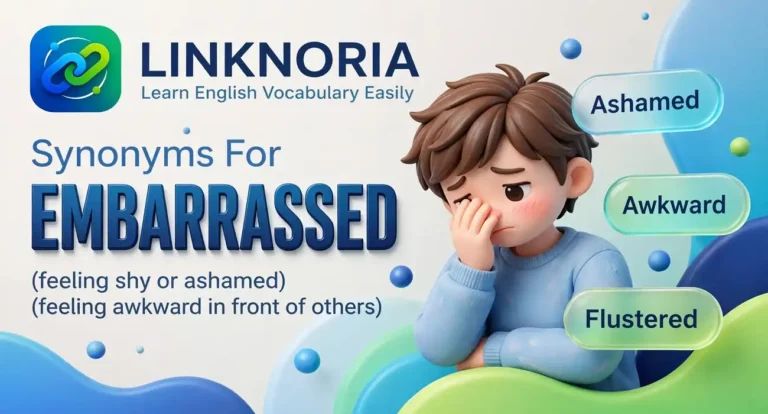
Picture this. You walk into the wrong classroom. Every face turns toward you. Your cheeks burn. Your heart beats fast. You wish the floor would swallow you whole.
We all know this feeling. It shows up at school, at work, and at family dinners. For example, a small mistake can trigger it in seconds. A forgotten name can do the same. Even a tiny slip of the tongue can set it off.
The word embarrassed describes this feeling well. Still, using it again and again makes writing dull. In fact, readers notice repetition fast. Speakers sound flat when they repeat one word.
This guide solves that problem. First, you will learn 30 fresh synonyms for embarrassed. Each one comes with a simple meaning and real examples. You will also see antonyms, common mistakes, and a quick quiz. By the end, you will pick the exact word for every awkward moment.
What Are Synonyms for Embarrassed?
Synonyms for embarrassed include ashamed, awkward, self-conscious, sheepish, flustered, mortified, bashful, abashed, uncomfortable, and humiliated.
She felt awkward when she waved at a stranger by mistake.
He felt mortified when his phone rang loudly during the exam.
Table of 30 Synonyms for Embarrassed
| No. | Synonym | Part of Speech | Simple Meaning |
|---|---|---|---|
| 1 | ashamed | adjective | Feeling guilt or shame |
| 2 | abashed | adjective | Feeling shy after a mistake |
| 3 | humiliated | adjective | Made to feel deeply ashamed |
| 4 | mortified | adjective | Extremely embarrassed or ashamed |
| 5 | sheepish | adjective | Shy after doing something silly |
| 6 | shamefaced | adjective | Showing shame on your face |
| 7 | self-conscious | adjective | Worried about how others see you |
| 8 | awkward | adjective | Uncomfortable in a social situation |
| 9 | uncomfortable | adjective | Not relaxed or at ease |
| 10 | flustered | adjective | Confused and nervous under pressure |
| 11 | disconcerted | adjective | Unsettled by something unexpected |
| 12 | discomfited | adjective | Uneasy and slightly embarrassed |
| 13 | chagrined | adjective | Annoyed by failure or disappointment |
| 14 | red-faced | adjective | Face red from embarrassment |
| 15 | blushing | adjective | Face turning red from shyness |
| 16 | cringing | adjective | Shrinking back from embarrassment |
| 17 | apologetic | adjective | Sorry and wanting to apologise |
| 18 | guilty | adjective | Feeling bad about a mistake |
| 19 | bashful | adjective | Shy around other people |
| 20 | uneasy | adjective | Worried and not calm |
| 21 | rattled | adjective | Shaken and nervous after surprise |
| 22 | fazed | adjective | Bothered or disturbed by something |
| 23 | nonplussed | adjective | So surprised you cannot react |
| 24 | taken aback | adjective | Surprised by something unexpected |
| 25 | confused | adjective | Unable to think clearly |
| 26 | perplexed | adjective | Very puzzled and unsure |
| 27 | distressed | adjective | Upset and worried |
| 28 | dismayed | adjective | Shocked and disappointed |
| 29 | regretful | adjective | Sorry about something past |
| 30 | sorry | adjective | Feeling sad about a mistake |
Detailed Synonyms for Embarrassed
1. Ashamed
Meaning: You feel ashamed when guilt follows a mistake you made.
Examples: I felt ashamed after I lied to my teacher. She felt ashamed when she forgot her mother’s birthday.
2. Abashed
Meaning: You feel abashed when a small mistake leaves you shy and quiet.
Examples: He felt abashed when the class laughed at his answer. I felt abashed after I called the teacher by the wrong name.
Usage Note: Abashed sounds formal and old-fashioned, so use it in writing more than in daily speech.
3. Humiliated
Meaning: You feel humiliated when others see your mistake and you lose pride.
Examples: She felt humiliated when her joke fell flat in front of everyone. He felt humiliated after his boss corrected him in the meeting.
4. Mortified
Meaning: You feel mortified when embarrassment hits you with full force.
Examples: I felt mortified when I tripped on the stage stairs. She felt mortified when her secret diary page appeared on the screen.
Usage Note: Mortified is stronger than embarrassed, so save it for serious moments.
5. Sheepish
Meaning: You look sheepish when you grin shyly after a silly mistake.
Examples: He gave a sheepish smile after he spilled juice on the table. She looked sheepish when she admitted she lost the keys.
Usage Note: Sheepish often describes a smile or a look, not just a feeling.
6. Shamefaced
Meaning: You look shamefaced when shame shows clearly on your face.
Examples: The boy stood shamefaced before his teacher after the prank. She felt shamefaced when her friends saw her messy room.
Usage Note: Shamefaced is uncommon in daily talk, so it fits written stories better.
7. Self-conscious
Meaning: You feel self-conscious when you worry about how others judge you.
Examples: I felt self-conscious about my new haircut at the party. She felt self-conscious when everyone stared at her bright dress.
8. Awkward
Meaning: You feel awkward when a social moment turns clumsy and tense.
Examples: I felt awkward when I met my ex at the cafe. He felt awkward during the long silence after his joke.
9. Uncomfortable
Meaning: You feel uncomfortable when a situation makes you uneasy and tense.
Examples: She felt uncomfortable when strangers asked about her salary. I felt uncomfortable sitting alone in the large hall.
10. Flustered
Meaning: You feel flustered when surprise and nerves mix and you lose focus.
Examples: He felt flustered when the interviewer asked a tough question. She felt flustered after she dropped her notes on the floor.
11. Disconcerted
Meaning: You feel disconcerted when something unexpected shakes your calm.
Examples: I felt disconcerted when the lights went out mid-speech. He felt disconcerted by the sudden change in plans.
Usage Note: Disconcerted sounds formal, so it suits essays and reports.
12. Discomfited
Meaning: You feel discomfited when a small event leaves you uneasy and unsure.
Examples: She felt discomfited when the host ignored her greeting. I felt discomfited by the rude comment at dinner.
Usage Note: Discomfited is rare in daily speech, so use it in formal writing.
13. Chagrined
Meaning: You feel chagrined when failure or disappointment leaves you annoyed with yourself.
Examples: He felt chagrined after he lost the easy match. She felt chagrined when her plan failed in front of the team.
Usage Note: Chagrined is formal and literary, so it fits books and articles.
14. Red-faced
Meaning: You feel red-faced when embarrassment makes your face flush.
Examples: He stood red-faced after his friends sang loudly for his birthday. She went red-faced when the teacher read her note aloud.
15. Blushing
Meaning: You keep blushing when shyness sends heat to your cheeks.
Examples: She was blushing when her crush smiled at her. He kept blushing through the whole compliment.
16. Cringing
Meaning: You keep cringing when you recall an awkward moment and shrink inside.
Examples: I was cringing as I watched my old video online. She kept cringing at the memory of her wrong answer.
17. Apologetic
Meaning: You sound apologetic when you say sorry with real regret.
Examples: He felt apologetic after he broke his sister’s phone. She wrote an apologetic note to her neighbour about the noise.
18. Guilty
Meaning: You feel guilty when you believe your action caused harm.
Examples: I felt guilty after I ate the last slice without asking. He felt guilty when he saw his friend’s sad face.
19. Bashful
Meaning: You act bashful when shyness holds you back around people.
Examples: The bashful boy hid behind his mother at the party. She felt bashful when the crowd praised her song.
20. Uneasy
Meaning: You feel uneasy when worry sits in your chest without a clear cause.
Examples: I felt uneasy before I gave my first speech. He felt uneasy when the room went quiet.
21. Rattled
Meaning: You feel rattled when a sudden shock leaves you nervous and off balance.
Examples: She felt rattled after the car horn blared beside her. I felt rattled when my name echoed through the hall.
22. Fazed
Meaning: You feel fazed when an event disturbs you and breaks your calm.
Examples: He felt fazed when the crowd booed his first song. She felt fazed after her mistake flashed on the big screen.
Usage Note: Fazed often appears with “not”, as in “not fazed”, so use it with care in positive sentences.
23. Nonplussed
Meaning: You feel nonplussed when surprise leaves you unsure what to do.
Examples: She felt nonplussed when the stranger knew her name. I felt nonplussed by the odd question at the interview.
Usage Note: Nonplussed means confused in American English, but some readers use it to mean calm, so context matters.
24. Taken aback
Meaning: You feel taken aback when a shock catches you off guard.
Examples: I was taken aback when my boss praised me in public. She was taken aback by the sudden applause.
25. Confused
Meaning: You feel confused when you cannot follow what is happening.
Examples: He felt confused when the teacher changed the topic fast. I felt confused after I read the strange message twice.
26. Perplexed
Meaning: You feel perplexed when a puzzle leaves you unsure and lost.
Examples: She felt perplexed by the riddle on the board. I felt perplexed when the map led us in circles.
27. Distressed
Meaning: You feel distressed when worry and upset weigh on you at once.
Examples: She felt distressed after she lost her wallet at the fair. He felt distressed when his flight got cancelled twice.
28. Dismayed
Meaning: You feel dismayed when shock and disappointment hit together.
Examples: I felt dismayed when I saw my low exam score. She felt dismayed after the rain ruined the picnic.
29. Regretful
Meaning: You feel regretful when you wish you had acted differently.
Examples: He felt regretful after he shouted at his little brother. She felt regretful when she missed her friend’s show.
30. Sorry
Meaning: You feel sorry when regret fills you after a mistake.
Examples: I felt sorry when I broke my friend’s favourite mug. He felt sorry after he forgot the meeting time.
Antonyms of Embarrassed
- Proud — feeling pleased with yourself.
- Confident — sure of yourself and calm.
- Unashamed — feeling no shame at all.
- Unabashed — bold and not shy.
- Composed — calm and in control.
- At ease — relaxed and comfortable.
- Pleased — happy and satisfied.
- Bold — brave and fearless.
When to Use Which Synonym
| Synonym | Best Used When | Example Situation |
|---|---|---|
| Ashamed | Deep guilt follows a wrong act | You lied to a friend |
| Awkward | Light social tension fills the air | You meet an ex by chance |
| Mortified | Extreme public embarrassment strikes hard | You trip on stage |
| Sheepish | A silly mistake brings a shy smile | You spill a drink |
| Self-conscious | Worry about looks or judgment grows | You wear a new outfit |
| Flustered | Nerves rise under sudden pressure | A tough question at work |
| Apologetic | You want to say sorry | You break a promise |
| Bashful | Shyness holds someone back | A child meets guests |
| Red-faced | A visible blush follows a slip | Your secret gets read aloud |
| Sorry | Simple regret fits daily talk | You miss a call |
Affixation Pattern
Root: embarrass
Prefix: none
Suffix: -ed
Embarrass comes from the French word embarrasser, which meant to block or hinder. For example, the suffix -ed turns the verb into an adjective that describes a feeling.
Word Formation
- Verb: embarrass
- Noun: embarrassment
- Adjective: embarrassing
- Adverb: embarrassingly
- US Pronunciation: /ɪmˈbær.əst/
- UK Pronunciation: /ɪmˈbær.əst/
- Syllables: 3
Prototype Meaning
When native speakers hear embarrassed, they picture hot cheeks, a shy smile, and eyes that look away. For example, they see a person who made a small social slip and wishes to hide for a moment. The feeling is light and short, and it fades fast once the moment passes. Embarrassed does not imply deep guilt, a serious crime, or lasting shame. Instead, it points to social discomfort, not moral failure. In the end, a person can feel embarrassed and still laugh about it later.
Prototype Categorization
Deep Shame — ashamed, humiliated, mortified, shamefaced, guilty.
Mild Social Discomfort — awkward, uncomfortable, self-conscious, uneasy, bashful.
Visible Reactions — red-faced, blushing, sheepish, cringing, flustered.
Surprise and Confusion — taken aback, nonplussed, confused, perplexed, disconcerted, fazed, rattled.
Regret and Apology — apologetic, sorry, regretful, chagrined, dismayed, distressed, discomfited, abashed.
Labels help you match a word to the moment. For instance, a quick scan shows which shade fits your sentence best.
Common Mistakes When Using Embarrassed
- Do not use embarrassed for serious guilt. Use ashamed or guilty instead.
- Do not mix up embarrassed and embarrassing. The first describes a feeling, and the second describes a thing.
- Do not say “I am embarrassing” when you mean “I am embarrassed”.
- Do not use mortified for tiny slips. Save it for strong moments.
- Do not use nonplussed to mean calm. It means confused and stuck.
FAQ About Synonyms for Embarrassed
What is another word for embarrassed?
Ashamed, awkward, self-conscious, sheepish, and flustered all work well. In short, pick the one that fits your moment best.
What is the embarrassed meaning in simple words?
It means feeling shy and uneasy after a small social mistake. For instance, your face may turn red, and you may wish to hide.
How can I use embarrassed in a sentence?
For example, say: “I felt embarrassed when I waved at the wrong person.” The word fits daily moments with ease.
What is the difference between embarrassed vs ashamed?
Embarrassed is light social discomfort that fades fast. In contrast, ashamed runs deeper and links to guilt about a wrong act.
Is mortified stronger than embarrassed?
Yes, mortified is far stronger. Therefore, use it only when the moment feels truly awful.
What is the opposite of embarrassed?
Proud and confident are clear opposites. Unashamed and composed also work in many cases.
Topic Quiz
1. Which word means feeling shy after a silly mistake?
- Proud
- Sheepish
- Bold
- Calm
2. Which synonym fits a face that turns red?
- Blushing
- Guilty
- Perplexed
- Sorry
3. Which word is the strongest form of embarrassment?
- Uneasy
- Bashful
- Mortified
- Awkward
4. What is the noun form of embarrass?
- Embarrassingly
- Embarrassment
- Embarrassing
- Embarrassed
5. Which word means sorry about something in the past?
- Fazed
- Rattled
- Regretful
- Flustered
Answer Key
- (B)
- (A)
- (C)
- (B)
- (C)
Conclusion
You now hold 30 fresh words for the feeling we call embarrassed. In short, each one paints a slightly different shade of the moment. Finally, pick the word that fits, and your writing will sound natural and alive.
Try one new synonym in your next message or story. After all, small swaps like these build real confidence fast. Keep this guide close and return to it when words feel stuck.
Keep learning with these guides: synonyms for sad, synonyms for angry, and synonyms for calm.

Mustansar Abbas is the author and founder of Linknoria.com, where he writes practical, well-researched guides on technology, productivity, and digital tools to help readers make smarter, more informed decisions.



Pingback: 30 Synonyms for Pressed: Useful Words & Expressions