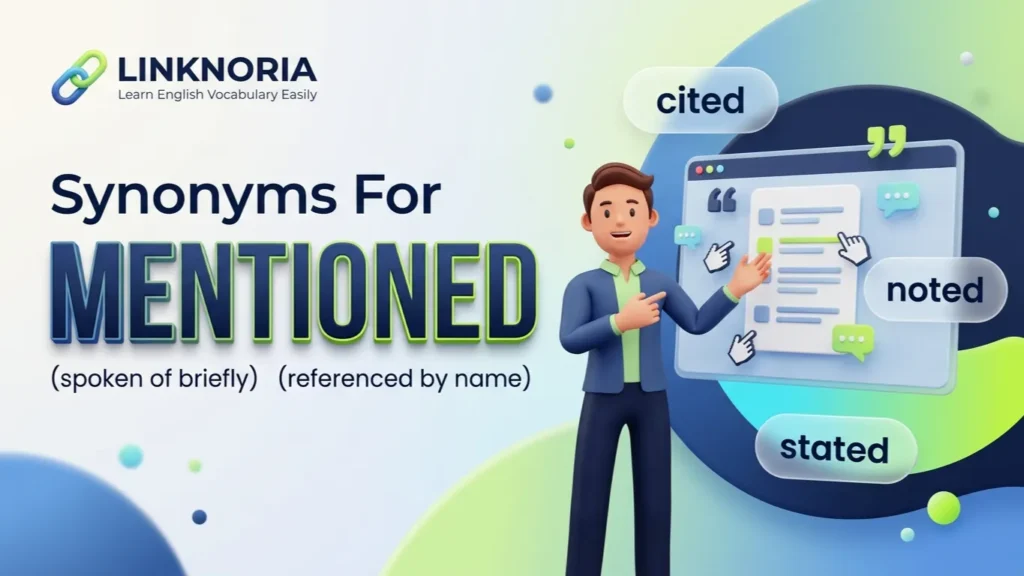
Mentioned means that someone talked about, referred to, or briefly gave information about a person, thing, or idea.
Useful alternatives include stated, noted, referred to, cited, reported, said, discussed, identified, indicated, and specified. These words help students, writers, and daily speakers choose clearer language for different situations.
Stated, noted, referred to, cited, said, reported, discussed, identified, indicated, specified, expressed, remarked, observed, declared, described, highlighted, addressed, brought up, named, listed, pointed out, acknowledged, recorded, included, referenced, alluded to, touched on, introduced, presented, and disclosed.
Parts of Speech
| Word | Part of Speech | Simple Meaning |
| mentioned | Verb | Spoke about something briefly |
| stated | Verb | Gave information clearly |
| noted | Verb | Pointed out or recorded something |
| referred to | Verb phrase | Talked about something |
| cited | Verb | Gave an example or source |
| said | Verb | Spoke or gave words |
| reported | Verb | Gave information about something |
| discussed | Verb | Talked about a subject |
| identified | Verb | Named or recognized something |
| indicated | Verb | Showed or pointed to something |
| specified | Verb | Gave exact details |
| expressed | Verb | Showed a thought or feeling |
| remarked | Verb | Made a short comment |
| observed | Verb | Made a comment after noticing something |
| declared | Verb | Said something firmly |
| described | Verb | Gave details about something |
| highlighted | Verb | Gave special attention to something |
| addressed | Verb | Spoke about a subject |
| brought up | Verb phrase | Started talking about something |
| named | Verb | Gave or said a name |
| listed | Verb | Gave several things in order |
| pointed out | Verb phrase | Drew attention to something |
| acknowledged | Verb | Accepted or recognized something |
| recorded | Verb | Put information in written form |
| included | Verb | Added something as part of a whole |
| referenced | Verb | Referred to a source or idea |
| alluded to | Verb phrase | Referred to something indirectly |
| touched on | Verb phrase | Discussed something briefly |
| introduced | Verb | Presented something for the first time |
| presented | Verb | Gave information or an idea |
| disclosed | Verb | Revealed information |
Synonyms
1. Stated
Meaning: Stated means that someone gave information or an opinion clearly.
Examples: The report stated the main cause.
She stated her position clearly.
2. Noted
Meaning: Noted means that someone pointed out or recorded an important fact.
Examples: The teacher noted the mistake.
The study noted a change in results.
3. Referred To
Meaning: Referred to means that someone talked about or directed attention to something.
Examples: The writer referred to the earlier study.
He referred to your message.
4. Cited
Meaning: Cited means that someone gave a source, example, or piece of evidence.
Examples: The essay cited three studies.
She cited a useful example.
5. Said
Meaning: Said means that someone spoke words or gave information.
Examples: He said the meeting was canceled.
Maria said she needed help.
6. Reported
Meaning: Reported means that someone gave information about an event or situation.
Examples: The newspaper reported the news.
Several people reported the problem.
7. Discussed
Meaning: Discussed means that someone talked about a subject in some detail.
Examples: The class discussed climate change.
They discussed the new plan.
8. Identified
Meaning: Identified means that someone named or recognized a person, thing, or problem.
Examples: The doctor identified the problem.
The report identified several risks.
9. Indicated
Meaning: Indicated means that someone showed or pointed toward an idea, fact, or result.
Examples: The results indicated progress.
The sign indicated the correct road.
10. Specified
Meaning: Specified means that someone gave exact information or details.
Examples: The form specified the required documents.
The contract specified the payment date.
11. Expressed
Meaning: Expressed means that someone showed a thought, opinion, or feeling.
Examples: She expressed her concern.
He expressed strong support.
12. Remarked
Meaning: Remarked means that someone made a short comment about something.
Examples: Tom remarked on the weather.
She remarked that the room was quiet.
13. Observed
Meaning: Observed means that someone made a comment after noticing something.
Examples: The researcher observed a clear pattern.
The teacher observed that the students were tired.
14. Declared
Meaning: Declared means that someone announced something firmly and clearly.
Examples: The leader declared his support.
The company declared its new policy.
15. Described
Meaning: Described means that someone gave details about a person, place, thing, or event.
Examples: She described the accident.
The article described the new method.
16. Highlighted
Meaning: Highlighted means that someone gave special attention to an important point.
Examples: The report highlighted several problems.
The speaker highlighted the need for change.
17. Addressed
Meaning: Addressed means that someone spoke about or dealt with a particular subject.
Examples: The speech addressed public safety.
The report addressed the main concern.
18. Brought Up
Meaning: Brought up means that someone started talking about a subject.
Examples: She brought up an interesting idea.
He brought up the issue during lunch.
19. Named
Meaning: Named means that someone said the name of a person, place, thing, or idea.
Examples: The report named the main causes.
She named three possible choices.
20. Listed
Meaning: Listed means that someone gave several items or points one after another.
Examples: The document listed the required steps.
He listed four reasons for his choice.
21. Pointed Out
Meaning: Pointed out means that someone drew attention to a fact or detail.
Examples: She pointed out a small error.
The guide pointed out the safest route.
22. Acknowledged
Meaning: Acknowledged means that someone accepted, recognized, or admitted something.
Examples: He acknowledged the mistake.
The report acknowledged the possible risk.
23. Recorded
Meaning: Recorded means that someone wrote down or stored information.
Examples: The nurse recorded the results.
The system recorded the time.
24. Included
Meaning: Included means that someone added something as part of a larger group or text.
Examples: The report included useful data.
She included his name in the list.
25. Referenced
Meaning: Referenced means that someone referred to a source, person, idea, or earlier point.
Examples: The paper referenced several books.
The article referenced an earlier study.
26. Alluded To
Meaning: Alluded to means that someone referred to something without explaining it directly.
Examples: He alluded to a past problem.
The writer alluded to the old story.
27. Touched On
Meaning: Touched on means that someone discussed a subject briefly.
Examples: The lecture touched on several topics.
She touched on the main issue.
28. Introduced
Meaning: Introduced means that someone presented a person, idea, subject, or topic for the first time.
Examples: The teacher introduced a new topic.
The article introduced a useful method.
29. Presented
Meaning: Presented means that someone gave information, an idea, or an argument to others.
Examples: She presented her research.
The speaker presented several solutions.
30. Disclosed
Meaning: Disclosed means that someone revealed information that was not previously known.
Examples: The company disclosed its results.
He disclosed the details to the team.
Antonyms of mentioned
- Ignored
- Withheld
- Concealed
- Suppressed
- Omitted
- Silenced
- Hid
- Overlooked
- Avoided
- Kept secret
When to Use Which Synonym
| Synonym | Best Used When | Example Situation |
| Stated | Giving information clearly | An official statement |
| Noted | Pointing out a fact | A research report |
| Referred to | Talking about an earlier subject | An academic essay |
| Cited | Giving a source or example | A research paper |
| Said | Reporting ordinary speech | A conversation |
| Reported | Giving information about an event | A news article |
| Discussed | Talking about a subject in detail | A classroom debate |
| Identified | Naming a problem or person | A medical report |
| Indicated | Showing a result or sign | Research findings |
| Specified | Giving exact details | A contract |
| Expressed | Showing an opinion or feeling | A personal letter |
| Highlighted | Giving special attention | A formal report |
| Addressed | Dealing with a subject | A public speech |
| Brought up | Starting a topic | An informal conversation |
| Pointed out | Drawing attention to a detail | A classroom discussion |
| Acknowledged | Recognizing something | A formal response |
| Alluded to | Referring indirectly | A literary essay |
| Touched on | Discussing briefly | A short presentation |
| Disclosed | Revealing private or new information | A company announcement |
Affixation Pattern
Affixation Pattern
| Root | Prefix | Suffix |
| mention | none | -ed |
The word mentioned is the past tense and past participle of mention. The suffix -ed shows that the action happened in the past. The word comes through Old French from Latin mentio, meaning a calling to mind or reference.
Word Formation
Word Formation
Real forms of the word include:
- Mention
- Mentions
- Mentioned
- Mentioning
- Mentionable
- Unmentioned
US Pronunciation: /ˈmɛnʃənd/
UK Pronunciation: /ˈmenʃənd/
Number of Syllables: 2
Prototype Meaning
Prototype Meaning
When native speakers hear it mentioned, they usually picture someone briefly bringing a person, fact, topic, or idea into a conversation or piece of writing. The information does not need to be explained in detail. A person can mention something in speech, an email, a report, or an essay. The word does not imply that the speaker agrees with the information or considers it important. It simply shows that the subject was referred to.
Prototype Categorization
Prototype Categorization
1. Simple Speaking
- Said
- Remarked
- Brought up
- Named
- Pointed out
These choices fit everyday conversations and simple descriptions.
2. Academic Writing
- Cited
- Referenced
- Noted
- Stated
- Indicated
These forms work well in essays, research papers, and formal reports.
3. Detailed Information
- Described
- Specified
- Presented
- Reported
- Identified
These words suit situations where information is given clearly.
4. Special Attention
- Highlighted
- Addressed
- Observed
- Acknowledged
These choices show that a particular point received attention.
5. Indirect Reference
- Referred to
- Alluded to
- Touched on
These expressions work when a subject is brought into a discussion without full explanation.
6. Revealing Information
- Disclosed
- Recorded
- Included
These words fit situations involving information that is revealed, stored, or added to a larger text.
Grouping the words helps writers see small differences in meaning. The right choice depends on the purpose, level of detail, and style of the sentence.
Common Usage Mistakes
Common Usage Mistakes
- Using “mentioned” for a detailed discussion: Use discussed or described when the subject received more attention.
- Using “cited” for ordinary conversation: Cited usually suggests a source, example, or evidence.
- Using “stated” for every reference: Stated often suggests a clear declaration, not just a brief reference.
- Confusing “referred to” with “disclosed”: A reference does not always reveal new information.
- Using “alluded to” when the meaning is direct: Alluded to suggests an indirect reference.
- Using “reported” for personal opinions: Reported usually presents information about an event, finding, or situation.
- Confusing “highlighted” with “mentioned”: Highlighted gives special attention to a point.
- Using “specified” for a general idea: Specified suggests exact details.
- Writing “mentionned”: The correct spelling is mentioned, with one “n” before the “-ed.”
- Using “brought up” in every formal essay: This phrase is natural in speech but can sound informal in academic writing.
FAQ
What can I use instead of mentioning?
You can use refer to, state, note, cite, discuss, identify, point out, or bring up. The best option depends on how much attention the subject receives and how formal your writing is.
What is a synonym for “as I’ve mentioned”?
Natural choices include “as I noted,” “as stated earlier,” “as previously mentioned,” and “as discussed above.” Academic writing often uses “as noted earlier” or “as stated previously.”
What is another word for stated or mentioned?
Useful choices include noted, expressed, reported, declared, indicated, cited, referenced, and pointed out. “Stated” often sounds more direct, while “mentioned” can suggest a brief reference.
What does “mentioned” mean?
“Mentioned” means that someone talked about or referred to something without necessarily giving a full explanation. The subject can appear in a conversation, report, essay, message, or speech.
What is a formal synonym for mentioned?
Referenced, noted, stated, cited, and addressed can work in formal writing. The best choice depends on the sentence. “Cited” is especially useful when referring to a source or piece of evidence.
What is an academic synonym for mentioned?
Noted, cited, referenced, stated, indicated, and addressed are common academic choices. “Cited” works well when a source supports a claim, while “noted” can introduce an important observation.
Is it stated the same as mentioned?
They can have similar meanings, but they are not always interchangeable. “Mentioned” often means briefly referring to something. “Stated” usually means clearly expressed information, an opinion, or a position.
Is “as mentioned” formal?
Yes. “As mentioned” is acceptable in formal writing, especially when referring to information given earlier. “As noted earlier” and “as discussed above” can sound more precise in academic work.
Topic Quiz
1. What does “mentioned” usually mean?
A. Completely ignored
B. Briefly talked about
C. Completely explained
D. Secretly removed
2. Which word is best for giving a source in an academic essay?
A. Brought up
B. Said
C. Cited
D. Named
3. Which synonym means “revealed information”?
A. Disclosed
B. Touched on
C. Alluded to
D. Remarked
4. Which phrase means “referred to something indirectly”?
A. Stated
B. Alluded to
C. Identified
D. Listed
5. Which word is best for giving exact details?
A. Specified
B. Said
C. Remarked
D. Brought up
Answer Key
- (B)
- (C)
- (A)
- (B)
- (A)
Conclusion
Knowing different words can make your English more precise. Noted, cited, stated, referenced, and disclosed each carry a slightly different meaning.
Students can use these choices in essays and assignments. Writers can make their sentences more natural. Daily speakers can choose simple phrases such as said or brought up.
Try using one new synonym in your next sentence. Small vocabulary changes can make your writing clearer and stronger.

Mustansar Abbas is the author and founder of Linknoria.com, where he writes practical, well-researched guides on technology, productivity, and digital tools to help readers make smarter, more informed decisions.