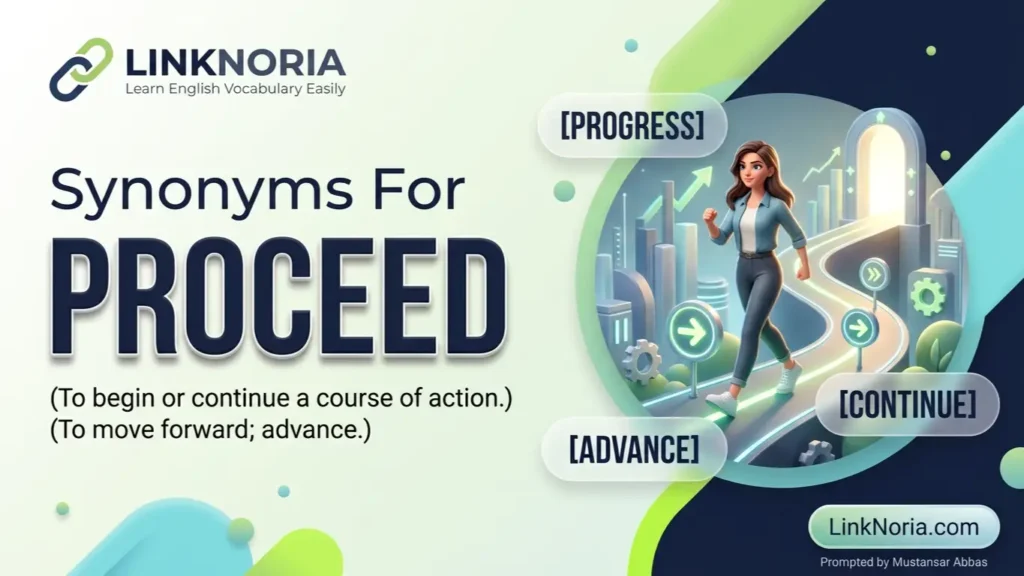
Proceed means to move forward, continue an action, or advance after a pause or interruption.
Imagine standing at an airport gate as the attendant announces that boarding can finally begin. That forward movement into action after waiting is the exact moment you proceed.
The verb proceed describes advancing physically, carrying out an action, or continuing a process following a specific rule or decision. It applies to travelers walking down an aisle, legal teams starting court trials, and project managers keeping tasks on schedule.
Learning synonyms for this word helps you vary your language, choose the right tone for business or academic writing, and express forward motion clearly.
This article explains the meaning of “proceed,” its emotional tone, history, pronunciation, word parts, and 30 useful synonyms with clear examples. By the end, you will know how to talk about it like a confident English speaker.
Meaning of Proceed
Definition
To go forward or onward, especially after an interruption, or to carry on an action or legal process in an orderly way.
Simple meaning
To move forward or keep going with a task.
Connotation
Neutral to formal. It suggests order, authorization, purpose, and deliberate motion without extra emotional weight.
Examples
- The flight attendant asked passengers to proceed to gate twelve for immediate boarding.
- After reviewing the security guidelines, the committee voted to proceed with the proposed software update.
Etymology
Derived from Latin procedere, formed from pro- (forward) and cedere (to go, movement).
Short history
- Old English (450–1100): The word did not exist in Old English; native terms like forþgan (to go forward) served this purpose.
- Middle English (1100–1500): Entered Middle English from Anglo-French proceder in legal contexts to describe formal steps in court.
- Modern English (1500–Present): Expanded beyond legal settings to describe general physical advancement, task continuation, and procedural logic.
Quick Synonym Comparison Table
| Word | Formality | Primary Context | Direct Meaning |
| Proceed | Formal | General / Official | Advance forward systematically |
| Continue | Neutral | General | Keep doing an action |
| Advance | Neutral | Physical / Strategy | Move forward toward a target |
| Progress | Neutral | Development | Move forward while making gains |
| Press on | Informal | Challenge / Effort | Push forward despite difficulties |
Pronunciation
- US IPA: /prəˈsiːd/
- UK IPA: /prəˈsiːd/
- Syllables: pro-ceed (2 syllables)
30 Synonyms for Proceed
Choosing the correct word depends on whether you mean physical motion, ongoing progress, or formal authorization.
1. Advance (verb)
/ US /ədˈvæns/ | UK /ədˈvɑːns/ /
Meaning: To move forward in location, time, or development.
- Troops received orders to advance toward the northern ridge before morning.
- Technology continues to advance at an unprecedented rate across all sectors.
2. Continue (verb)
/ US /kənˈtɪnjuː/ | UK /kənˈtɪnjuː/ /
Meaning: To keep going without stopping or to resume after an interruption.
- The speaker paused for a drink of water before preparing to continue her lecture.
- Heavy rainfall will continue across the valley throughout the evening.
3. Progress (verb)
/ US /prəˈɡrɛs/ | UK /prəˈɡrɛs/ /
Meaning: To move forward toward a higher state or completed stage.
- Medical researchers progress toward finding safer clinical treatments every year.
- Construction work began to progress rapidly once weather conditions improved.
4. Persist (verb)
/ US /pərˈsɪst/ | UK /pəˈsɪst/ /
Meaning: To continue steadily despite opposition, obstacles, or warnings.
- Athletes must persist through rigorous daily training to reach professional levels.
- If symptoms persist after three days, consult a qualified medical doctor.
5. Resume (verb)
/ US /rɪˈzjuːm/ | UK /rɪˈzjuːm/ /
Meaning: To begin again after a temporary halt or pause.
- Court officials announced that trial proceedings will resume on Monday morning.
- The factory plans to resume full production once supplies arrive.
6. Press on (verb)
/ US /prɛs ɑːn/ | UK /prɛs ɒn/ /
Meaning: To continue moving or working forward with determination.
- Hikers decided to press on through the fog to reach shelter before nightfall.
- The team chose to press on with the project despite budget cuts.
7. Carry on (verb)
/ US /ˈkæri ɑːn/ | UK /ˈkæri ɒn/ /
Meaning: To keep doing an activity or task as before.
- Students were instructed to carry on with their reading while the teacher took attendance.
- Despite personal difficulties, she managed to carry on her daily duties smoothly.
8. Forge ahead (verb)
/ US /fɔːrdʒ əˈhɛd/ | UK /fɔːdʒ əˈhɛd/ /
Meaning: To move forward rapidly and forcefully into new ground.
- Engineers decided to forge ahead with testing the new propulsion system.
- The small enterprise continues to forge ahead despite strong industry competition.
9. Move forward (verb)
/ US /muːv ˈfɔːrwərd/ | UK /muːv ˈfɔːwəd/ /
Meaning: To progress to the next phase or step of a plan.
- Board members agreed to move forward with the corporate acquisition proposal.
- The design team needs approval from leadership to move forward safely.
10. Go ahead (verb)
/ US /ɡoʊ əˈhɛd/ | UK /ɡəʊ əˈhɛd/ /
Meaning: To start or continue doing something, often after receiving permission.
- You may go ahead with your presentation as soon as the projector connects.
- City officials gave the developer permission to go ahead with construction.
11. Head (verb)
/ US /hɛd/ | UK /hɛd/ /
Meaning: To travel or point toward a specific direction or location.
- Commuters line up to head toward the central train station during peak hours.
- The captain instructed the crew to head due west across the channel.
12. Journey (verb)
/ US /ˈdʒɜːrni/ | UK /ˈdʒɜːni/ /
Meaning: To travel over a distance from one place to another.
- Pilgrims journey across steep mountain paths to visit ancient sacred sites.
- Researchers journey into isolated forests to study wildlife behavior.
13. Pass (verb)
/ US /pæs/ | UK /pɑːs/ /
Meaning: To move past a point or transition from one stage to another.
- Security allowed permitted personnel to pass through the main gates.
- Time seemed to pass quickly during the engaging classroom workshop.
14. Proceed forward (verb)
/ US /prəˈsiːd ˈfɔːrwərd/ | UK /prəˈsiːd ˈfɔːwəd/ /
Meaning: To advance directly in a forward physical or procedural path.
- Drivers must proceed forward only when the green signal illuminates.
- Applicants can proceed forward to stage two after passing background checks.
15. Extend (verb)
/ US /ɪkˈstɛnd/ | UK /ɪkˈstɛnd/ /
Meaning: To stretch out, lengthen, or reach forward into a space or time.
- The historic pipeline will extend across three northern states.
- Organizers agreed to extend the conference deadline by one full week.
16. Promote (verb)
/ US /prəˈmoʊt/ | UK /prəˈməʊt/ /
Meaning: To help bring about the advancement or growth of an initiative.
- Health organizations work to promote clean water projects in rural regions.
- The campaign aims to promote local business growth across the city.
17. Stem from (verb)
/ US /stɛm frʌm/ | UK /stɛm frɒm/ /
Meaning: To originate, arise, or proceed as a consequence from a specific source.
- Many legal conflicts stem from poorly worded contract clauses.
- Her interest in marine science stems from early childhood trips to the beach.
18. Emanate (verb)
/ US /ˈɛməneɪt/ | UK /ˈɛməneɪt/ /
Meaning: To issue forth, originate, or flow out from a source.
- Soft musical notes began to emanate from the open studio window.
- Heat starts to emanate from the central engine unit after starting.
19. Issue (verb)
/ US /ˈɪʃuː/ | UK /ˈɪʃuː/ /
Meaning: To come forth or proceed out from a formal authority or location.
- Official warnings issue from government offices during weather emergencies.
- Smoke continued to issue from the chimney throughout the cold night.
20. Derive (verb)
/ US /dɪˈraɪv/ | UK /dɪˈraɪv/ /
Meaning: To draw, obtain, or proceed logically from an origin or basic principle.
- Modern medical treatments often derive from active botanical compounds.
- Linguists show how several modern dialects derive from ancient Latin roots.
21. Spring (verb)
/ US /sprɪŋ/ | UK /sprɪŋ/ /
Meaning: To move, launch, or arise quickly forward from a resting point.
- New green shoots spring from the soil during early warm months.
- Creative solutions often spring from open group discussions.
22. Arise (verb)
/ US /əˈraɪz/ | UK /əˈraɪz/ /
Meaning: To come into existence, occur, or proceed as a result of circumstances.
- Unexpected questions may arise during the open public comment period.
- Opportunities arise when team members collaborate across departments.
23. Follow (verb)
/ US /ˈfɑːloʊ/ | UK /ˈfɒləʊ/ /
Meaning: To move behind, come after, or proceed along a designated path or rule.
- Tourists follow the marked walking trail to reach the historic monument.
- You must follow established laboratory safety procedures at all times.
24. March (verb)
/ US /mɑːrtʃ/ | UK /mɑːtʃ/ /
Meaning: To walk forward with steady, measured, or military steps.
- Demonstration leaders march through central avenues toward the capital building.
- Students march across the stage to receive their official graduation diplomas.
25. Navigate (verb)
/ US /ˈnævɪɡeɪt/ | UK /ˈnævɪɡeɪt/ /
Meaning: To plan, direct, and proceed along a complex route or situation.
- Captains use radar systems to navigate safely through dense sea fog.
- New employees learn to navigate internal company software systems quickly.
26. Pursue (verb)
/ US /pərˈsuː/ | UK /pəˈsjuː/ /
Meaning: To follow, push forward, or strive continuously toward an objective.
- Scholars travel abroad to pursue advanced academic research opportunities.
- Detectives continue to pursue new leads in the unresolved investigation.
27. Trek (verb)
/ US /trɛk/ | UK /trɛk/ /
Meaning: To make a slow, arduous, or long physical journey on foot.
- Explorers trek across frozen terrain to reach scientific research stations.
- Families trek up the steep mountain slope during autumn weekends.
28. Wend (verb)
/ US /wɛnd/ | UK /wɛnd/ /
Meaning: To go or proceed along a slow, winding, or indirect route.
- Travelers wend their way through narrow market alleys filled with vendors.
- The clear river waters wend slowly down toward the open bay.
29. Plow ahead (verb)
/ US /plaʊ əˈhɛd/ | UK /plaʊ əˈhɛd/ /
Meaning: To force one’s way forward through resistance, work, or obstacles.
- Operators plow ahead through snowdrifts to clear emergency highway lanes.
- Authors plow ahead with drafting chapters despite recurring writer blocks.
30. Sail (verb)
/ US /seɪl/ | UK /seɪl/ /
Meaning: To move forward smoothly, easily, or effortless through an environment.
- The cargo vessel will sail out of harbor at first light.
- She managed to sail through her final examinations without minor errors.
Quick Synonym Comparison Table
| Synonym | Formality Level | Primary Context / Usage | Key Nuance / Distinction |
| Advance | Neutral | Physical, strategy, military | Implies directional gain toward a specified target |
| Continue | Neutral | General, ongoing tasks | Highlights uninterrupted action or resuming action |
| Persist | Neutral | Obstacles, difficulties | Focuses on determination against continuous resistance |
| Resume | Formal | Official meetings, trials | Refers strictly to starting again after a pause |
| Forge ahead | Expressive | Business, innovation | Emphasizes driving forward with strong momentum |
| Stem from | Academic | Cause and effect, origin | Describes originating or proceeding out from a source |
| Go ahead | Informal | Direct speech, permissions | Signifies taking action after getting clear approval |
| Wend | Literary | Travel, nature writing | Describes moving along a slow, indirect, or winding path |
| Press on | Conversational | Endurance, journeys | Suggests pushing past fatigue or challenging weather |
| Pursue | Professional | Goals, careers, leads | Involves active, intentional effort toward a goal |
Synonyms by Context / Usage
Matching your word selection to your setting ensures clear communication:
Formal & Academic
- Stem from: Used in research to explain how results proceed directly from initial variables.
- Emanate: Applied in technical writing to describe light, heat, or authority proceeding outward.
- Resume: Essential in legal or academic records when sessions start again after lunch or recess.
Professional & Business
- Move forward: The preferred phrase in executive meetings when advancing to the next project phase.
- Go ahead: Used in business correspondence to approve budgets or launch campaign steps.
- Navigate: Used when describing how companies manage complex regulatory or financial environments.
Informal & Conversational
- Press on: Common among friends when encouraging someone to finish a long walk or difficult task.
- Carry on: Everyday British and Commonwealth phrasing for keeping up routine work.
- Plow ahead: Casual expression for working through a large stack of paperwork or chores.
Literary & Creative
- Wend: Adds poetic imagery when describing travel through natural landscapes or old streets.
- Forge ahead: Creates strong visual drama when characters push through hardship or storms.
- Journey: Focuses on the emotional or physical distance traveled rather than the destination.
Example Sentences Using the Synonyms
- The expedition team chose to press on despite freezing temperatures and high winds.
- Panel members voted to resume discussions after taking a brief fifteen-minute break.
- She hopes to pursue a degree in environmental science after completing high school.
- Clean water initiatives promote better public health outcomes across rural communities.
- The ancient trail turns north as travelers wend through dense pine forests.
Parts of Speech
| Form | Part of Speech | Example Sentence |
| Proceed | Verb | The board decided to proceed with the recommended safety protocol. |
| Proceeding | Noun | The legal proceeding lasted three weeks before reaching a verdict. |
| Proceeds | Noun (Plural) | All event proceeds benefit local children’s healthcare programs. |
| Procedural | Adjective | Workers followed strict procedural rules during emergency drills. |
| Procedure | Noun | Standard operating procedure requires two independent signatures. |
Antonyms of Proceed
- Halt (verb): To bring physical movement or ongoing activity to an abrupt stop.
- Retreat (verb): To move backward or withdraw from a forward position or commitment.
- Stop (verb): To cease moving, acting, or operating entirely.
- Pause (verb): To temporarily delay or interrupt action before starting again.
- Recede (verb): To move back or away from a previous point or limit.
When to Use Which Synonym
| Desired Tone / Meaning | Recommended Word | Context to Avoid |
| Starting after permission | Go ahead | Avoid high-level legal documents; use proceed instead. |
| Moving despite hardship | Press on | Do not use it for simple, automated software operations. |
| Originating from a cause | Stem from | Avoid when describing straightforward physical walking. |
| Starting again after a break | Resume | Do not use it when an action has never been interrupted. |
Affixation Pattern
- Root: Ceed / Cess (Latin cedere, meaning to go, move, or yield).
- Prefix: Pro- (Latin prefix meaning forward, forth, or in front of).
- Suffix: None (Base verb form).
Word Formation
The word combines the directional prefix pro- with the Latin movement root cedere.
- Proceed (verb): US /prəˈsiːd/ | UK /prəˈsiːd/ | 2 Syllables (pro-ceed)
- Proceeds (noun): US /ˈproʊsiːdz/ | UK /ˈprəʊsiːdz/ | 2 Syllables (pro-ceeds)
- Procedure (noun): US /prəˈsiːdʒər/ | UK /prəˈsiːdʒə/ | 3 Syllables (pro-ce-dure)
Prototype Meaning
When native speakers hear the word proceed, they picture a line of travelers passing an official check-in counter or a project team moving smoothly into step two after receiving manager sign-off.
It does not imply rushing wildly, chaotic wandering, turning around backward, or acting without proper authority.
Prototype Categorization
- Physical Advancement: Advance, head, march, trek.
- Task Continuation: Continue, carry on, press on, plow ahead.
- Causal & Origin: Stem from, emanate, issue, derive.
- Formal Approval: Go ahead, move forward, resume.
Grouping synonyms into structured categories allows writers to select verbs that fit specific technical, narrative, or organizational needs.
Common Usage Mistakes
- Confusing “proceed” with “precede”: Remember that proceed means to go forward, whereas precede means to come before something else in time or order.
- Misusing plural “proceeds”: The plural noun proceeds (money raised from an event) takes a plural verb and carries a different pronunciation stress on the first syllable.
- Redundant phrasing: Avoid writing “proceed forward,” because proceed already contains the meaning of moving forward within its prefix.
Connotative Meaning
- Positive: Associated with order, steady progress, official permission, clarity, and goal accomplishment.
- Negative: Can occasionally sound overly bureaucratic, cold, or rigid if applied to sensitive personal matters.
- Neutral: Simply describes directional physical motion or moving to the next item on an agenda.
(Connotation refers to the secondary emotional association or feeling a word evokes beyond its literal dictionary definition.)
Short Questions and Answers
What does the word “proceed” mean?
To proceed means to move forward, carry on with an action, or advance to the next step, especially after an official pause or authorization.
What is another way to say “please proceed”?
In professional settings, you can say “please continue,” “please go ahead,” or “you may begin.”
What is a synonym for going forward?
Direct synonyms for going forward include advancing, progressing, proceeding, and moving forward.
Do not proceed synonyms?
Phrases that mean do not proceed include halt, stop, stand down, cease action, and hold position.
What is the difference between proceed and precede?
Proceed means to go forward or carry on, while precede means to come before something else in order, rank, or time.
What is a formal synonym for proceed in business?
In formal business contexts, strong synonyms for proceed include advance, resume, execute, and move forward.
How is the noun proceeds different from the verb proceed?
The verb proceed (stressed on the second syllable) means to move forward, whereas the plural noun proceeds (stressed on the first syllable) refers to profits or funds collected from an event.
Conclusion
Mastering proceed and its versatile synonyms empowers you to communicate movement, authority, and task progression clearly across writing contexts. Choosing precise verbs keeps your prose engaging and accurate.
Try selecting two new synonyms from this article and use them in your next written report or daily practice.
Quiz about “Proceed”
Test your knowledge on the meaning, grammar, synonyms, and usage of proceed:
- Proceed in a Sentence: Which sentence uses proceed correctly?
- A) The rain started to proceed from the sky yesterday.
- B) Passengers may proceed to the gate once their group number is called.
- C) She decided to put her book on the wooden shelf.
- Pronounce Proceed: Where is the primary stress placed when you pronounce the verb proceed?
- Proceed Noun: What does the plural noun proceeds mean, and how does its pronunciation differ from the verb?
- Proceed Synonym Formal: What is a formal synonym for proceed when starting an official meeting again after a short recess?
- Proceed to: Complete this sentence using the correct verb form: “After completing the security check, visitors should ________ to the main reception desk.”
- Proceed Antonyms: Which of the following words is a direct antonym of proceed?
- A) Advance
- B) Halt
- C) Progress
- Another Word for Proceed Forward: Why do writing style guides recommend avoiding the phrase “proceed forward”?
- Proceed from Meaning: What does it mean when a problem or outcome is said to proceed from an earlier event?
Answers
- Answer: B) Passengers may proceed to the gate once their group number is called.
- Answer: The primary stress is on the second syllable (pro-CEED).
- Answer: The noun proceeds refers to money or profits raised from an event; it is pronounced with stress on the first syllable (PRO-ceeds).
- Answer: Resume (or carry on proceedings).
- Answer: Proceed (or advance / head).
- Answer: B) Halt.
- Answer: The phrase is redundant because the prefix pro- in proceed already means “forward.”
- Answer: It means the problem originates, stems, or arises as a direct result or consequence of that earlier event.

Mustansar Abbas is the author and founder of Linknoria.com, where he writes practical, well-researched guides on technology, productivity, and digital tools to help readers make smarter, more informed decisions.