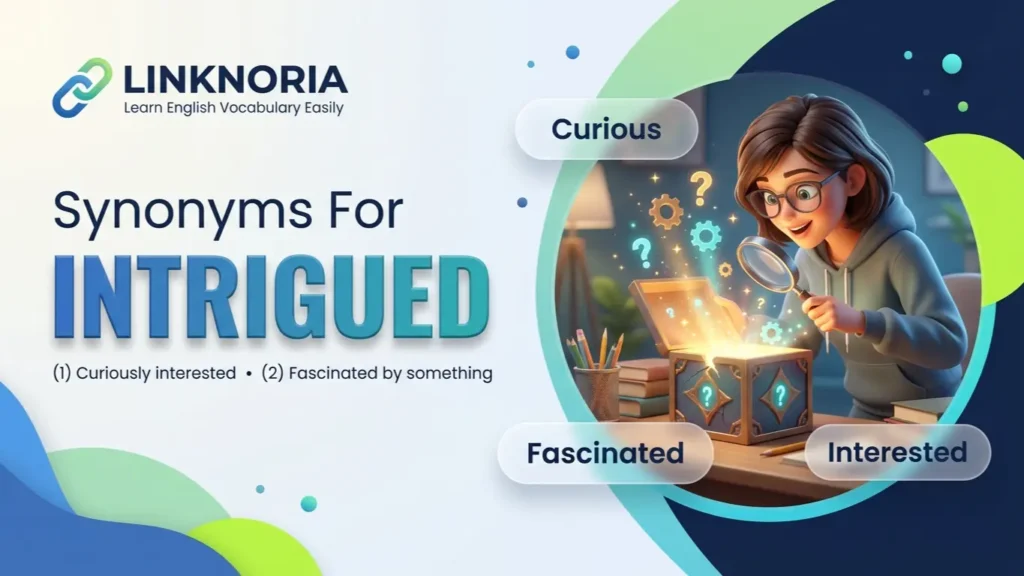
Have you ever heard a strange sound, discovered a hidden message, or read a story that made you want to know more? You may have felt intrigued. The word describes a feeling of interest that makes you want to learn more about someone, something, or a situation.
People are intrigued in daily conversations, school assignments, professional emails, stories, and online discussions. Repeating the same word can make writing feel dull. Learning synonyms helps you express curiosity, fascination, or interest with greater accuracy.
This guide explains 30 synonyms and related expressions for intrigued. You will learn their meanings, see practical examples, explore antonyms, and discover how to choose the right word for each situation.
Quick Answer: What Are Synonyms for Intrigued?
Common synonyms for intrigued include curious, interested, fascinated, captivated, absorbed, engaged, puzzled, intrigued, keen, and enthralled. The best choice depends on the feeling you want to express, from simple curiosity to deep fascination or confusion.
- Curious: Mia was curious about the strange light outside her window.
- Fascinated: The students were fascinated by the scientist’s discovery.
Table of 30 Synonyms for Intrigued
| No. | Synonym | Part of Speech | Simple Meaning |
| 1 | Curious | Adjective | Eager to know or learn |
| 2 | Interested | Adjective | Wanting to know more |
| 3 | Fascinated | Adjective | Extremely interested in something |
| 4 | Captivated | Adjective | Strongly attracted and held by interest |
| 5 | Absorbed | Adjective | Giving full attention to something |
| 6 | Engaged | Adjective | Actively interested and involved |
| 7 | Puzzled | Adjective | Confused and wanting an answer |
| 8 | Enthralled | Adjective | Completely held by interest |
| 9 | Spellbound | Adjective | Unable to look away from interest |
| 10 | Intrigued by | Adjective phrase | Interested in something unusual |
| 11 | Keen | Adjective | Eager or enthusiastic |
| 12 | Inquisitive | Adjective | Always eager to ask questions |
| 13 | Wondering | Adjective | Thinking curiously about something |
| 14 | Perplexed | Adjective | Confused by something difficult |
| 15 | Bewitched | Adjective | Strongly charmed or fascinated |
| 16 | Absorbing | Adjective | Holding someone’s attention |
| 17 | Compelled | Adjective | Feeling strongly drawn to act or learn |
| 18 | Attracted | Adjective | Drawn toward someone or something |
| 19 | Drawn to | Adjective phrase | Feeling interested or pulled toward |
| 20 | Eager | Adjective | Excited to learn or do something |
| 21 | Engrossed | Adjective | Deeply focused on something |
| 22 | Mesmerized | Adjective | Held by intense attention |
| 23 | Allured | Adjective | Attracted by an appealing quality |
| 24 | Intrigued by the idea | Phrase | Interested in a possible plan |
| 25 | Curious about | Adjective phrase | Wanting information about something |
| 26 | Taken with | Adjective phrase | Strongly impressed or attracted |
| 27 | Impressed | Adjective | Feeling admiration for something |
| 28 | Stimulated | Adjective | Mentally excited or challenged |
| 29 | Thoughtful | Adjective | Deep in thought or reflection |
| 30 | Wonder-struck | Adjective | Filled with amazement and wonder |
Detailed Synonyms for Intrigued
1. Curious
Meaning: Curious describes someone who wants to discover or understand something.
Examples:
- I was curious about the package left at our door.
- The child grew curious when she saw the colorful insects.
2. Interested
Meaning: Interested means wanting to learn more about a person, subject, or event.
Examples:
- Daniel was interested in the history of his hometown.
- I am interested in hearing how you solved the problem.
3. Fascinated
Meaning: Fascinated describes a strong interest that makes something especially exciting or attractive.
Examples:
- We were fascinated by the stars visible through the telescope.
- Sara became fascinated with how ancient buildings were made.
4. Captivated
Meaning: Captivated means having your attention held strongly by something appealing.
Examples:
- The audience was captivated by the singer’s beautiful voice.
- I felt captivated by the story’s unexpected ending.
5. Absorbed
Meaning: Absorbed describes someone giving nearly all their attention to an activity or subject.
Examples:
- He was absorbed in a book about space.
- Mom became absorbed in planning the family celebration.
6. Engaged
Meaning: Engaged means actively interested in an activity, conversation, or subject.
Examples:
- The teacher kept the class engaged with a lively discussion.
- I felt engaged during the workshop because everyone shared ideas.
7. Puzzled
Meaning: Puzzled means confused by something that needs an explanation.
Examples:
- I was puzzled by the unusual message on my phone.
- The detective looked puzzled when the witness changed her story.
Usage Note: Use puzzled when interest comes with confusion rather than admiration.
8. Enthralled
Meaning: Enthralled means completely fascinated or delighted by something.
Examples:
- The children were enthralled by the magician’s performance.
- She felt enthralled while listening to stories about distant lands.
Usage Note: This word is stronger and more expressive than interested.
9. Spellbound
Meaning: Spellbound describes someone whose attention is held as if by magic.
Examples:
- The audience sat spellbound throughout the final scene.
- We were spellbound by the northern lights dancing across the sky.
10. Intrigued by
Meaning: Intrigued by means interested in something because it seems unusual or mysterious.
Examples:
- I was intrigued by his suggestion to redesign the garden.
- She felt intrigued by the symbols carved into the old door.
Usage Note: This phrase is commonly followed by a noun or an -ing form, such as “intrigued by the idea” or “intrigued by learning.”
11. Keen
Meaning: Keen means eager or strongly interested in doing or learning something.
Examples:
- Amir is keen to learn how the new software works.
- My sister is keen on photography and creative writing.
Usage Note: Keen is common in British English and often appears in professional or everyday conversation.
12. Inquisitive
Meaning: Inquisitive describes someone who enjoys asking questions and discovering information.
Examples:
- The inquisitive student asked how the machine worked.
- Her inquisitive nature helped her learn about different cultures.
13. Wondering
Meaning: Wondering describes thinking about something because you want to understand it.
Examples:
- I was wondering why the shop had closed early.
- He stood by the window, wondering where the birds had gone.
14. Perplexed
Meaning: Perplexed means deeply confused by something difficult to understand.
Examples:
- The team was perplexed by the unexpected test results.
- She looked perplexed when the directions led to a locked gate.
Usage Note: Perplexed emphasizes confusion more than curiosity.
15. Bewitched
Meaning: Bewitched means strongly charmed or fascinated by someone or something.
Examples:
- He was bewitched by the quiet beauty of the old village.
- The visitors seemed bewitched by the dancer’s graceful movements.
Usage Note: This word can sound poetic or magical.
16. Absorbing
Meaning: Absorbing describes something that holds a person’s attention.
Examples:
- The documentary was so absorbing that I forgot the time.
- She found the research project absorbing and rewarding.
Usage Note: Absorbing describes the thing that holds attention, while absorbed describes the person giving attention.
17. Compelled
Meaning: Compelled describes feeling strongly driven to do something or find out more.
Examples:
- I felt compelled to read the final chapter.
- She was compelled to ask how the team had solved the mystery.
Usage Note: Compelled can suggest a strong inner urge, not simply mild interest.
18. Attracted
Meaning: Attracted means drawn toward someone or something because of its appeal.
Examples:
- He was attracted to the unusual design of the building.
- I felt attracted to the course because it offered practical projects.
Usage Note: The word can describe physical, emotional, or intellectual appeal.
19. Drawn to
Meaning: Drawn to means naturally interested in or attracted to something.
Examples:
- She was drawn to stories about brave explorers.
- I have always been drawn to creative work and new ideas.
20. Eager
Meaning: Eager means excited and ready to do or learn something.
Examples:
- The children were eager to see the new science exhibit.
- He was eager to learn more about the job opportunity.
Usage Note: Eager often suggests readiness or anticipation, not mystery.
21. Engrossed
Meaning: Engrossed means giving deep attention to something that holds your interest.
Examples:
- She was engrossed in solving a challenging puzzle.
- The passengers were engrossed in a gripping news report.
Usage Note: This word is close to absorbed and often describes deep focus.
22. Mesmerized
Meaning: Mesmerized means so fascinated that it is difficult to look away or think about anything else.
Examples:
- The children were mesmerized by the aquarium’s glowing jellyfish.
- I was mesmerized by the pianist’s skillful performance.
Usage Note: It suggests a powerful effect on someone’s attention.
23. Allured
Meaning: Allured means attracted by something appealing, tempting, or interesting.
Examples:
- The promise of adventure allured him to the distant island.
- She was allured by the chance to explore a new field.
Usage Note: Allured is less common than attracted and often has a literary tone.
24. Intrigued by the Idea
Meaning: This phrase means interested in exploring a plan or possibility.
Examples:
- Our manager was intrigued by the idea of flexible work hours.
- I was intrigued by the idea of learning a new language abroad.
25. Curious About
Meaning: Curious about means wanting to know more about a particular subject.
Examples:
- She was curious about the history behind her family name.
- We are curious about how the new community garden will grow.
26. Taken With
Meaning: Taken with means strongly impressed or pleased by someone or something.
Examples:
- I was taken with the artist’s simple use of color.
- They were taken with the peaceful atmosphere of the small café.
Usage Note: This expression often suggests admiration or personal appeal.
27. Impressed
Meaning: Impressed means feeling admiration because something is good, skillful, or remarkable.
Examples:
- I was impressed by how clearly she explained the topic.
- The coach was impressed with the team’s teamwork.
Usage Note: Someone can be impressed without feeling curious or wanting to investigate further.
28. Stimulated
Meaning: Stimulated describes being mentally awakened, challenged, or encouraged to think.
Examples:
- The debate stimulated my interest in environmental science.
- The workshop left us stimulated by several new ideas.
Usage Note: This word often describes a response to learning, discussion, or creative work.
29. Thoughtful
Meaning: Thoughtful can describe someone carefully considering an idea or question.
Examples:
- He gave a thoughtful response to the difficult question.
- She looked thoughtful after hearing the surprising news.
Usage Note: Thoughtful does not directly mean intrigued. It emphasizes careful thinking or consideration.
30. Wonder-Struck
Meaning: Wonder-struck describes someone filled with amazement at something remarkable.
Examples:
- The children were wonder-struck by the giant waterfall.
- I stood wonder-struck beneath the bright night sky.
Usage Note: This is a less common, expressive word. It fits moments of amazement more than ordinary curiosity.
Antonyms of Intrigued
Antonyms are words with opposite or contrasting meanings. The best antonym for intrigued depends on the sentence.
- Uninterested — not wanting to know more.
- Indifferent — not caring much about something.
- Bored — feeling tired of something uninteresting.
- Uncurious — not eager to discover information.
- Unimpressed — not feeling admiration or excitement.
- Apathetic — showing little interest or concern.
- Disengaged — not involved or paying attention.
- Unmoved — not emotionally affected.
- Repelled — feeling pushed away or strongly discouraged.
- Disinterested — having no personal interest or involvement; in some contexts, it means impartial.
When to Use Which Synonym
| Synonym | Best Used When | Example Situation |
| Curious | Someone wants answers | Asking about a strange noise |
| Interested | Someone wants to learn more | Exploring a new subject |
| Fascinated | Interest is very strong | Watching an unusual science experiment |
| Captivated | Attention is held by something appealing | Listening to a moving speech |
| Absorbed | Someone gives full attention | Reading a detailed novel |
| Puzzled | Something is confusing | Trying to understand a strange result |
| Enthralled | Someone is deeply delighted | Watching a wonderful performance |
| Inquisitive | Someone asks many questions | A child exploring how things work |
| Perplexed | Confusion is strong | Facing an unclear set of instructions |
| Keen | Someone is eager to participate | Applying for a course |
| Engrossed | Someone is deeply focused | Working on a complex puzzle |
| Mesmerized | Something holds attention intensely | Watching colorful lights |
| Eager | Someone is ready and excited | Waiting to hear the results |
| Drawn to | Something naturally attracts interest | Choosing a creative subject |
| Impressed | Someone admires quality or skill | Seeing an excellent presentation |
Affixation Pattern
- Root: Intrigue
- Prefix: None
- Suffix: -ed
- Base word: Intrigue
- Form: Intrigued
The word intrigue entered English through French and is linked to the idea of a complicated plot or secret plan. As a verb, it can mean to arouse curiosity or interest. Adding -ed creates intrigued, which commonly describes the feeling a person experiences.
Word Formation
Common forms related to intrigued include:
- Intrigue — a verb meaning to arouse curiosity; also a noun for a secret or complicated plan.
- Intrigues — the third-person singular verb form or the plural noun.
- Intrigued — the past tense and past participle of intrigue, also used as an adjective.
- Intriguing — an adjective describing something that arouses interest.
- Intriguingly — an adverb meaning in a way that arouses curiosity.
US pronunciation: /ɪnˈtriːɡd/
UK pronunciation: /ɪnˈtriːɡd/
Number of syllables: 2 — in-trigued.
Prototype Meaning
When people hear intrigued, they often picture someone who has noticed something unusual and wants to learn more. Perhaps a mysterious message, a surprising discovery, or an interesting question has caught their attention. The feeling may include curiosity, interest, or a little confusion. Being intrigued does not mean someone fully understands, agrees with, loves, or approves of something. It simply means the subject has sparked enough interest to invite further thought or discovery.
Prototype Categorization
1. Curiosity and questions
- Curious
- Inquisitive
- Wondering
- Curious about
These words suit situations where someone wants answers or more information.
2. General interest and eagerness
- Interested
- Keen
- Eager
- Engaged
Use these terms when someone wants to learn, participate, or explore a subject.
3. Strong fascination
- Fascinated
- Captivated
- Enthralled
- Spellbound
- Mesmerized
- Wonder-struck
These words express a stronger response to something exciting, beautiful, or remarkable.
4. Deep attention
- Absorbed
- Absorbing
- Engrossed
- Stimulated
These terms fit situations involving concentration, learning, or close attention.
5. Confusion and uncertainty
- Puzzled
- Perplexed
- Thoughtful
These words can fit moments when a person is trying to understand something, although they do not all mean the same thing as intrigued.
6. Attraction and admiration
- Attracted
- Drawn to
- Allured
- Taken with
- Impressed
- Bewitched
These terms work when something appeals to a person or earns their admiration.
Grouping related words by meaning helps you select an expression that fits the situation. A word for confusion may not work in a sentence about admiration, even when both feelings involve strong attention.
Common Usage Mistakes
- Confusing “intrigued” with “intriguing”: A person is intrigued; something that creates interest is intriguing. Example: “I am intrigued by the intriguing story.”
- Using “intrigued” when you mean “confused”: Confusion may be part of the feeling, but puzzled or perplexed is more exact when someone cannot understand something.
- Treating every synonym as identical: Curious suggests wanting to know more, while captivated suggests strong attraction or attention.
- Using the wrong preposition: Say “intrigued by the mystery” or “intrigued by how it works.” These are natural patterns.
- Confusing interest with approval: Being intrigued by an idea does not mean agreeing with it.
- Using “intrigued” as a noun: The word usually functions as an adjective or verb form. Use intrigue for the related noun.
- Overusing “fascinated”: Choose a milder word like interested when the feeling is not especially strong.
- Assuming “disinterested” always means bored: It can also mean impartial or not personally involved. Uninterested is clearer when someone simply does not care.
FAQ
What are 5 good synonyms?
Five useful synonyms are curious, interested, fascinated, captivated, and puzzled. Choose curious when someone wants answers, fascinated for strong interest, and puzzled when something is difficult to understand.
What is a synonym for the word intriguing?
Fascinating, interesting, captivating, and mysterious can describe something intriguing. Intriguing describes the thing that creates interest, while intrigued describes the person who feels that interest.
What are other words for intrigue?
As a verb, intrigue can mean interest, fascinate, or arouse curiosity. As a noun, it can describe a secret plan or complicated scheme. The right alternative depends on how the word is used.
What is another word for curious or intrigued?
Interested is a common alternative to both words. Inquisitive describes someone who likes asking questions, while fascinated expresses a stronger feeling of interest.
What are the antonyms of intrigued?
Common contrasting words include uninterested, indifferent, bored, apathetic, and unimpressed. The best choice depends on the intended meaning and the sentence.
What does “intrigued” mean in a professional setting?
In professional writing, intrigued means interested in learning more about an idea, proposal, or opportunity. For example, “I am intrigued by your proposal and would welcome more details” sounds polite and open-minded.
How do you pronounce intrigued?
In both common US and UK pronunciations, intrigued is pronounced /ɪnˈtriːɡd/. It has two syllables, with the main stress on the second syllable.
Is it intriguing?
Yes. Intrigued describes a mental or emotional state of curiosity and interest. It often occurs when something seems unusual, surprising, or worth exploring, but it does not automatically mean confusion or excitement.
What is the difference between intrigued and interested?
Interested is a broad word for wanting to know or pay attention to something. Intrigued often suggests that something unusual or mysterious has sparked that interest.
Topic Quiz
1. Which word best describes someone who wants to discover more about a mystery?
A. Indifferent B. Curious C. Bored D. Unmoved
2. Which word describes something that holds a person’s attention strongly?
A. Uninterested B. Apathetic C. Captivated D. Disengaged
3. What is the difference between “intrigued” and “intriguing”?
A. They always mean the opposite. B. “Intrigued” describes a person’s interest; “intriguing” describes something that creates interest. C. “Intriguing” is only a noun. D. They have no connection in meaning.
4. Which word best fits a person who is confused by an unclear result?
A. Perplexed B. Enthralled C. Keen D. Eager
5. Which sentence uses “intrigued” correctly?
A. The mystery was intrigued by the detective. B. She intrigued by the story. C. I was intrigued by the unusual painting. D. He felt intrigue by the news.
Answer Key
- (B)
- (C)
- (B)
- (A)
- (C)
Conclusion
Learning synonyms for intrigued helps you express curiosity, strong interest, deep attention, or confusion more precisely. Words such as curious, fascinated, captivated, and puzzled each bring a different shade of meaning to your writing.
Choose the word that matches the feeling and situation. Simple, accurate vocabulary makes your conversations, schoolwork, and professional messages clearer and more engaging.
Keep practicing with the examples and quiz, and try using one new word in your next sentence.

Mustansar Abbas is the author and founder of Linknoria.com, where he writes practical, well-researched guides on technology, productivity, and digital tools to help readers make smarter, more informed decisions.