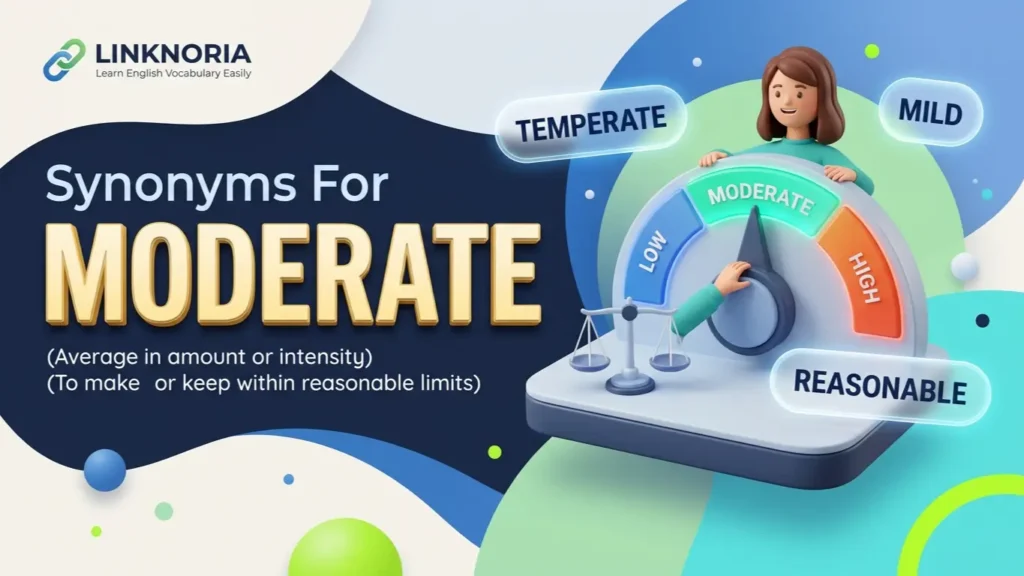
Have you ever added just enough sugar to your tea, chosen a comfortable walking speed, or tried to give a balanced opinion? You may describe these choices as moderate. The word means keeping something within reasonable limits, avoiding extremes, or choosing a middle level.
People use moderation when discussing prices, weather, exercise, opinions, amounts, and research findings. Repeating the same word can make writing less clear. Learning synonyms helps you choose a word that matches the exact meaning you want to express.
This guide explains 30 synonyms and related expressions for moderate, with simple meanings, practical examples, antonyms, pronunciation, usage tips, and a quiz.
Quick Answer: What Are Synonyms for Moderate?
Common synonyms for moderate include mild, reasonable, balanced, average, limited, temperate, restrained, modest, measured, and middle-of-the-road. The best choice depends on the context because moderation can describe an amount, intensity, opinion, action, or change.
- Mild: The town experienced mild weather throughout the afternoon.
- Reasonable: The shop offered a reasonable price for the jacket.
In an essay, balanced may describe a fair view of both sides. In research, modest or limited may describe a small effect, depending on the findings.
Table of 30 Synonyms for Moderate
| No. | Synonym | Part of Speech | Simple Meaning |
| 1 | Mild | Adjective | Not strong or severe |
| 2 | Reasonable | Adjective | Fair and within acceptable limits |
| 3 | Balanced | Adjective | Keeping different sides in proportion |
| 4 | Average | Adjective / Noun | Typical or near the usual level |
| 5 | Limited | Adjective | Restricted in amount or size |
| 6 | Temperate | Adjective | Not extreme in behavior or climate |
| 7 | Restrained | Adjective | Controlled and not excessive |
| 8 | Modest | Adjective | Not large, high, or excessive |
| 9 | Measured | Adjective | Careful and controlled |
| 10 | Middle-of-the-road | Adjective | Neither extreme nor strongly one-sided |
| 11 | Moderate-sized | Adjective | Medium in size |
| 12 | Middling | Adjective | Around an average level |
| 13 | Manageable | Adjective | Easy enough to handle |
| 14 | Gentle | Adjective | Soft, mild, or not forceful |
| 15 | Fair | Adjective | Reasonable and just |
| 16 | Steady | Adjective | Stable and not changing sharply |
| 17 | Controlled | Adjective | Kept within set limits |
| 18 | Cautious | Adjective | Careful to avoid risk |
| 19 | Reserved | Adjective | Not openly expressive or extreme |
| 20 | Conservative | Adjective | Avoiding major changes or risks |
| 21 | Tame | Adjective | Not wild, intense, or exciting |
| 22 | Ordinary | Adjective | Normal or not unusual |
| 23 | Standard | Adjective | Usual or commonly accepted |
| 24 | Acceptable | Adjective | Good enough for a purpose |
| 25 | Proportionate | Adjective | Suitable in size or degree |
| 26 | Even-handed | Adjective | Fair to all sides |
| 27 | Unassuming | Adjective | Not showy or demanding |
| 28 | Moderate in size | Phrase | Neither small nor large |
| 29 | Not excessive | Phrase | Kept within reasonable limits |
| 30 | In moderation | Phrase | Without doing too much |
Detailed Synonyms for Moderate
1. Mild
Meaning: Mild describes something that has little strength or severity.
Examples:
- The forecast predicts mild temperatures this weekend.
- He felt mild discomfort after the long walk.
2. Reasonable
Meaning: Reasonable describes something fair, sensible, or within acceptable limits.
Examples:
- We found a reasonable price for the hotel room.
- Her teacher gave her a reasonable amount of homework.
3. Balanced
Meaning: Balanced describes something that gives suitable attention to different needs or sides.
Examples:
- The student wrote a balanced essay about online learning.
- I try to eat a balanced diet with different food groups.
4. Average
Meaning: Average describes a level that is typical rather than unusually high or low.
Examples:
- The area receives average rainfall during the spring.
- His test score was close to the class average.
Usage Note: Average means typical, while moderate often means neither too much nor too little.
5. Limited
Meaning: Limited describes something restricted in amount, range, or size.
Examples:
- The library has limited space for large events.
- Researchers collected limited data during the first stage.
Usage Note: In research, use limited only when the amount, scope, or evidence is genuinely restricted.
6. Temperate
Meaning: Temperate describes a climate or behavior that avoids extremes.
Examples:
- The coastal region has a temperate climate.
- She took a temperate approach during the heated discussion.
Usage Note: Temperate often appears in writing about climate, habits, or self-control.
7. Restrained
Meaning: Restrained describes actions or feelings that someone keeps under control.
Examples:
- He gave a restrained response to the unexpected criticism.
- The room had restrained decorations in soft colors.
8. Modest
Meaning: Modest describes something fairly small, simple, or not excessive.
Examples:
- The charity reported a modest increase in donations.
- They live in a modest home near the park.
Usage Note: In research, modest can describe a small effect or change, but the evidence must support that description.
9. Measured
Meaning: Measured describes an action or response that shows careful control.
Examples:
- The manager gave a measured reply to the complaint.
- She spoke in a measured tone during the meeting.
10. Middle-of-the-road
Meaning: Middle-of-the-road describes a position that avoids extreme views.
Examples:
- The candidate presented a middle-of-the-road plan for public transport.
- Their music suits listeners who prefer a middle-of-the-road style.
Usage Note: This expression often describes political views, opinions, or popular tastes.
11. Moderate-Sized
Meaning: Moderate-sized describes something that is neither small nor large.
Examples:
- They rented a moderate-sized apartment near the university.
- A moderate-sized garden fits well behind the house.
Usage Note: Medium-sized is usually more natural in everyday English.
12. Middling
Meaning: Middling describes something around an average or middle level.
Examples:
- The restaurant received middling reviews from local visitors.
- Her performance was middling, despite several weeks of practice.
Usage Note: Middling can suggest an ordinary or unimpressive result.
13. Manageable
Meaning: Manageable describes something that a person can handle without too much difficulty.
Examples:
- The teacher divided the project into manageable tasks.
- A manageable workload helped the team meet its deadline.
Usage Note: This word suits workloads, problems, costs, and levels of difficulty.
14. Gentle
Meaning: Gentle describes an action or effect that is mild and not forceful.
Examples:
- Take a gentle walk while you recover from the cold.
- A gentle breeze moved the curtains by the window.
15. Fair
Meaning: Fair describes a decision, amount, or judgment that seems reasonable and just.
Examples:
- The landlord offered a fair rent for the apartment.
- The coach gave every player a fair chance to participate.
Usage Note: Fair often emphasizes justice, not simply a middle level.
16. Steady
Meaning: Steady describes something stable without sudden or extreme changes.
Examples:
- The company reported steady growth over the year.
- She kept a steady pace during the morning walk.
17. Controlled
Meaning: Controlled describes something kept within chosen or required limits.
Examples:
- The experiment took place in a controlled environment.
- He made a controlled effort to keep his voice calm.
18. Cautious
Meaning: Cautious describes someone who acts carefully to reduce risk.
Examples:
- The researchers made cautious claims about their early findings.
- She took a cautious approach before investing her savings.
Usage Note: Cautious focuses on care and risk, not necessarily on a moderate amount.
19. Reserved
Meaning: Reserved describes someone who does not show feelings or opinions openly.
Examples:
- He remained reserved during the first team meeting.
- Her reserved response showed little excitement about the plan.
Usage Note: This word describes personality or expression more often than amount or intensity.
20. Conservative
Meaning: Conservative describes an approach that avoids major changes or unnecessary risks.
Examples:
- The business used a conservative estimate for next year’s costs.
- The doctor recommended a conservative treatment plan.
Usage Note: The word has several meanings, including political ones. Choose it only when the context fits.
21. Tame
Meaning: Tame describes something that feels mild, ordinary, or lacking excitement.
Examples:
- The movie seemed tame compared with the director’s earlier work.
- The party felt tame without music or games.
Usage Note: Tame can sound critical when you mean that something lacks energy.
22. Ordinary
Meaning: Ordinary describes something usual or not different from everyday experience.
Examples:
- It was an ordinary day with no major events.
- The meal used ordinary ingredients from the local shop.
23. Standard
Meaning: Standard describes something that follows a usual or accepted level.
Examples:
- The hotel room included standard furniture and basic facilities.
- The report followed the standard format used by the department.
Usage Note: Standard means usual or accepted, not always moderate in intensity.
24. Acceptable
Meaning: Acceptable describes something good enough to meet a need or requirement.
Examples:
- The team agreed on an acceptable delivery date.
- The research sample was acceptable for the initial review.
25. Proportionate
Meaning: Proportionate describes something suitable in size or degree for a situation.
Examples:
- The response was proportionate to the problem.
- The budget gave each department a proportionate share of the funds.
Usage Note: This is useful in formal essays, reports, and discussions about fairness.
26. Even-Handed
Meaning: Even-handed describes a fair approach that treats different sides equally.
Examples:
- The journalist gave an even-handed account of the debate.
- Our teacher took an even-handed approach to the disagreement.
27. Unassuming
Meaning: Unassuming describes someone or something that does not seek attention or praise.
Examples:
- The unassuming café served excellent homemade food.
- She remained unassuming despite receiving a major award.
Usage Note: This word is not a direct synonym for moderate in every context. It often describes a humble manner or simple appearance.
28. Moderate in Size
Meaning: This phrase describes something that falls between small and large.
Examples:
- The family chose a house moderate in size and easy to maintain.
- We ordered a moderate-size table for the dining room.
29. Not Excessive
Meaning: This phrase means staying within sensible or suitable limits.
Examples:
- Keep the amount of salt in the recipe not excessive.
- The report recommended spending that was not excessive.
Usage Note: More natural phrasing in the first example is “Keep the amount of salt in the recipe reasonable.”
30. In Moderation
Meaning: This phrase means doing or using something without going too far.
Examples:
- You can enjoy sweet treats in moderation.
- The trainer said to increase exercise in moderation.
Antonyms of Moderate
The opposite of moderate depends on its meaning in the sentence. These words can describe excess, intensity, or extreme views.
- Extreme — far from the middle or usual range.
- Excessive — more than needed or suitable.
- Severe — very strong or serious.
- Intense — extremely strong or powerful.
- Excessive — beyond a reasonable amount.
- Unrestrained — not kept under control.
- Radical — favoring major or fundamental change.
- Unreasonable — not fair or sensible.
- Unbalanced — lacking proper proportion or fairness.
When to Use Which Synonym
| Synonym | Best Used When | Example Situation |
| Mild | Describing low intensity | Mild weather |
| Reasonable | Describing a fair amount | Reasonable prices |
| Balanced | Showing fair consideration | A balanced essay |
| Average | Describing a typical level | Average results |
| Limited | Describing a restricted amount | Limited evidence |
| Temperate | Describing climate or self-control | Temperate climate |
| Restrained | Describing controlled expression | Restrained reaction |
| Modest | Describing a small change or amount | Modest improvement |
| Measured | Describing a careful response | Measured comments |
| Middle-of-the-road | Describing a non-extreme view | Middle-of-the-road policy |
| Manageable | Describing something easy enough to handle | Manageable workload |
| Proportionate | Describing a suitable degree | Proportionate response |
| Even-handed | Describing fairness to both sides | Even-handed report |
| Steady | Describing stable progress | Steady growth |
| In moderation | Describing sensible limits | Enjoying sweets in moderation |
Affixation Pattern
- Root: Moder
- Prefix: None
- Suffix: -ate
- Base word: Moderate
Moderates entered English through Latin and Old French, with links to the idea of keeping within limits or controlling something. In modern English, it can work as an adjective, verb, or noun in specific contexts.
Word Formation
Common existing forms include:
- Moderate — not extreme; also to reduce or control something.
- Moderates — the third-person singular verb form or plural noun.
- Moderated — the past tense and past participle of moderate.
- Moderating — the present participle of moderate.
- Moderately — to a medium or reasonable degree.
- Moderation — the practice of avoiding extremes.
- Moderator — a person who guides a discussion or manages a forum.
- Moderate — also a noun for a person with middle-ground views.
US pronunciation: /ˈmɑː.dɚ.ət/ (adjective); /ˈmɑː.dəˌreɪt/ (verb)
UK pronunciation: /ˈmɒd.ər.ət/ (adjective); /ˈmɒd.ə.reɪt/ (verb)
Number of syllables: Three — mod-er-ate. The stress and final sound vary by part of speech.
Prototype Meaning
When people hear moderate, they often picture something near the middle of a scale rather than at either extreme. It may describe mild weather, a reasonable price, a balanced opinion, or an amount that feels suitable. The word often suggests control and proportion. It does not always mean average, weak, or unimportant. A moderate response can still be firm, and a moderate level may be exactly right for a particular purpose.
Prototype Categorization
1. Middle level or typical amount
- Average
- Middling
- Moderate-sized
- Moderate in size
These terms describe something near the middle range.
2. Mild intensity
- Mild
- Gentle
- Tame
- Temperate
Use these words for low intensity, calm conditions, or a lack of extremes.
3. Reasonable limits and control
- Reasonable
- Restrained
- Measured
- Controlled
- In moderation
- Not excessive
These terms work when discussing behavior, spending, or the amount of something.
4. Fairness and balance
- Balanced
- Fair
- Even-handed
- Proportionate
These choices fit opinions, decisions, responses, and formal writing.
5. Small amount or manageable level
- Limited
- Modest
- Manageable
- Acceptable
These words describe amounts, changes, or workloads that stay within practical limits.
6. Cautious or non-extreme approach
- Cautious
- Conservative
- Middle-of-the-road
- Reserved
- Unassuming
These terms describe approaches, views, or personal styles. Their meanings differ, so use the one that matches the intended point.
Grouping synonyms by purpose helps you avoid replacing a word with one that changes the meaning. Think about the subject first: amount, intensity, fairness, or behavior.
Common Usage Mistakes
- Using “moderate” for every average result: Average means typical, while moderate often means within reasonable limits.
- Confusing “moderate” and “moderately”: Use moderate as an adjective and moderately as an adverb. Example: “The weather is moderate” and “It is moderately warm.”
- Using “mild” for every situation: Mild suits low intensity, such as mild pain or mild weather. It may not fit a moderate political position.
- Calling a small effect “moderate” without evidence: In research, describe an effect according to the study’s results and accepted measures.
- Confusing “moderate” with “moderator”: A moderator guides a discussion or manages an online space. The words have related forms but different meanings.
- Using “conservative” as a universal replacement: It often suggests caution or resistance to change, not simply a middle level.
- Writing “moderate amount” when another word is clearer: Use reasonable amount, small amount, or limited amount when that meaning is more accurate.
- Mixing up “moderate” as a verb and adjective: “The teacher moderated the debate” uses the verb. “The debate had moderate support” uses the adjective.
FAQ
What is another word for moderate?
Common alternatives include mild, reasonable, balanced, modest, and restrained. Choose based on context. A reasonable price is fair, a mild headache is not severe, and a balanced opinion considers different sides.
What is the synonym of moderately?
Moderately can mean fairly, reasonably, somewhat, or to a limited degree. For example, “The test was moderately difficult” means it was somewhat difficult, not extremely hard.
What is a word for more than moderate?
Words such as strong, substantial, considerable, and significant can describe something above a moderate level. The best choice depends on the subject. In research, use significance carefully because it can have a specific statistical meaning.
What are 5 strong synonyms?
Five useful synonyms are reasonable, balanced, mild, restrained, and modest. Each fits a different situation: fairness, opinions, intensity, behavior, or size. They are not interchangeable in every sentence.
What is a moderate amount?
A moderate amount is enough for a purpose without being too much or too little. The exact amount depends on the situation, such as food portions, exercise, spending, or workload.
What does moderate mean in research?
In research, moderate usually describes a middle level of strength, size, or intensity. Researchers should explain how they measure that level and avoid using the word without supporting evidence.
What is a synonym for moderate in an essay?
Balanced, reasonable, measured, and middle-of-the-road can work in essays. Use balanced for an argument that considers both sides and measured for a careful response or statement.
What are the antonyms of moderate?
Common antonyms include extreme, excessive, severe, intense, and unrestrained. The right opposite depends on the meaning. Extreme suits opinions or levels, while excessive suits amount beyond what is suitable.
What is another word for a moderate person?
A moderate person may be described as balanced, reasonable, or middle-of-the-road, especially when discussing opinions. Temperate can describe someone who shows self-control, but it sounds more formal.
Topic Quiz
1. Which word best describes a fair price that is not too high?
A. Severe B. Reasonable C. Excessive D. Extreme
2. Which synonym best fits a person who avoids extreme political views?
A. Middle-of-the-road B. Intense C. Unrestrained D. Severe
3. What is the adverb form of “moderate”?
A. Moderation B. Moderator C. Moderately D. Moderated
4. Which phrase means using or doing something without going too far?
A. At full strength B. In moderation C. Without limits D. To an extreme
5. Which word best describes a response that matches the seriousness of a problem?
A. Proportionate B. Tame C. Middling D. Ordinary
Answer Key
- (B)
- (A)
- (C)
- (B)
- (A)
Conclusion
Choosing the right synonym for moderate makes your writing clearer and more precise. Words such as mild, reasonable, balanced, and modest express different ideas, even when they share a similar meaning.
Consider the context before replacing the word. Think about the amount, intensity, fairness, or behavior you want to describe. A suitable word helps readers understand your point without confusion.
Practice using these alternatives in essays, reports, and everyday conversations. Try one new word in your next piece of writing and see how naturally it fits.

Mustansar Abbas is the author and founder of Linknoria.com, where he writes practical, well-researched guides on technology, productivity, and digital tools to help readers make smarter, more informed decisions.